
Qualcomm Files Patent to Change a Photo's Camera Angle After the Shot
A photo captures one angle and nothing else, but this Qualcomm patent application describes software that guesses what the scene looks like from another one. It builds a rough 3D version of the scene first, then shows it from the angle you ask for.
What Qualcomm's change-the-angle photo edit does
Every time you snap a photo, you lock in a single angle for good. If you later wish you could see the back of that chair, or the person turned 30 degrees to the left, you're out of luck, because the picture simply doesn't contain that information.
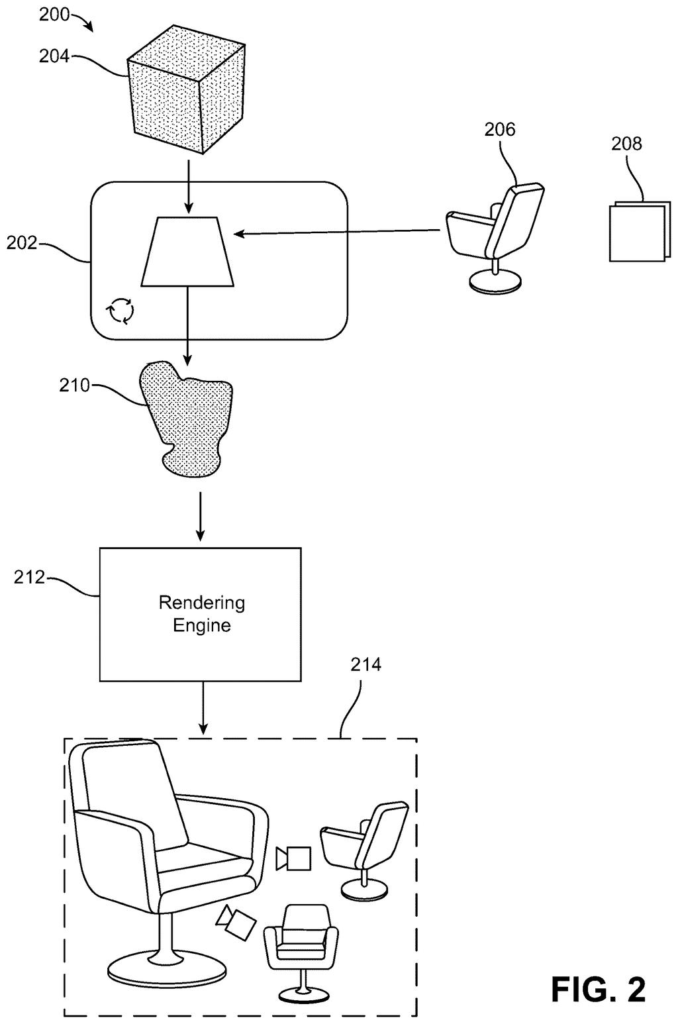
Qualcomm's patent application describes software that makes an educated guess. You give it a photo (or a few) and say where the camera should have been standing. It first builds a rough 3D version of the scene out of many tiny, fuzzy, egg-shaped blobs, called Gaussian splats. Then it turns that 3D guess back into a new picture from the angle you asked for.
The filing says older editing tools tend to stretch or smear things when the angle changes, and that 3D scanning methods usually need a big pile of photos from many sides. The pitch here is that this can start from one image, or a few, instead.
… process, using a machine learning system, the first image embedding and the requested viewing angle to generate a three-dimensional (3D) Gaussian splat representation of the first image embedding …
Translation: AI turns the photo and your new angle choice into a 3D digital scene model.
How a cloud of 3D blobs becomes a new view
The system takes in two things: an image embedding (a compressed list of numbers that stands in for the photo) and a requested viewing angle. The angle can come from a typed request such as 30 degrees to the left, a swipe on a touchscreen, or a per-pixel map of the direction each camera ray should travel.
A machine learning model then builds a 3D Gaussian splat (a cloud of tiny, fuzzy ellipsoids, each with its own position, size, tilt, color and opacity, arranged in the estimated 3D shape of the scene). The model is a diffusion model (it starts from a random cloud of ellipsoids and removes the randomness step by step), built on a U-Net (a network layout that shrinks the data and then expands it again).
From that splat, the system produces a second image embedding showing the scene from the requested angle, which a renderer can turn into a picture. A decoder can also turn the same splat into a 3D mesh (a surface made of flat polygons) of the whole environment or of one object.
To train it, the filing says the system takes known splats, adds noise in stages, and teaches the model to recover the original, adjusting its internal settings to shrink the error. It also says training can happen on the device itself or on a server.
… process the 3D Gaussian splat representation to generate a second image embedding of the environment represented in the first image embedding from the requested viewing angle …
Translation: The system uses that 3D model to render a brand new picture from the exact perspective you asked for.
What this means for phone photo editing
If this works as described, editing a photo after the fact gets more forgiving: you could nudge the viewpoint, turn a head a little, or peek around an object without the stretched and smeared edges the filing says older tools produce. It would also need only one photo or a few, instead of the dense set of shots that traditional 3D scanning calls for.
Qualcomm designs phone chips, and the filing lists smartphones, headsets, smart glasses, cars and cameras as places the software could run, including on-device training. The examiner's first review rejected the claims as filed, which is routine and usually followed by amendments, so the final scope may be narrower.
Qualcomm's 13th filing we've tracked in our AI photo editing race since July builds on earlier applications like keeping zoomed images sharp and filling in missing camera detail.
The price of this design is honesty. A single photo cannot show the back of a chair, so the system has to invent it, and the filing never says how you would tell a good guess from a bad one.
There is a speed cost too. The model cleans up random blobs over many repeated passes, and the filing gives no timing, so nobody can say yet whether a phone could do this while you wait.
For a casual edit, like turning a friend's head a few degrees, a believable guess is all you need, and that trade looks worth making. For anything where the hidden part must be accurate, a made-up back side is a risk. Working from one photo instead of dozens is a real convenience.
Get our take in your Top Stories
Liked this breakdown? Add Patentlyze as a preferred source on Google, and our plain-English take shows up more often in your Top Stories the next time Qualcomm patent news breaks.
There are more where this came from
We read every patent application Big Tech publishes and send you the ones worth knowing. Plain English, free, every week.
The drawings
9 drawing sheets from US 2026/0330765 A1 · click any drawing to enlarge


Show the other 1 sheets

Want this weekly breakdown for a company we don't cover? Patentlyze Pro →
Be the first to weigh in