
Sony · Filed Mar 20, 2025 · Published Oct 22, 2026

Sony Files Patent to Train Eye-Tracking AI on Computer-Generated Faces

Sony wants to teach software where you are looking by showing it thousands of computer-generated people instead of real ones. The filing describes a virtual studio that tilts faces, moves a camera and rejects bad pictures automatically.
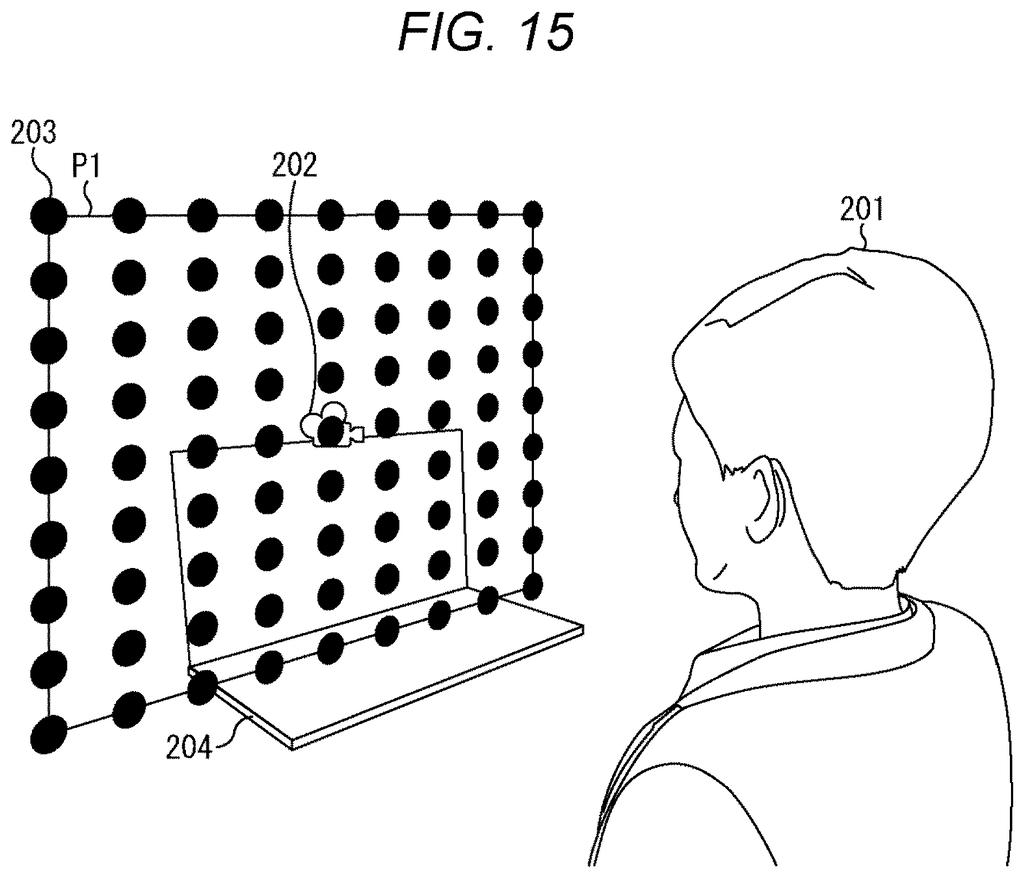
A computer-generated avatar looks at a grid of target points in front of a camera to create practice photos for gaze software. Drawing from patent filing US 2026/0330788 A1.
A computer-generated avatar looks at a grid of target points in front of a camera to create practice photos for gaze software.
See all 27 drawings from this filing ↓
Publication number US 2026/0330788 A1 US20260330788A1
Applicant SONY GROUP CORPORATION
Filing date Mar 20, 2025
Publication date Oct 22, 2026
Inventors Naoyuki KAWABATA
US classification 345/419
Examiner PROVIDENCE, VINCENT ALEXANDER (Art Unit 2617)
Status when we published Examiner raised objections; the company can respond (Aug 12, 2026)
Parent application is a National Stage Entry of PCTJP2023032952 (filed 2023-09-11)
Document 20 claims

What Sony's avatar-based gaze training does

Every time you join a video call, your laptop camera sees a slightly different version of you: closer, farther, head tilted, eyes on a slide or on the wall. A gaze-tracking program has to cope with all of it.

Teaching it takes thousands of face pictures, each with the right answer attached, and real people are a poor source. Their answers are noisy, and the photos tend to bunch up, say mostly faces in the lower half of the frame. Sony's patent builds the pictures instead. A computer-generated person sits in a virtual room, a virtual camera moves around, and the system aims both of the person's eyes at a chosen target so it knows exactly where they are looking.

Then it repeats the process with new faces, ages and skin tones until the collection is varied enough.

From the filing · CLAIM 1
controlling a state of a three-dimensional model of a person in a three-dimensional virtual space and a rendering condition for rendering the three-dimensional model …

Translation: Sony adjusts how a digital person looks and is displayed inside a virtual environment.

How Sony's avatars get tilted, moved and filtered

The system builds three things inside a 3D computer-graphics scene: an avatar (a computer-generated person), a camera object (a virtual camera that takes the pictures), and a gaze point (an invisible target the avatar looks at). Each eye is its own eyeball object, so the system can aim both eyes at the same spot.

Next it changes the scene step by step. The filing gives examples:

  • Face tilt, nod and turn each swept from -25 to +25 degrees in 5-degree steps (11 steps per direction).
  • The camera placed at five distances, with 20 face positions at each, for 100 relative positions.
  • A grid of 81 gaze targets spaced 5 cm apart.

Every combination produces a rendered picture paired with its answer key. That answer is a single gaze direction for both eyes, which means the finished model does not have to reconcile two conflicting eye estimates.

The system also checks its own work. If an eye falls outside the picture, hides behind the face, or looks almost entirely white because the iris is barely visible, that picture is left out of the training set.

A third variation analyzes an existing set of real photos, finds its bias (for example, faces mostly about 50 cm from the camera), and generates avatars at 40, 60 and 70 cm to fill the gaps. The system also saves a script for each picture so it can be recreated later.

From the filing · THE ABSTRACT
… generation processing of a learning data set of a line-of-sight estimation model, for example …

Translation: This system helps build training data to teach AI how people look when they stare at things.

What this means for webcam gaze tracking

If it works, the payoff is gaze tracking that holds up in messy real conditions. The filing's own example is an online meeting where a presenter can tell which part of a shared slide the audience is looking at and add detail where it is needed. It also says the same approach could train systems that read gestures, emotions or lip movements.

The saved scripts add a privacy angle: a dataset can be rebuilt on demand without keeping photos of real people. The examiner's first review rejected the claims as filed, which is routine at this stage and usually followed by amendments. Nothing here names a Sony product, so treat it as a look at how the company prepares training data.

Sony's 39th filing we've tracked since July in the AR glasses race adds to a body of work that includes applications like body tracking across frames and a speed-based play area.

Editorial take

Training on made-up people buys clean answers and costs realism. A rendered eye is tidy, so a model taught only on avatars could stumble on the smudged, squinting, badly lit faces it meets in real life. Sony's filing seems aware of this, since it lets real photos and avatar images mix and matches the avatar pictures to the format of the real ones.

The rule that throws out bad images also trims the training set. A face turned hard one way with eyes rolled the other is a rare pose, and the model never practices it. Those rare poses could be exactly where it fails.

The trade still looks worth it. Perfect answer labels and full control over the spread of faces beat noisy photos of volunteers, and any gap shows up in testing, where it can be measured and patched.

Get our take in your Top Stories

Liked this breakdown? Add Patentlyze as a preferred source on Google, and our plain-English take shows up more often in your Top Stories the next time Sony patent news breaks.

There are more where this came from

We read every patent application Big Tech publishes and send you the ones worth knowing. Plain English, free, every week.

The drawings

27 drawing sheets from US 2026/0330788 A1 · click any drawing to enlarge

Why ideal training views mismatch real eye camera shots, drawing sheet 1 from US 2026/0330788 A1
Sheet 1 Why ideal training views mismatch real eye camera shots
Steps to generate fake faces and train gaze tracking, drawing sheet 2 from US 2026/0330788 A1
Sheet 2 Steps to generate fake faces and train gaze tracking
Components that position virtual heads and build the synthetic dataset, drawing sheet 3 from US 2026/0330788 A1
Sheet 3 Components that position virtual heads and build the synthetic dataset
How the system makes training data for gaze tracking, drawing sheet 4 from US 2026/0330788 A1
Sheet 4 How the system makes training data for gaze tracking
Steps for generating avatar images paired with known viewing targets, drawing sheet 5 from US 2026/0330788 A1
Sheet 5 Steps for generating avatar images paired with known viewing targets
Placing a virtual face, camera, and target in 3D, drawing sheet 6 from US 2026/0330788 A1
Sheet 6 Placing a virtual face, camera, and target in 3D
Three rotational axes used to alter an avatar's head posture, drawing sheet 7 from US 2026/0330788 A1
Sheet 7 Three rotational axes used to alter an avatar's head posture
Tilting a virtual head to vary training camera angles, drawing sheet 8 from US 2026/0330788 A1
Sheet 8 Tilting a virtual head to vary training camera angles
Show the other 19 sheets
Tilting an avatar to simulate different head poses, drawing sheet 9 from US 2026/0330788 A1
Sheet 9 Tilting an avatar to simulate different head poses
Turning the avatar left and right across preset angles, drawing sheet 10 from US 2026/0330788 A1
Sheet 10 Turning the avatar left and right across preset angles
Combining multiple head rotations to mimic natural glances, drawing sheet 11 from US 2026/0330788 A1
Sheet 11 Combining multiple head rotations to mimic natural glances
Moving the virtual camera along three spatial axes, drawing sheet 12 from US 2026/0330788 A1
Sheet 12 Moving the virtual camera along three spatial axes
Testing different sitting positions before a laptop camera, drawing sheet 13 from US 2026/0330788 A1
Sheet 13 Testing different sitting positions before a laptop camera
Shifting the target point where the digital eyes must look, drawing sheet 14 from US 2026/0330788 A1
Sheet 14 Shifting the target point where the digital eyes must look
Mapping eye targets on a screen to train AI, drawing sheet 15 from US 2026/0330788 A1
Sheet 15 Mapping eye targets on a screen to train AI
How camera placement changes the recorded eye image, drawing sheet 16 from US 2026/0330788 A1
Sheet 16 How camera placement changes the recorded eye image
A computer-generated face rendered off-center to train the AI, drawing sheet 17 from US 2026/0330788 A1
Sheet 17 A computer-generated face rendered off-center to train the AI
Generated faces showing different head angles and camera perspectives, drawing sheet 18 from US 2026/0330788 A1
Sheet 18 Generated faces showing different head angles and camera perspectives
Flagging unnatural eye poses before training data is saved, drawing sheet 19 from US 2026/0330788 A1
Sheet 19 Flagging unnatural eye poses before training data is saved
The system parts that check face poses before training, drawing sheet 20 from US 2026/0330788 A1
Sheet 20 The system parts that check face poses before training
Inside the data generator that spots unrealistic eye positions, drawing sheet 21 from US 2026/0330788 A1
Sheet 21 Inside the data generator that spots unrealistic eye positions
Skipping abnormal eye angles while building the training set, drawing sheet 22 from US 2026/0330788 A1
Sheet 22 Skipping abnormal eye angles while building the training set
Setup for adding new computer-generated faces to existing data, drawing sheet 23 from US 2026/0330788 A1
Sheet 23 Setup for adding new computer-generated faces to existing data
Components that analyze missing gaze angles to generate matching faces, drawing sheet 24 from US 2026/0330788 A1
Sheet 24 Components that analyze missing gaze angles to generate matching faces
Adding simulated eye pictures to training sets for AI, drawing sheet 25 from US 2026/0330788 A1
Sheet 25 Adding simulated eye pictures to training sets for AI
How the system creates missing faces to teach AI, drawing sheet 26 from US 2026/0330788 A1
Sheet 26 How the system creates missing faces to teach AI
Computer chips that generate faces and track your gaze, drawing sheet 27 from US 2026/0330788 A1
Sheet 27 Computer chips that generate faces and track your gaze
Browse all the drawings 27 drawing sheets
Patent filing page

Source. Full patent text and figures from the official USPTO publication PDF.
Reader comments

Be the first to weigh in

Start the discussion

Real name or a handle, either is fine. Comments are read by a person before they appear, so allow a little time. Keep it about the filing.