
Google DeepMind Files Patent for AI Training That Needs a Fraction of the Practice
Teaching an AI a new task usually takes millions of tries. This Google DeepMind filing describes a training method that cut that practice by a factor of 63 on average across the tests it shows.
What DeepMind's data-saving AI trainer actually does
A robot arm drops a cup for the thousandth time this afternoon. Each fumble is a lesson, but every lesson costs time, electricity and, sometimes, a broken cup. That is the trouble with AI that learns by trial and error: it needs a huge amount of practice before it gets good.
This Google DeepMind patent application describes a way to make each attempt count for more. While the AI learns, it keeps a slow-changing reference copy of itself and uses that copy to check its own progress. If a lesson would yank the AI too far from the reference without a good reason, the system throws that lesson out instead of learning from it.
The filing says this let the AI beat human scores using about 63 times less practice, on average, than DeepMind's earlier Agent57 system on the test tasks it describes. That could matter wherever practice is expensive, like real robots that wear out.
obtaining a set of one or more transition sequences, each transition sequence comprising a respective transition at each of a plurality of time steps, wherein each transition includes: (i) an observation received at the time step, (ii) an action performed in response to the observation, and (iii) one or more rewards received as a result of performing the action; …
Translation: The system collects past experiences broken down into observations, actions, and resulting rewards.
How the training skips unreliable practice steps
The method is a form of reinforcement learning (an AI learns by trying actions and collecting rewards). The system stores past experience as short sequences of steps. Each step records what the AI saw, what it did, and what reward it got. It then replays those sequences to learn from them.
The main claim is about deciding which steps to learn from. For every step, the system scores the action with the current network and with a target network (a copy of the same network that changes more slowly, to keep training stable). It uses the gap between the two scores to decide whether that step goes into the learning at all. The description gives two tests:
- Trust region: keep the step if the two scores are within a set distance, scaled to how large the AI's recent errors have been.
- Sign check: even outside that distance, keep the step if the AI's score is drifting in the same direction as its error, meaning the update is heading the right way.
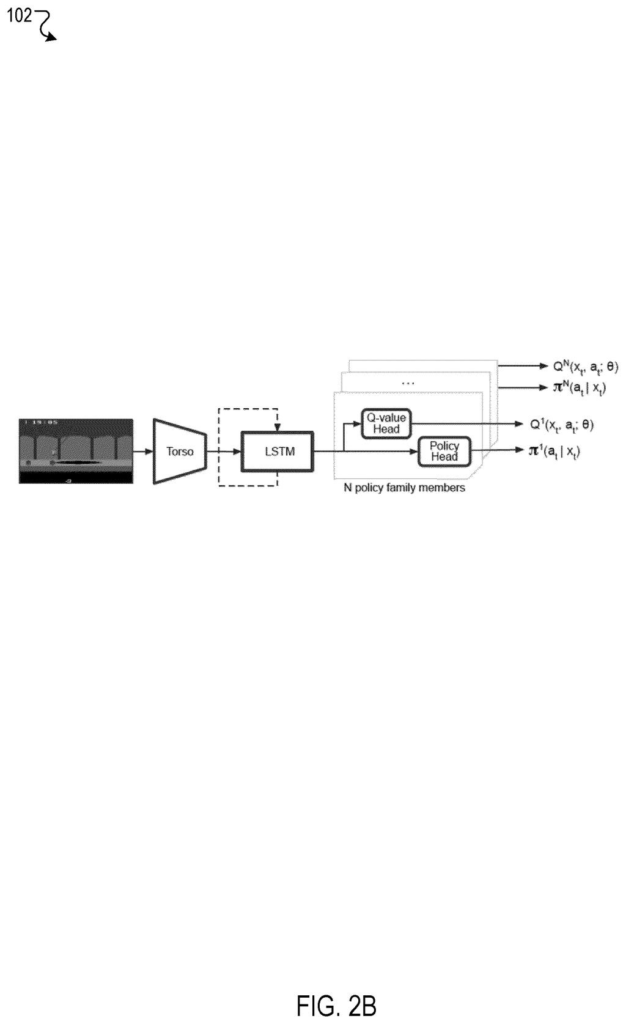
The claims also cover training several versions of the AI at once. Each version has a different setting for how far ahead rewards count and how much bonus it gets for exploring (a "return computation scheme"). The versions share one common base network and each has its own output layer.
A second independent claim covers a distilled helper network, trained to imitate the main one while random groups of its layers are skipped. That helper then chooses actions with probabilities, which the description says produces better practice data.
Methods, systems, and apparatus, including computer programs encoded on a computer storage medium, for data-efficient reinforcement learning with adaptive return computation schemes.
Translation: The technology helps artificial intelligence learn efficiently using fewer trial and error examples.
Why cheaper practice matters for real-world robots
The practical payoff is cheaper learning. The filing says the approach can need as much as 200 times less experience on some tasks, and about 63 times less on average in its own comparison. That matters most where practice is costly: a real robot that wears down, a factory where a bad move does damage, or a data center where mistakes cost money. The description lists all three as possible settings.
For you, nothing changes soon. This is training technology that lives in research labs, not a feature on your phone. But cheaper training means more tasks become worth teaching to an AI, and less computing power gets burned along the way.
Google's fifth application we've tracked in robot grasping and movement since August builds on ideas like auto-programming robots for factories and reusing past robot experience.
This one needs no new hardware at all. It is a change to how an AI practices, and the description already reports results from a working setup with 64 practice workers feeding a single learner.
What has to exist first is an AI with a place to practice, either a simulator or a real machine, plus a clear way to score success. The shortest route to use is inside a research team's own training pipeline, where this recipe could replace the old one and shorten training runs.
You would never see it as a feature. If it works as the filing says, you would see it as robots and game-playing AI that arrive sooner and cost less to build. The reported savings come from the company's own test tasks, so factories and real robots are the next hurdle.
Get our take in your Top Stories
Liked this breakdown? Add Patentlyze as a preferred source on Google, and our plain-English take shows up more often in your Top Stories the next time Google patent news breaks.
There are more where this came from
We read every patent application Big Tech publishes and send you the ones worth knowing. Plain English, free, every week.
The drawings
9 drawing sheets from US 2026/0320402 A1 · click any drawing to enlarge


Show the other 1 sheets

Want this weekly breakdown for a company we don't cover? Patentlyze Pro →
Be the first to weigh in