
Microsoft Files Patent for Finding Forgotten Apps Hiding in Company Cloud Systems
Big companies often run thousands of cloud servers and databases, and nobody has an up-to-date list of which ones belong to which app. Microsoft's filing tries to rebuild that list automatically from the traffic between them.
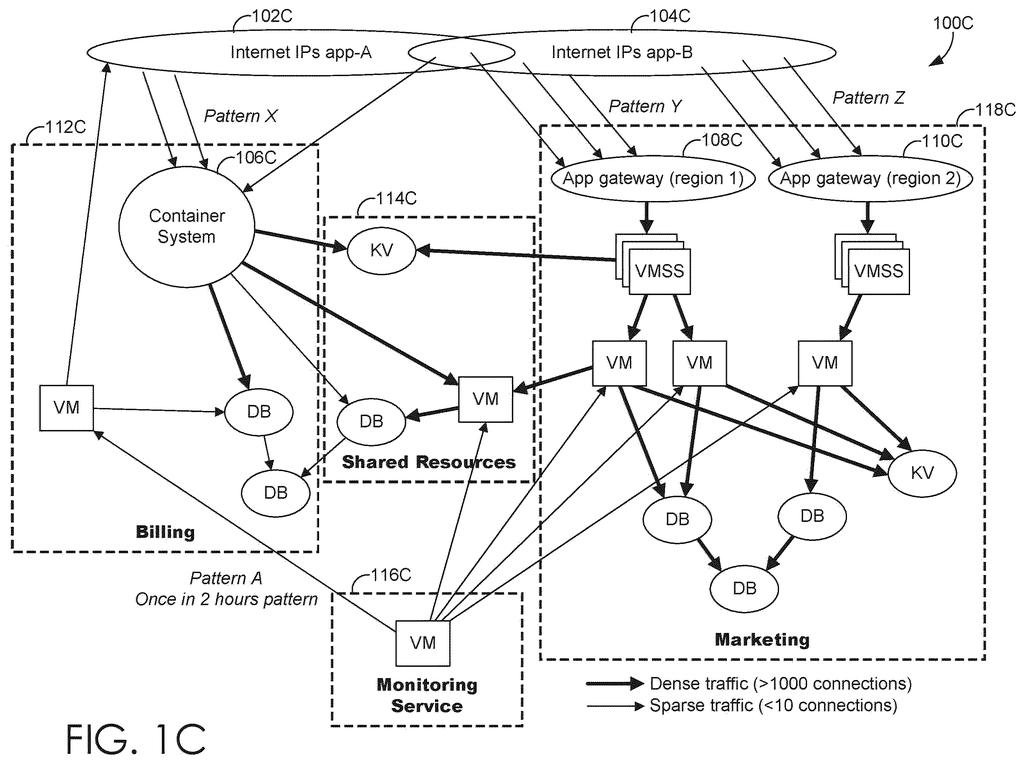
What Microsoft's app-discovery graph actually does
A security camera stares at an empty hallway all night while the real trouble is in a room nobody knew existed. Many companies face a similar problem in the cloud: hundreds of servers, databases and storage accounts, and no reliable record of which ones make up the billing app, which make up the marketing app, and which are shared by both.
Microsoft's filing describes a tool that builds that record on its own. It reads records of who talked to whom, along with settings and notes from administrators, and draws a map where each server or database is a dot and each connection is a line. Clusters of dots that belong together become an app.
When you ask the security dashboard how safe your setup is, the answer comes with that map attached. It can flag a lonely machine that turns out to be an unknown app, or a risky link between two apps that should be kept apart.
… generating an annotated application discovery graph comprising a plurality of entities representing the plurality of computing resources …
Translation: It builds a digital map showing all the different apps and resources running across the company network.
How Microsoft links servers into app clusters
The filing describes an application discovery engine inside a security management system. It collects three kinds of data: configuration data (how resources are set up), support-text data (notes administrators typed in), and access logs (records of who requested what). Using all three together, which the filing calls security data triangulation, is meant to cover for the weaknesses of any single source.
The engine turns resources into a graph. Each resource is a node, and each connection is an edge with a weight showing how likely a real link is. In the filing's example, two virtual machines that actually talk to each other get a weight of 1, while two that merely sit in the same virtual network get 0.1. Weak links below a threshold can be dropped.
Next, it starts at entry nodes (things reachable from the internet, like an application gateway) and grows spanning trees (the set of everything reachable from that starting point without looping back). Trees that overlap, measured with a similarity score such as the Jaccard index (a simple measure of shared members), get merged into one application.
Finally, the graph is annotated. A node with no connections is marked as a newly discovered application, and shared resources or services are tagged. A dashboard shows these annotations with priority labels and suggested fixes the administrator can trigger.
Application discovery supports identifying and mapping various applications within a computing environment.
Translation: The software automatically finds and catalogs every software program currently operating in the cloud.
Why cloud security teams need a live app map
If you work anywhere with a big cloud footprint, the practical gain is a security view organized around apps instead of a pile of individual servers. Alerts can be ranked by which application they touch, and a risky link, such as a system handling sensitive data talking to one that doesn't, can stand out.
The filing stresses that it works without installing agents (small monitoring programs) on each machine, which some cloud service types don't allow. It also notes it can fall back to network-level data when detailed logs are missing. That fits Microsoft's cloud security tooling, though the filing names no specific product. It is also a continuation of an earlier application that has already been issued as a patent.
Microsoft's 550th filing in our Microsoft coverage since May joins work like the split-password spotter and the AI nurse coach.
You can't protect what you can't see, and in cloud environments, the list of what exists changes fast enough that any inventory kept by hand goes stale within weeks. When attackers find a forgotten server or an app sharing data with something sensitive, they aren't slowed down by the fact that the spreadsheet was out of date.
Rebuilding that list automatically from actual traffic, rather than relying on someone's memory or a one-time audit, matches the scale of that problem. The approach weights how confident it is about each connection and merges overlapping groups, which means the map updates itself as the environment shifts.
The harder cases are apps that generate little traffic or whose activity logs are incomplete, and the filing acknowledges the picture gets fuzzier there. A rough automatic map that refreshes constantly, though, tends to be more useful in practice than a precise one that nobody has time to maintain.
Get our take in your Top Stories
Liked this breakdown? Add Patentlyze as a preferred source on Google, and our plain-English take shows up more often in your Top Stories the next time Microsoft patent news breaks.
There are more where this came from
We read every patent application Big Tech publishes and send you the ones worth knowing. Plain English, free, every week.
The drawings
18 drawing sheets from US 2026/0330011 A1 · click any drawing to enlarge


Show the other 10 sheets


Want this weekly breakdown for a company we don't cover? Patentlyze Pro →
Be the first to weigh in