
Sony · Filed Mar 21, 2025 · Published Oct 22, 2026

Sony Files Patent to Let 3D Video Load Only the Detail You Need

A 3D model's sharpest detail is the heaviest part to load, and Sony's new patent application lets a device leave that detail behind when it isn't needed.
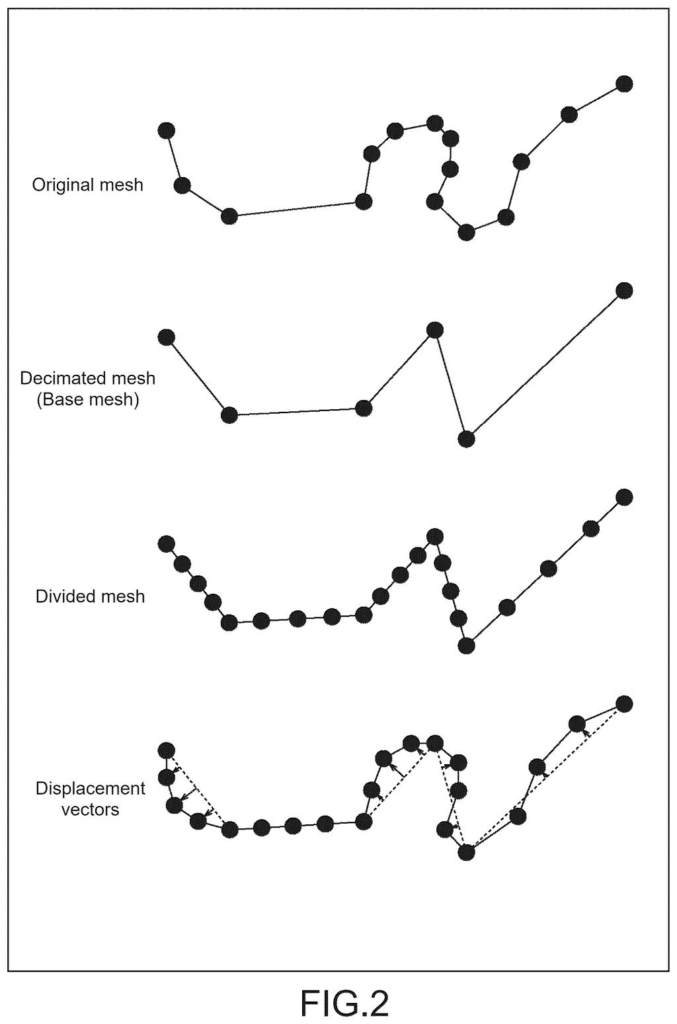
A rough 3D shape gradually adds extra points and pushes them back into place to recreate fine surface shapes. Drawing from patent filing US 2026/0330693 A1.
A rough 3D shape gradually adds extra points and pushes them back into place to recreate fine surface shapes.
See all 38 drawings from this filing ↓
Publication number US 2026/0330693 A1 US20260330693A1
Applicant Sony Group Corporation
Filing date Mar 21, 2025
Publication date Oct 22, 2026
Inventors Ryohei TAKAHASHI, Mitsuhiro HIRABAYASHI
US classification 345/419
Examiner SUN, HAI TAO (Art Unit 2616)
Status when we published Approved; patent expected soon (Oct 6, 2026)
Parent application is a National Stage Entry of PCTJP2023035354 (filed 2023-09-28)
Document 20 claims

What Sony's layered 3D model file actually does

Every time you rotate a 3D character on your screen, your device has to rebuild its shape from stored data. The more detail in that shape, the more data it has to download and crunch, even if you are viewing it from across the room.

Sony's patent application goes after that waste. A 3D model is stored as a rough, low-detail version plus a series of correction layers that sharpen it step by step. Today those layers can be packed into one lump, so a player has to grab and process all of them. Sony's filing puts each layer in its own separate compartment of the file and adds labels saying which is which. Your device can then pick up only the layers it needs for the sharpness you actually want.

From the filing · CLAIM 1
… stores encoded data of the base mesh in a base-mesh track of the content file, stores encoded data of the attributes in an attribute track of the content file, stores encoded data of the displacement vectors for each of the layers in mutually different displacement tracks of the content file …

Translation: It splits up different parts of the 3D model into separate data tracks so they can be loaded individually.

How Sony gives each detail layer its own track

The filing builds on V-DMC (Video-based Dynamic Mesh Coding), a method for compressing moving 3D objects. A mesh (a 3D shape made of points joined by lines) is stored as a coarse base mesh, made by removing points from the original, plus displacement vectors (instructions for nudging each added point back to its true position) and textures (the surface images).

The displacement vectors are sorted into layers, one per round of subdividing the mesh. The company's complaint is that when all layers sit in a single track (a separate lane inside the file container), a player must pull and decode every layer, even when it only wants a lower-detail result. Sony stores each layer in its own displacement track, keeps the base mesh and textures in their own tracks, and saves association information that ties each track to its layer.

The filing also describes several extras:

  • A label saying whether a layer's vectors are absolute (measured from the base mesh) or relative (measured from the layer below).
  • Quality info such as average vertex and triangle counts. The example uses 3,000 vertices for the base mesh, then 30,000 and 60,000 for two layers.
  • A streaming version, using MPEG-DASH (a standard way to stream video over the internet), where a control file lists each layer so a player downloads only what it needs.
  • Layered textures, grouped with the matching displacement tracks.

The claims cover both the file-making side and the playback side.

From the filing · THE ABSTRACT
… enable an increase in processing load related to reconstruction of 3D data including displacement vectors to be suppressed …

Translation: This method prevents your device from working too hard when putting complex 3D objects back together.

Why lighter 3D files matter for your devices

The practical payoff is lighter work for whatever is playing the 3D content. The filing says picking only the needed layers can cut hardware demands, processing time and the bandwidth used to stream the model, and it makes playback more stable when your connection or your device's speed fluctuates. For you, that could mean 3D content loading faster on modest hardware.

The patent office has approved this application, and once Sony pays the final fee it should be issued as a granted patent. The description also assumes this would extend an existing international standard for carrying 3D video data, so its impact depends on whether the industry adopts that file layout.

Sony's 637th filing we've tracked since May adds to a run that includes grading animation move switches and cutting cloud game lag.

Editorial take

Claim 1 is a tight, specific recipe. It names a file with a track for the coarse base mesh, a track for textures, a separate track for each detail layer, and a label tying every layer track to its level, and it defines the mesh as a thinned-out version of an original with textures on its surfaces.

That specificity limits the reach. The claim covers how the finished file is organized and says nothing about the compression math that makes the mesh small in the first place. Other independent claims add the player side and a streaming version with a layer list, so coverage runs from file creation to playback.

If issued, the claims would rest on one decision: give every detail layer its own lane and its own label. It is routine housekeeping for a file format, with a clear practical payoff.

Get our take in your Top Stories

Liked this breakdown? Add Patentlyze as a preferred source on Google, and our plain-English take shows up more often in your Top Stories the next time Sony patent news breaks.

There are more where this came from

We read every patent application Big Tech publishes and send you the ones worth knowing. Plain English, free, every week.

The drawings

38 drawing sheets from US 2026/0330693 A1 · click any drawing to enlarge

How 3D shapes wrap surface images around geometric wireframes, drawing sheet 1 from US 2026/0330693 A1
Sheet 1 How 3D shapes wrap surface images around geometric wireframes
Simplifying a complex 3D shape and rebuilding its surface curve, drawing sheet 2 from US 2026/0330693 A1
Sheet 2 Simplifying a complex 3D shape and rebuilding its surface curve
Combining base shapes, surface shifts, and colors into one stream, drawing sheet 3 from US 2026/0330693 A1
Sheet 3 Combining base shapes, surface shifts, and colors into one stream
Adding details in stages to sharpen a 3D model, drawing sheet 4 from US 2026/0330693 A1
Sheet 4 Adding details in stages to sharpen a 3D model
Different ways to package detail layers for streaming, drawing sheet 5 from US 2026/0330693 A1
Sheet 5 Different ways to package detail layers for streaming
Storing surface shifts that build on the previous detail level, drawing sheet 6 from US 2026/0330693 A1
Sheet 6 Storing surface shifts that build on the previous detail level
Storing complete surface positions directly from the base shape, drawing sheet 7 from US 2026/0330693 A1
Sheet 7 Storing complete surface positions directly from the base shape
Tracking surface movement step by step versus in one jump, drawing sheet 8 from US 2026/0330693 A1
Sheet 8 Tracking surface movement step by step versus in one jump
Show the other 30 sheets
Tagging shape adjustments with their exact detail level, drawing sheet 9 from US 2026/0330693 A1
Sheet 9 Tagging shape adjustments with their exact detail level
Adding vector types and vertex counts to file headers, drawing sheet 10 from US 2026/0330693 A1
Sheet 10 Adding vector types and vertex counts to file headers
Descriptors that tell streaming apps how shapes are refined, drawing sheet 11 from US 2026/0330693 A1
Sheet 11 Descriptors that tell streaming apps how shapes are refined
Playlist code organizing 3D streaming layers by quality, drawing sheet 12 from US 2026/0330693 A1
Sheet 12 Playlist code organizing 3D streaming layers by quality
Parameters defining average 3D mesh resolution over time, drawing sheet 13 from US 2026/0330693 A1
Sheet 13 Parameters defining average 3D mesh resolution over time
Streaming code listing triangle counts for each detail tier, drawing sheet 14 from US 2026/0330693 A1
Sheet 14 Streaming code listing triangle counts for each detail tier
Splitting surface colors and fine shapes into matched tiers, drawing sheet 15 from US 2026/0330693 A1
Sheet 15 Splitting surface colors and fine shapes into matched tiers
Marking surface color tracks with their matched detail level, drawing sheet 16 from US 2026/0330693 A1
Sheet 16 Marking surface color tracks with their matched detail level
Matching detail levels to surface textures across file tracks, drawing sheet 17 from US 2026/0330693 A1
Sheet 17 Matching detail levels to surface textures across file tracks
File formatting that links related shape and texture streams, drawing sheet 18 from US 2026/0330693 A1
Sheet 18 File formatting that links related shape and texture streams
Direct track references that pair shape data with surface images, drawing sheet 19 from US 2026/0330693 A1
Sheet 19 Direct track references that pair shape data with surface images
Tagging grouped 3D streams with their precise detail level, drawing sheet 20 from US 2026/0330693 A1
Sheet 20 Tagging grouped 3D streams with their precise detail level
File structure storing both group IDs and detail level counts, drawing sheet 21 from US 2026/0330693 A1
Sheet 21 File structure storing both group IDs and detail level counts
Streaming manifest entries listing available 3D shape tiers, drawing sheet 22 from US 2026/0330693 A1
Sheet 22 Streaming manifest entries listing available 3D shape tiers
Web video playlists listing surface textures and playback combos, drawing sheet 23 from US 2026/0330693 A1
Sheet 23 Web video playlists listing surface textures and playback combos
Streaming options bundled into preselected video quality levels, drawing sheet 24 from US 2026/0330693 A1
Sheet 24 Streaming options bundled into preselected video quality levels
Parameters that specify 3D detail level and movement type, drawing sheet 25 from US 2026/0330693 A1
Sheet 25 Parameters that specify 3D detail level and movement type
Streaming manifest combining base shapes with selected detail levels, drawing sheet 26 from US 2026/0330693 A1
Sheet 26 Streaming manifest combining base shapes with selected detail levels
First half of a file matching shapes with surfaces, drawing sheet 27 from US 2026/0330693 A1
Sheet 27 First half of a file matching shapes with surfaces
Second half of a file linking textures to shape detail, drawing sheet 28 from US 2026/0330693 A1
Sheet 28 Second half of a file linking textures to shape detail
Media file container arranged to store 3D video tracks, drawing sheet 29 from US 2026/0330693 A1
Sheet 29 Media file container arranged to store 3D video tracks
Hardware units that convert 3D objects into layered streaming files, drawing sheet 30 from US 2026/0330693 A1
Sheet 30 Hardware units that convert 3D objects into layered streaming files
Steps for packaging 3D meshes into layered streaming files, drawing sheet 31 from US 2026/0330693 A1
Sheet 31 Steps for packaging 3D meshes into layered streaming files
Pairing 3D video shapes with matching surface textures, drawing sheet 32 from US 2026/0330693 A1
Sheet 32 Pairing 3D video shapes with matching surface textures
Hardware that builds 3D scenes from incoming files, drawing sheet 33 from US 2026/0330693 A1
Sheet 33 Hardware that builds 3D scenes from incoming files
Playing a 3D scene at the requested detail level, drawing sheet 34 from US 2026/0330693 A1
Sheet 34 Playing a 3D scene at the requested detail level
Streaming 3D video by choosing detail layers from online descriptions, drawing sheet 35 from US 2026/0330693 A1
Sheet 35 Streaming 3D video by choosing detail layers from online descriptions
Matching detail tracks with correct textures during local playback, drawing sheet 36 from US 2026/0330693 A1
Sheet 36 Matching detail tracks with correct textures during local playback
Fetching paired detail and surface colors over a network stream, drawing sheet 37 from US 2026/0330693 A1
Sheet 37 Fetching paired detail and surface colors over a network stream
Computer components that run the 3D processing software, drawing sheet 38 from US 2026/0330693 A1
Sheet 38 Computer components that run the 3D processing software
Browse all the drawings 38 drawing sheets
Patent filing page

Source. Full patent text and figures from the official USPTO publication PDF.
Reader comments

Be the first to weigh in

Start the discussion

Real name or a handle, either is fine. Comments are read by a person before they appear, so allow a little time. Keep it about the filing.