
Sony Files Patent to Let 3D Video Load Only the Detail You Need
A 3D model's sharpest detail is the heaviest part to load, and Sony's new patent application lets a device leave that detail behind when it isn't needed.
What Sony's layered 3D model file actually does
Every time you rotate a 3D character on your screen, your device has to rebuild its shape from stored data. The more detail in that shape, the more data it has to download and crunch, even if you are viewing it from across the room.
Sony's patent application goes after that waste. A 3D model is stored as a rough, low-detail version plus a series of correction layers that sharpen it step by step. Today those layers can be packed into one lump, so a player has to grab and process all of them. Sony's filing puts each layer in its own separate compartment of the file and adds labels saying which is which. Your device can then pick up only the layers it needs for the sharpness you actually want.
… stores encoded data of the base mesh in a base-mesh track of the content file, stores encoded data of the attributes in an attribute track of the content file, stores encoded data of the displacement vectors for each of the layers in mutually different displacement tracks of the content file …
Translation: It splits up different parts of the 3D model into separate data tracks so they can be loaded individually.
How Sony gives each detail layer its own track
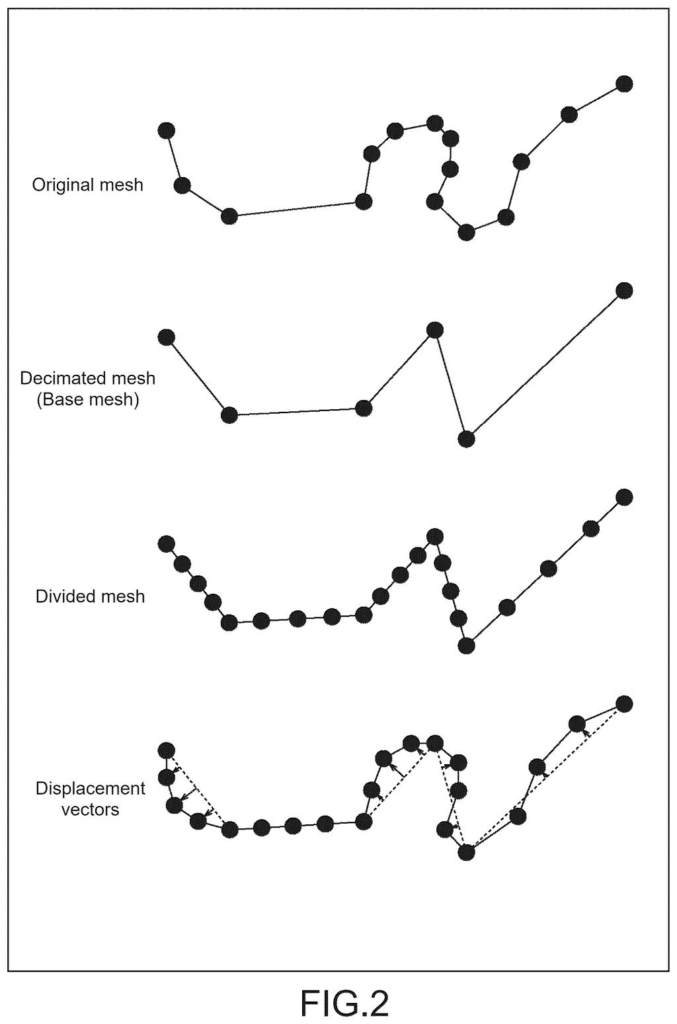
The filing builds on V-DMC (Video-based Dynamic Mesh Coding), a method for compressing moving 3D objects. A mesh (a 3D shape made of points joined by lines) is stored as a coarse base mesh, made by removing points from the original, plus displacement vectors (instructions for nudging each added point back to its true position) and textures (the surface images).
The displacement vectors are sorted into layers, one per round of subdividing the mesh. The company's complaint is that when all layers sit in a single track (a separate lane inside the file container), a player must pull and decode every layer, even when it only wants a lower-detail result. Sony stores each layer in its own displacement track, keeps the base mesh and textures in their own tracks, and saves association information that ties each track to its layer.
The filing also describes several extras:
- A label saying whether a layer's vectors are absolute (measured from the base mesh) or relative (measured from the layer below).
- Quality info such as average vertex and triangle counts. The example uses 3,000 vertices for the base mesh, then 30,000 and 60,000 for two layers.
- A streaming version, using MPEG-DASH (a standard way to stream video over the internet), where a control file lists each layer so a player downloads only what it needs.
- Layered textures, grouped with the matching displacement tracks.
The claims cover both the file-making side and the playback side.
… enable an increase in processing load related to reconstruction of 3D data including displacement vectors to be suppressed …
Translation: This method prevents your device from working too hard when putting complex 3D objects back together.
Why lighter 3D files matter for your devices
The practical payoff is lighter work for whatever is playing the 3D content. The filing says picking only the needed layers can cut hardware demands, processing time and the bandwidth used to stream the model, and it makes playback more stable when your connection or your device's speed fluctuates. For you, that could mean 3D content loading faster on modest hardware.
The patent office has approved this application, and once Sony pays the final fee it should be issued as a granted patent. The description also assumes this would extend an existing international standard for carrying 3D video data, so its impact depends on whether the industry adopts that file layout.
Sony's 637th filing we've tracked since May adds to a run that includes grading animation move switches and cutting cloud game lag.
Claim 1 is a tight, specific recipe. It names a file with a track for the coarse base mesh, a track for textures, a separate track for each detail layer, and a label tying every layer track to its level, and it defines the mesh as a thinned-out version of an original with textures on its surfaces.
That specificity limits the reach. The claim covers how the finished file is organized and says nothing about the compression math that makes the mesh small in the first place. Other independent claims add the player side and a streaming version with a layer list, so coverage runs from file creation to playback.
If issued, the claims would rest on one decision: give every detail layer its own lane and its own label. It is routine housekeeping for a file format, with a clear practical payoff.
Get our take in your Top Stories
Liked this breakdown? Add Patentlyze as a preferred source on Google, and our plain-English take shows up more often in your Top Stories the next time Sony patent news breaks.
There are more where this came from
We read every patent application Big Tech publishes and send you the ones worth knowing. Plain English, free, every week.
The drawings
38 drawing sheets from US 2026/0330693 A1 · click any drawing to enlarge


Show the other 30 sheets


Want this weekly breakdown for a company we don't cover? Patentlyze Pro →
Be the first to weigh in