
Microsoft Files Patent to Keep Touchscreens Accurate Through Sweat, Humidity and Dirt
Your touchscreen's idea of 'untouched' drifts with every damp fingertip and layer of grime. Microsoft's patent application has the screen correct that drift on every scan, while you are still using it.
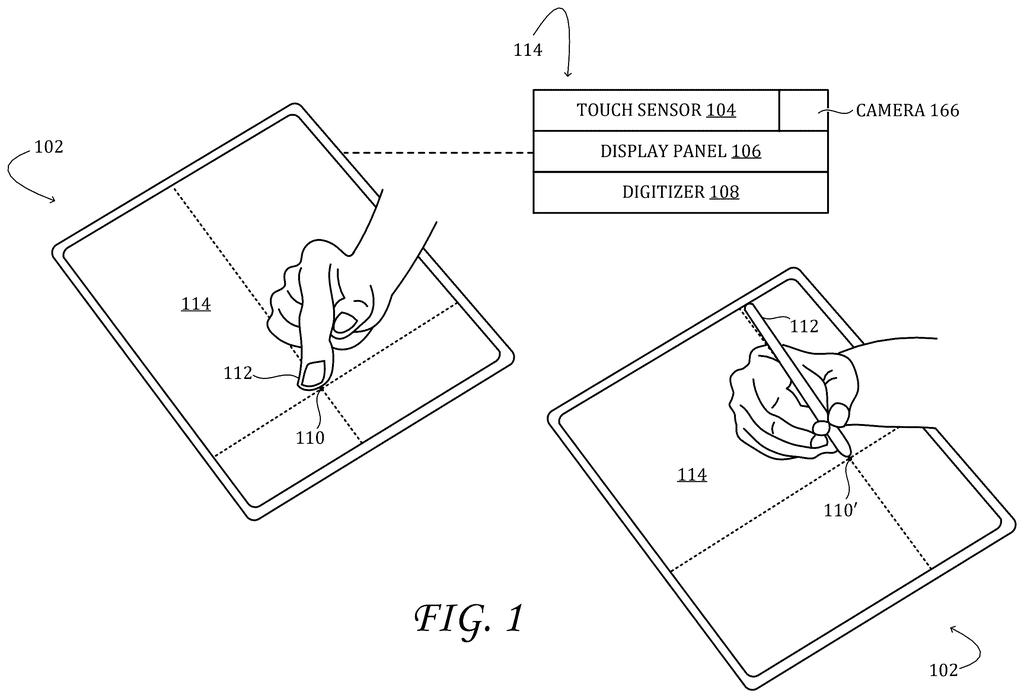
What Microsoft's self-calibrating touchscreen does
Every time you swipe a phone or tablet with a slightly sweaty thumb, the screen has to tell your finger apart from everything else going on: humidity, grime, stray electrical noise. Even an untouched screen gives off a faint background signal, and that signal changes over time.
Microsoft's patent application describes a touchscreen that keeps re-zeroing itself while you use it. It works like a kitchen scale that resets to zero as you cook, except it happens over and over without you noticing. Spots on the screen that look quiet help update the screen's idea of what 'normal' is. Spots that look busy, because your finger is there or noise is spiking, get a best guess based on their quiet neighbors.
The goal is a screen that never has to pause for a special recalibration, and does not lose its footing when your hand rests on it for a long time.
scanning a series of driven electrodes of a touch sensor while recording signal from a series of sensory electrodes of the touch sensor; storing the signal in a signal matrix having a row corresponding to each row of a calibration matrix and a column corresponding to each column of the calibration matrix; …
Translation: The device reads electrical signals from a grid of sensors and organizes them into a data table.
How the screen guesses values under your finger
A capacitive touchscreen (the kind that senses your finger through tiny electrical changes) is built from a grid of crossing wires. Each crossing gives off a small baseline signal even when nothing touches it. That baseline varies from spot to spot and drifts with humidity, sweat, dirt and electrical noise.
Microsoft's method keeps two grids of numbers: a signal matrix (the live reading from the latest scan, which the filing also calls a heat map) and a calibration matrix (the screen's running idea of what 'untouched' looks like). On each scan, every spot is checked against a threshold:
- Below the threshold: the spot looks quiet, so its calibration value is nudged toward the live reading. One example formula keeps a share of the old value and blends in the rest of the new one, so the baseline shifts gradually.
- Above the threshold: the spot might be a finger or a burst of noise, so it is marked uncertain and skipped. Its calibration value is estimated from quiet neighbors using interpolation (filling in between known points), extrapolation, or curve fitting.
In the simplest version, the calibrated signal handed to the operating system is the live reading minus the baseline. The filing also describes an optional neural network (software that learns patterns from examples) that can take in readings from temperature or motion sensors. It adds a periodic review that hunts for oddities, such as lots of touches landing in the empty gap between buttons.
… for each element in the signal matrix that is above the predetermined threshold, estimating the corresponding element in the calibration matrix based at least partly on one or more elements neighboring the corresponding element in the calibration matrix; …
Translation: When a spot gets too much interference, the system guesses its real value by looking at nearby areas.
Why this matters for wet and worn touchscreens
If a version of this ships, you would mostly notice less: fewer drifting or phantom touches when your hands are damp or the screen is dirty, and no pause while the screen recalibrates. The filing names tablets, laptops, smartphones, handheld game systems, medical devices and kiosks as possible homes. It also says continuous calibration can reduce the need for factory calibration, which frees flash memory that would otherwise hold a stored table.
The application has been approved and Microsoft has paid the fee to have it issued, so it should become a granted patent soon. A patent alone says nothing about whether any product will use the method.
One more thing to know: the patent office has already approved this application, and Microsoft has paid the fee to have it issued, so it should become a granted patent soon. The final granted claims may read a little differently from the version described here.
Microsoft's 18th filing in our Display topic coverage since May follows work like the water-resistant touchscreen and the center-sharpening thermal lens, showing the company keeps applying around how screens sense and capture the world.
Wet fingers, smudged glass, and years of daily wear degrade the accuracy of every touchscreen. The frustration is ordinary and universal, which makes it easy to underestimate how much it costs in misread taps and repeated inputs across billions of devices.
The approach matches the scale of the problem well: blend fresh readings with old ones in calm areas, and estimate where the surface looks disturbed. No exotic hardware required, just smarter use of what is already inside every touch device.
The most concrete gain may be on the manufacturing side, where a screen that recalibrates itself throughout its life could spare makers from storing a factory-set reference table. Small saving, real problem, sensible fit.
Get our take in your Top Stories
Liked this breakdown? Add Patentlyze as a preferred source on Google, and our plain-English take shows up more often in your Top Stories the next time Microsoft patent news breaks.
There are more where this came from
We read every patent application Big Tech publishes and send you the ones worth knowing. Plain English, free, every week.
The drawings
7 drawing sheets from US 2026/0329400 A1 · click any drawing to enlarge


Want this weekly breakdown for a company we don't cover? Patentlyze Pro →
Be the first to weigh in