
Sony Files Patent to Let Everyone on the Couch Control a Game by Voice
Sony's patent application describes a console that listens to a whole room of players at once, works out who said what, and turns each person's shouted commands into moves for their own character.
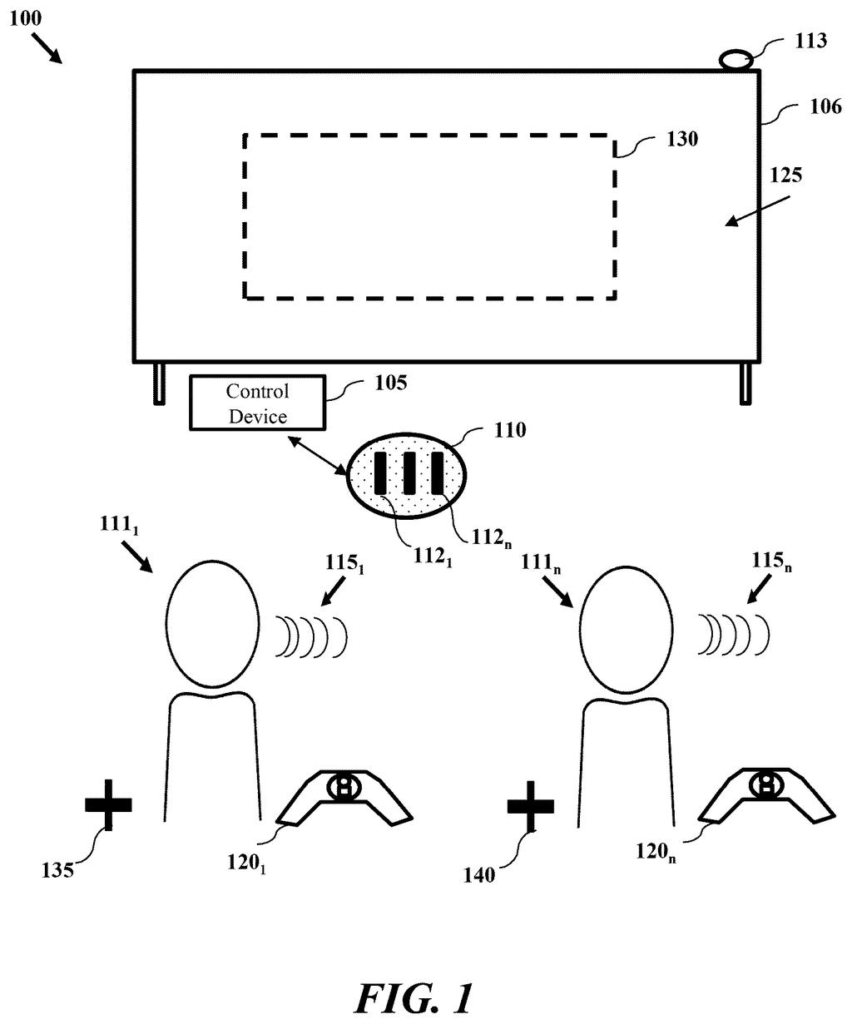
What Sony's voice-controlled couch co-op does
Every time you play a fighting game with a friend on the same couch, someone yells 'block!' or 'kick him!' and the game has no clue who said it. Sony's patent application describes a console that listens and sorts it out.
The idea is to pick each player's voice out of the noise in the room, work out which command belongs to which person, and then move that person's character. You could shout 'double punch, then uppercut' while your friend shouts their own moves, and both would register at the same moment. Your controller still works, and your voice becomes a second set of buttons.
Sony also describes using a row of microphones to judge where each person is sitting, and keeping a written transcript of who said what, which could be shown to spectators.
… identifying, from the audio stream, (i) first voice data representing utterances of the first user, and (ii) second voice data representing utterances of the second user; detecting (iii) a first command for the video game based on the first voice data, and (iv) a second command for the video game based on the second voice data; …
Translation: The system separates different players voices and figures out what each person wants the game to do.
How Sony tells players' voices apart
The core of the filing is a method for handling an audio stream that contains several people talking during a video game. The system pulls out the first player's voice and the second player's voice, detects a command in each, and then controls a game element tied to each player, such as their character.
The filing describes a few ways to separate the voices:
- Microphone array: several microphones hear the same sound at slightly different moments. Those phase and timing differences (tiny gaps in when a sound arrives) reveal where each speaker sits.
- Voice references: a saved sample of how each player sounds helps match a voice to a person. The description also mentions filtering by pitch and tone ranges.
- Trained models: machine learning software (software that learns from examples) turns speech into game commands. It can be trained on profile data, voice recordings and game data.
Commands can carry detail. The system can count actions, so 'punch three times' triggers three punches, and it can apply a style, such as an uppercut. The listed moves include jump, directional move, fire, punch, kick and block, and voice can also open game menus or change how the game is presented.
Voice can also modify a button press. A spoken command from a player can change what that player's controller input does. Players in different places on different consoles would each send their own audio stream.
… filtering of audio input streams to determine a plurality of user commands in parallel. Processes may be used to characterize human voice using models and to detect users in a group. User voice may be a control input in addition to game controller inputs.
Translation: Multiple people can talk at once to control the game alongside their standard controllers.
What voice commands could mean for game night
If this ever reaches a game, your voice becomes a second controller. You could keep your thumbs on the sticks for movement while shouting the complicated stuff, like a three-hit combo or a harder turn in a racing game. A friend next to you could do the same without confusing the console.
The filing also describes a written transcript of who said what, which could show up for spectators, and says the same approach could control a movie or broadcast on a display. The description says voice features would run only with user permission, so how privacy works in a shared living room would be a big part of whether people want it.
Sony's 648th filing in our Sony coverage since May follows work like pausing cloud games on dropped connections and robot arms that reroute mid-motion.
On the hardware side, this idea sits close to shippable. The filing relies on microphones, a signal-processing chip and a camera, and it says those can live in a console, a controller, a display or a headset. Most of the work is software.
The hard part is making it work in a loud living room. Two friends with similar voices, a TV blasting explosions and a third person laughing all land in the same audio stream, and the filing gives no accuracy numbers. Each game also needs its own list of voice commands, so developers would have to sign up title by title.
The shortest route to a product is a console feature that works with one or two games, most likely a fighting game where shouting 'uppercut' feels natural. Until someone shows it working at a loud party, it stays a promising sketch.
Get our take in your Top Stories
Liked this breakdown? Add Patentlyze as a preferred source on Google, and our plain-English take shows up more often in your Top Stories the next time Sony patent news breaks.
There are more where this came from
We read every patent application Big Tech publishes and send you the ones worth knowing. Plain English, free, every week.
The drawings
4 drawing sheets from US 2026/0325961 A1 · click any drawing to enlarge


Want this weekly breakdown for a company we don't cover? Patentlyze Pro →
Be the first to weigh in