
Sony Files Patent for Software That Lets Robot Arms Change Course Without Stopping
Sony's filing covers planning software that can rewrite a robot arm's path while the arm is still moving, so it doesn't have to stop and start over.
What Sony's robot-planning service does
You're watching two robot arms share a workspace, and halfway through the job someone changes the order. One arm now needs a new destination. The other is still mid-swing. Something has to work out new paths fast, without any collisions.
Sony's filing covers a planning service built from several small, separate programs that handle that job. One works out the robot's motion. Another builds maps ahead of time showing which arm positions are safe. A third is a viewer where an engineer can replay a motion or drag virtual sliders, and a fourth is the piece a person actually uses to send requests.
The headline trick is smooth changes. The plan can be rewritten while the arm is moving, so it doesn't need to come to a full stop first. Arms can also finish at different times, which frees a quick arm for its next task.
A motion planning system for providing a motion plan for robot motion, comprising: a motion planner receiving a motion planning problem and generating the motion plan; an artifact builder generating one or more planning artifacts; a visualizer displaying the given context in a visualizer session; and a service client providing an interface for an end user.
Translation: The system uses a planner, a builder, a visualizer, and a client interface to guide the robot.
How Sony's planner builds paths in advance
Sony splits the work into microservices (small, independent programs that each do one job and talk to each other). The claims name four: a motion planner, an artifact builder, a visualizer and a service client, which is the software a user works with. A user hands the planner a robot model, a list of constraints (such as avoiding collisions, hand position and speed limits), and a start and goal. The planner returns a plan, which is a function that maps time to robot joint positions.
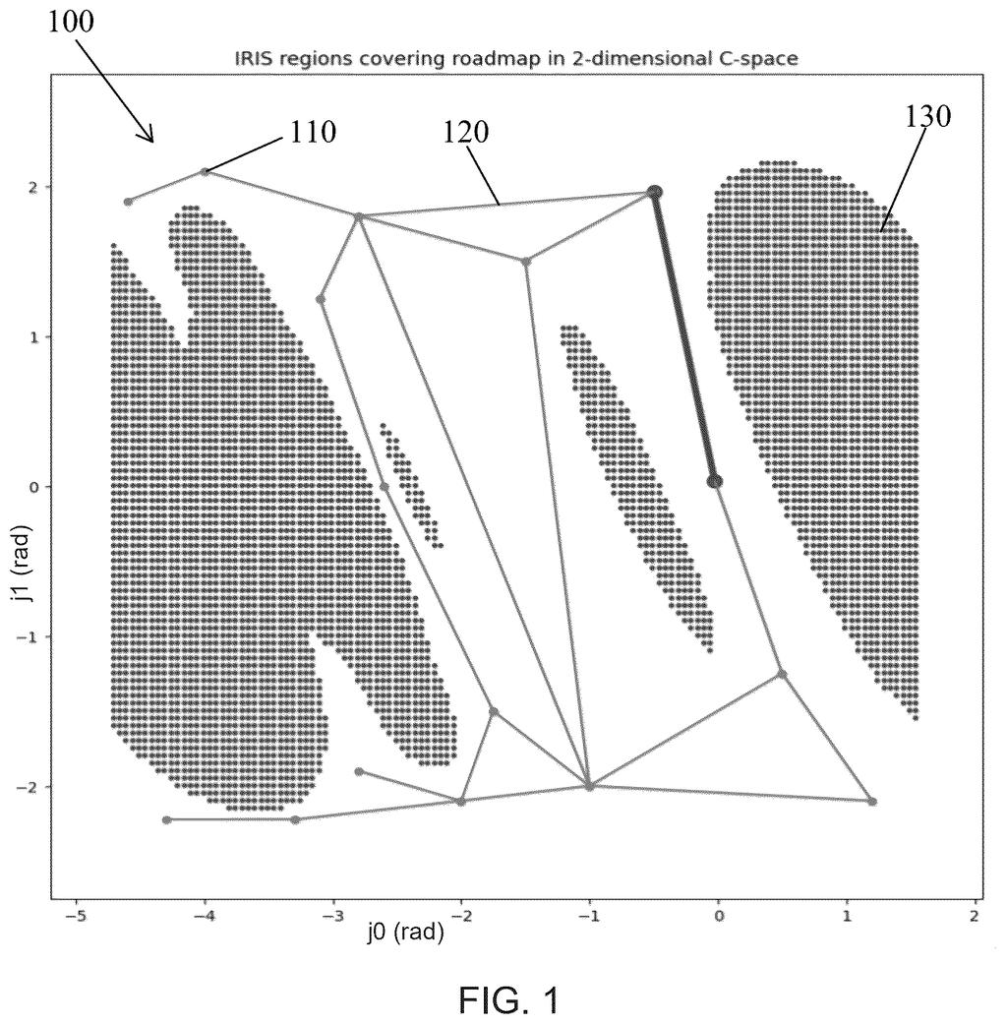
The artifact builder prepares for that ahead of time. Its two named products are IRIS regions (convex regions, meaning simply shaped zones of joint positions where every point is known to satisfy the constraints) and probabilistic roadmaps (a network of sampled safe positions and the paths between them). The planner loads these at runtime. That is how the abstract's mix of discrete and smooth optimization under a graph of convex sets comes together.
The visualizer lets an engineer inspect all this:
- The generated regions and roadmaps
- Geometric constraints, such as collision violations
- Trajectory playback and joint sliders
- Live position streaming from real robots
One claim covers the motion itself. Plans can update smoothly with no full stop, multiple arms can end at different times, new plans can be computed while other arms keep running, and different kinds of plans can run side by side.
The goal is to achieve time-optimal robot trajectories that are guaranteed to satisfy constraints, such as collision avoidance, end-effector pose and recipe-specific dynamic limits.
Translation: It aims to make robot paths as fast as possible while safely avoiding obstacles and following exact physical rules.
What Sony's no-stop planning means for robots
If you picture robot arms working side by side, the practical payoff is less dead time. Updating a plan mid-motion and freeing a fast arm for its next job means fewer pauses, and nobody has to halt everything to reroute one arm. The filing also describes building its safe-position maps from past runs, so they can improve over time.
For Sony, this reads as infrastructure software for people who build and run robots. The filing covers arms, grippers, legged robots and wheeled robots. It is still an application: the examiner's first review rejected the claims as filed, which is routine at this stage and usually followed by amendments.
Sony's 38th filing in our robotics patents we've tracked since May adds to a run that includes one on drone obstacle avoidance and one on a clip-on button presser.
The problem here is real, and it is a dull, expensive one. A robot arm that must stop, recalculate and restart every time the job changes wastes seconds, and seconds pile up over thousands of repetitions. The filing also points at a worse failure: a planned path that looks fine on paper and then breaks a limit once the robot tries to follow it.
Sony's answer covers both. Paths are built to respect collision and speed limits up front, and changing a path in flight is part of the design. That matches the size of the problem well.
The first claim, though, is mostly a parts list: a planner, a builder, a viewer and a client. The substance sits in the narrower claims about mid-motion updates and arms that finish at different times, and that is where the filing earns its keep.
Get our take in your Top Stories
Liked this breakdown? Add Patentlyze as a preferred source on Google, and our plain-English take shows up more often in your Top Stories the next time Sony patent news breaks.
There are more where this came from
We read every patent application Big Tech publishes and send you the ones worth knowing. Plain English, free, every week.
The drawings
9 drawing sheets from US 2026/0326295 A1 · click any drawing to enlarge


Show the other 1 sheets

Want this weekly breakdown for a company we don't cover? Patentlyze Pro →
Be the first to weigh in