
Nvidia Files Patent to Help Self-Driving Cars Focus on the Few Vehicles That Matter
Most of what a self-driving car sees never gets followed. Nvidia's patent application describes a filter that throws out far-lane traffic, and in its example pedestrians and traffic lights too, before the car's tracking software starts working.
What Nvidia's lane-based filter actually does
Ever tried to watch every single car on a ten-lane highway while you're driving? You don't. You watch the car ahead, the ones beside you, and maybe the motorcycle weaving behind. Everything else is background noise.
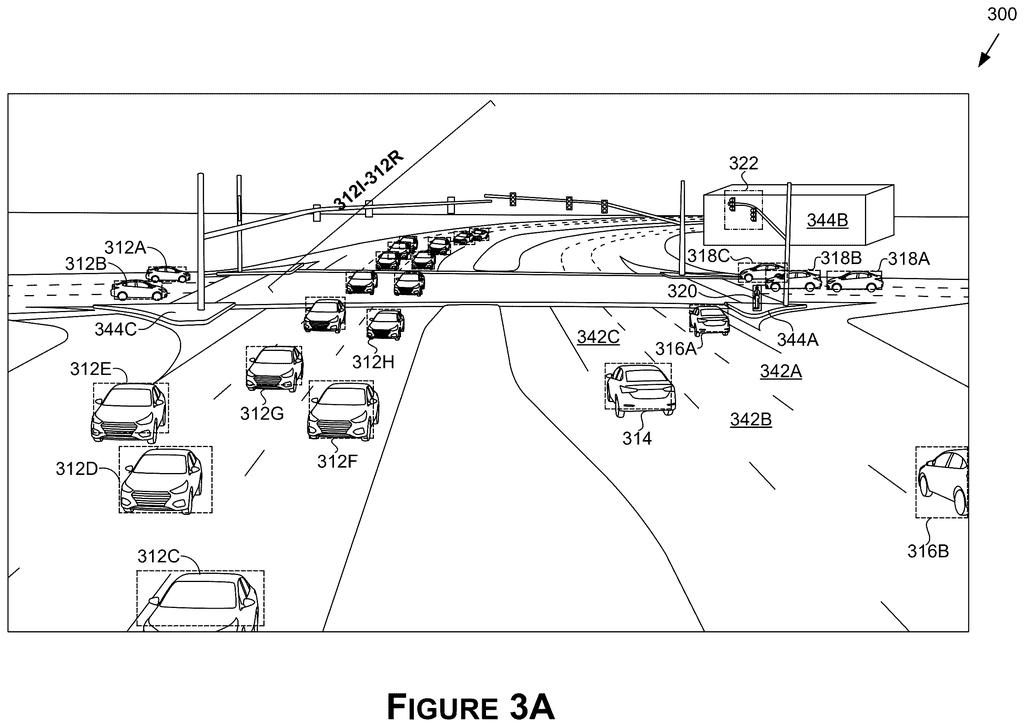
Nvidia's patent application gives a self-driving system that same habit. The car's cameras and sensors still spot everything around it. But before the computer starts following objects frame after frame, a filter sorts them. Anything outside the car's lane and the lanes right beside it gets dropped from the follow list, and in the filing's example so do pedestrians and traffic lights. Cars, trucks, bicycles and motorcycles stay.
The goal is speed. Following fewer things takes less computing, so the system can check the road more times per second and still keep close tabs on the vehicles that matter most. The filing gives no exact savings.
determine, based at least on sensor data obtained using the one or more sensors, one or more classifications and one or more locations associated with a set of objects; filter, based at least on the one or more classes and the one or more locations, the set of the objects to identify a subset of the objects …
Translation: The vehicle uses sensor data to categorize and locate nearby objects, then filters them down to the most important ones.
How the filter picks which objects to follow
The system starts with ordinary perception. Sensor data from cameras, radar or lidar feeds detectors that find lanes, find free space (ground the car can actually drive on, as opposed to a sidewalk), and draw boxes around objects with labels like car or pedestrian.
Before the object tracker (the software that follows each object from frame to frame to estimate where it is heading) gets any data, a filter trims the list:
- By location: each object is mapped to a lane, and only those in the car's own lane or the lanes immediately left and right are kept. Another independent claim uses free space instead, keeping objects on drivable ground and dropping those on non-drivable areas.
- By class: in the example, only cars, trucks, bicyclists and motorcyclists stay, while pedestrians and traffic lights are removed. A dependent claim also describes keeping a dynamic class and skipping a static one.
- In either order: the description says class filtering can come before lane filtering.
Each survivor gets a confidence score for being in its assigned lane, and low scorers are dropped. The tracker's output then feeds planning, navigation and control. The description also splits the work: GPUs (graphics chips) run detection and tracking while CPUs process the results, and when data passes between chips over a network link, fewer tracked objects means less to send.
… filter out or discard non-essential objects (e.g., objects that are not in an ego-lane or adjacent lanes) from objects detected using an object detection algorithm.
Translation: Cars outside your lane or the lanes next to you are ignored to save computing power.
Why a lighter tracking load matters in traffic
If you drive or ride in a car with driver assistance, the practical payoff is reaction time. A computer that wastes effort following oncoming traffic behind a divider, or cars two lanes away, has less time left for the vehicles in front of you. Trimming that list lets it refresh its picture more often, and the filing says more frames can be processed per second in the same time. That matters most on crowded city streets, where the number of detected objects balloons.
For Nvidia, the idea is broader than cars. The description names robots, drones, boats and simulation as other places it could run. It is also a continuation of two earlier applications that go back to 2020, so the concept has been in the pipeline for years. A filing alone says nothing about whether any product will use it.
This is the 102nd Nvidia filing we've tracked since May in our self-driving sensing race watch, following ones on reading turn signals and parking spot edges.
You would notice a good version of this the way you notice good brakes: you wouldn't, because nothing goes wrong. Fewer things to follow gives the car's computer room to update its view of the vehicles around you more often, and that is the benefit the filing is chasing in busy traffic.
The example class list deserves a second look. It drops pedestrians and traffic lights from the follow list, and the filing never says what protects a person stepping off a curb. Detection still happens before the filter, so the car still sees them, but the document does not say what the car does with them afterward. Anyone who rides in these cars should want that spelled out.
The filing gives no numbers on how much time is saved, so the size of the speedup is unknown. As a design idea it is sensible, and it matches how you drive yourself: you scan what matters first.
Get our take in your Top Stories
Liked this breakdown? Add Patentlyze as a preferred source on Google, and our plain-English take shows up more often in your Top Stories the next time Nvidia patent news breaks.
There are more where this came from
We read every patent application Big Tech publishes and send you the ones worth knowing. Plain English, free, every week.
The drawings
14 drawing sheets from US 2026/0341035 A1 · click any drawing to enlarge


Show the other 6 sheets


Want this weekly breakdown for a company we don't cover? Patentlyze Pro →
Be the first to weigh in