
Zoox Files Patent to Help Self-Driving Cars Guess Which Path to Check First
A self-driving car facing a messy road has too many possible moves to check them all. Zoox's patent describes an AI that glances at the options, guesses which one looks cheapest, and only then thinks hard about it.
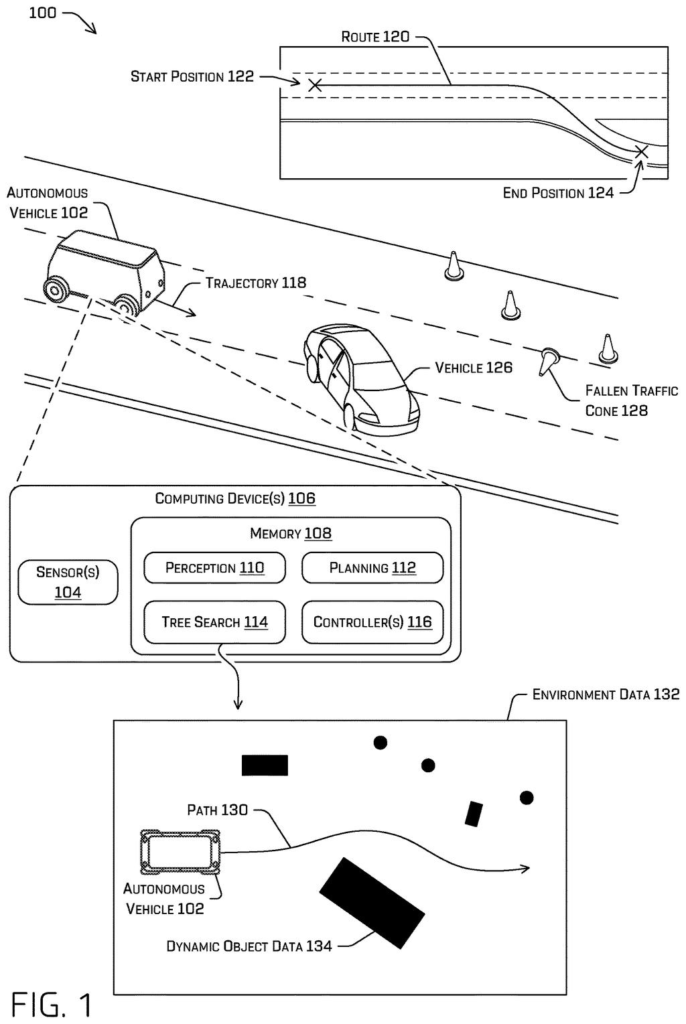
What Zoox's path-guessing AI actually does
Ever tried to cross a crowded parking lot by mentally testing every possible turn? You would never finish. Instead you glance around, guess which gap looks most promising, and only then think it through.
Zoox's patent teaches a self-driving car to work the same way. The car imagines many possible futures, like stay in lane, nudge left or stop, and each one branches into more choices. Checking every branch takes too long at street speed. So an AI model gives each option a quick cost score that reflects safety, progress and passenger comfort, and the car studies closely only the option with the lowest score.
The filing's example is a road where a stopped vehicle and a fallen traffic cone block all three lanes, a spot where lane-following software might simply give up.
… determining a prediction node for exploration based at least in part on the estimated cost being a minimum estimated cost from among a plurality of estimated costs associated with nodes of a same layer …
Translation: The car picks the most promising route option by finding the lowest predicted cost in that group.
How the tree search picks which branch to try
The car builds a tree of possibilities. Each node is a moment in the future, tied to a state, an action or a control for the vehicle moving through its surroundings. The claims cover running only a partial tree search, not the whole thing. The inputs are a top-down, multi-channel picture of the surroundings (static objects, map data, signage state, hidden areas) and a track for each moving object (its past and current position, speed, acceleration and type).
A machine-learned cost estimation model then scores the nodes in a layer. The node with the lowest estimated cost is picked for exploration. The model also sees the trace, the chain of actions and predicted states that led to that node. From the chosen node, a regular cost function generates candidate actions and scores them with a weighted sum of safety, progress along the route and passenger comfort. It can also label other road users as reactive (likely to respond to the car) or passive.
The result is a coarse path, described as points every 500 milliseconds, which is smoothed into a finer path (10 or 100 millisecond steps) for the car's controls to follow.
The filing also describes how to train the model. Knowing the truly best action would mean searching forever, so the loss function (the score used to correct the AI's mistakes) has two parts. One compares the AI's guess to what the search has found so far. The other is adjusted for how settled the search is. During training, the cost function can score every node, so labels are generated automatically and the model can be retrained when the cost function changes.
A first loss of the loss function term may be based on a difference between the architecture's estimated cost to go from a starting position and the cost to go from the starting position determined by the search so far.
Translation: The system improves itself by comparing its initial route cost guesses with actual search results.
Why blocked-lane scenarios matter for Zoox
The practical payoff is speed. The filing says earlier approaches to odd driving conditions were too heavy for real-time use on consumer-grade hardware, and that guessing costs instead of simulating every option could let the search run live. For you as a rider, that would mean a car that can squeeze past a blocked lane or an unmarked area instead of stopping or calling a remote operator.
It also matters for upkeep. Because the cost function labels the training data itself, changing how the car weighs safety, progress and comfort can trigger automatic retraining with little human labeling. The filing even presents this as a way to see why the system chose what it did, which is hard with most machine-learned systems. It is a patent application, so nothing here says it is in a car on the road today.
Amazon's 33rd filing we've tracked since May in our self-driving sensing race watch adds to a run that includes a spinning rain-clearing window and riders obeying police orders.
A driverless car that thinks too slowly has two bad options: stop in the road or hand control back to a human. Either outcome defeats the purpose, and in a three-lane blockage, either outcome also creates a traffic jam and a stranded passenger.
The scale of that failure justifies a serious engineering response. This filing teaches a car to skip dead-end options quickly and spend its limited time on the paths most likely to work, much the way an experienced driver trims possibilities without consciously listing them.
The candid acknowledgment that the right answer can never be fully confirmed during training is the most intellectually honest moment in the document. No road performance numbers appear here, so the idea stands on its logic alone, and that logic holds together.
Get our take in your Top Stories
Liked this breakdown? Add Patentlyze as a preferred source on Google, and our plain-English take shows up more often in your Top Stories the next time Amazon patent news breaks.
There are more where this came from
We read every patent application Big Tech publishes and send you the ones worth knowing. Plain English, free, every week.
The drawings
8 drawing sheets from US 2026/0326753 A1 · click any drawing to enlarge


Want this weekly breakdown for a company we don't cover? Patentlyze Pro →
Be the first to weigh in