
Nvidia Files Patent to Help Self-Driving Cars Find the Edges of a Parking Spot
Nvidia's patent has a self-driving car double-check its AI's guess about a parking space against the edges its cameras actually pick up. The AI makes the first guess, and plain edge detection helps correct it.
What Nvidia's parking-spot detection actually does
A car rolls slowly through a crowded lot while its cameras try to work out exactly where one parking space ends and the next begins. The paint is faded, a van sits half over a line, and the car is still moving. If you have ever misjudged a tight spot, you know how easy this is to get wrong.
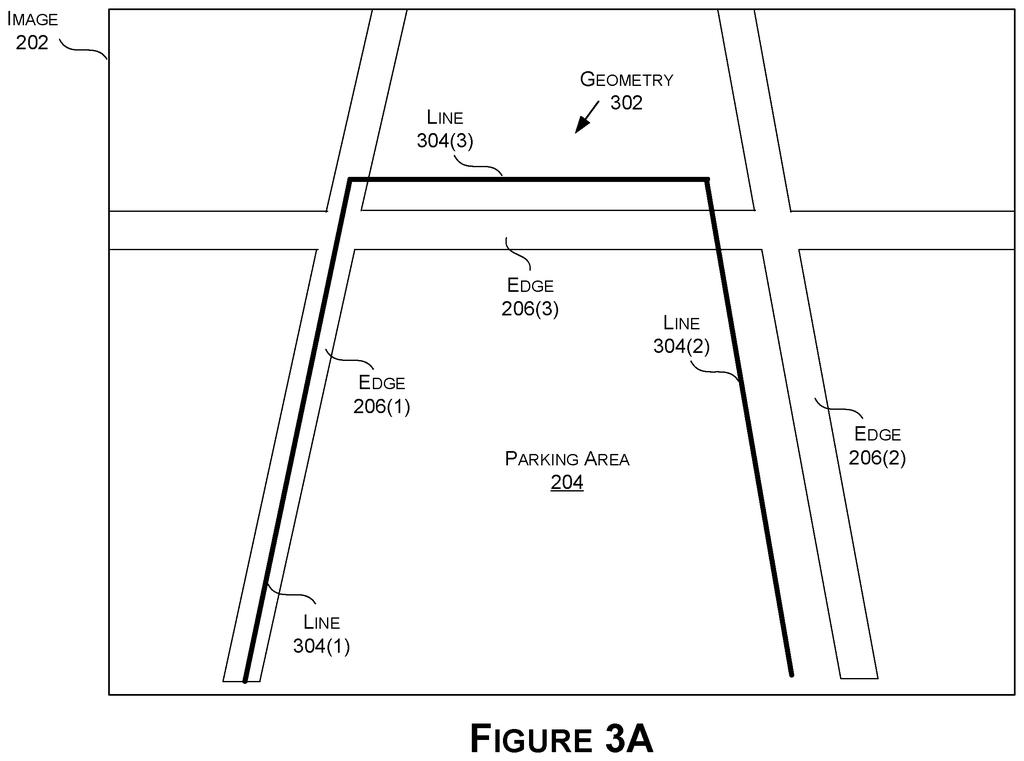
Nvidia's patent describes a two-step check. First, an AI model looks at the camera view and makes a rough guess at the outline of the space. Then the car runs a separate edge finder to pick out the real lines and edges in the picture, and keeps only the ones close to the guess. Edges that belong to a neighboring car, a person or a cone get thrown out.
From what is left, the car nudges the guess until it fits the real edges as closely as possible. The result is a sharper outline of the spot that the car can use to plan its path in.
determining, using one or more machine learning models and based at least on sensor data obtained using one or more sensors of a machine, a first geometry associated with a parking area located within an environment …
Translation: The vehicle uses AI and sensor data to make an initial guess about the shape of a parking spot.
How the AI's guess gets checked against edges
The system starts with sensor data, mostly camera images (the filing also lists radar, lidar and ultrasonic sensors). A trained machine learning model, meaning software that learned from many examples, predicts the geometry of the parking space: where its front, back, left and right edges probably sit.
Separately, an edge detection step scans the same image for anything that looks like an edge, producing pixels or 3D points. That pile includes the paint lines but also the outlines of other cars, signs and cones. The AI's guess works as a filter: points beyond a set distance from the guessed outline are dropped (the description gives examples of 10, 40 or 80 centimeters). A second pass fits lines to the survivors and filters again, more tightly.
Then an optimization step (a search for the best fit) takes two opposite corners from the guess and shifts them around, and also turns the angle of the space, trying many candidate sets of lines. Each candidate gets a cost, a score based on how far its lines sit from the remaining points. The lowest cost wins. When several cameras see the same spot, the system can merge each camera's outline the same way.
The process can repeat about every 10 milliseconds, the results are smoothed over a few seconds, and the car uses the final outline to plan a path into the space.
A predicted geometry associated with the parking area, as determined using one or more machine learning models, may then be used to filter the edge features in order to identify a portion of the edge features that represent the parking area.
Translation: The AI uses its initial guess to clean up messy sensor data so it can find the true edges of the spot.
What this means for cars that park themselves
If you drive a car with parking assist, this is the part that decides where the car believes the lines are. A sloppy outline means a car that parks crooked, stops too far from the curb, or hesitates. A sharper outline could make automatic parking feel less nervous, especially when the car is still moving or its cameras are slightly out of alignment, two problems the filing names directly.
For Nvidia, the filing sits inside its self-driving platform; the description is built around its own example autonomous vehicle and chips. It also says the idea could reach robots, warehouse vehicles and drones. One claim covers spaces defined by objects such as bumpers or curbs when there is no paint at all. The filing names no product.
Nvidia's 100th filing we've tracked since May in our self-driving sensing race watchlist follows work like basic flat map positioning and faster radar motion detection.
The design hands the AI the first word, and that is where it could break. The edge filter only keeps points near the AI's guess, so a guess that lands too far off throws away the real lines and keeps the clutter. The second pass narrows the window further, which helps with messy scenes but leaves even less room for a bad first guess.
Speed is the other price. An AI model, an edge finder, two filtering passes and a search for the best fit, repeated about every 10 milliseconds, take real computing power. Cars carry powerful chips, yet every extra task competes with the driving work for them.
The trade reads as worth it. A cheap rule-based check that catches what a learned model misses is a sensible way to buy accuracy, and parking is a slow job where a few extra milliseconds cost little.
Get our take in your Top Stories
Liked this breakdown? Add Patentlyze as a preferred source on Google, and our plain-English take shows up more often in your Top Stories the next time Nvidia patent news breaks.
There are more where this came from
We read every patent application Big Tech publishes and send you the ones worth knowing. Plain English, free, every week.
The drawings
25 drawing sheets from US 2026/0326748 A1 · click any drawing to enlarge


Show the other 17 sheets


Want this weekly breakdown for a company we don't cover? Patentlyze Pro →
Be the first to weigh in