
Qualcomm Files Patent to Shrink Video Files by Predicting Each Piece of a Frame Better
Video compression works by guessing each tiny piece of a frame and sending only the corrections. Qualcomm's new patent application describes making that guess by checking several neighborhoods of pixels at once instead of one.
What Qualcomm's multi-template video patent does
A streaming service has to squeeze a two-hour movie into a file small enough to send over your Wi-Fi. It does that by guessing most of each frame before it sends a single detail. Your phone makes the same guesses on its end, so only the corrections need to travel.
Qualcomm's new patent filing is about making those guesses better. One common trick looks at the pixels bordering a small piece of the picture, an L-shaped strip above and to the left, and hunts for another spot that looks similar. Qualcomm's filing uses several strips at once: the L shape, just the row above, and just the column to the left.
Each strip turns up its own best matches. The system pools them into one list, throws out any duplicates, and can even blend the top picks into a single guess. A closer guess means less correction data to send.
… performing a pruning process to avoid a same reference block candidate from being included multiple times in the template matching candidate list …
Translation: The software filters out duplicate prediction options to keep the list clean and efficient.
How the candidate list gets built and pruned
Video codecs (the software or chips that compress and unpack video) split every frame into small blocks. For each block, they build a prediction block, a best guess at what it looks like, and send only the residual, the leftover difference between the guess and the real thing.
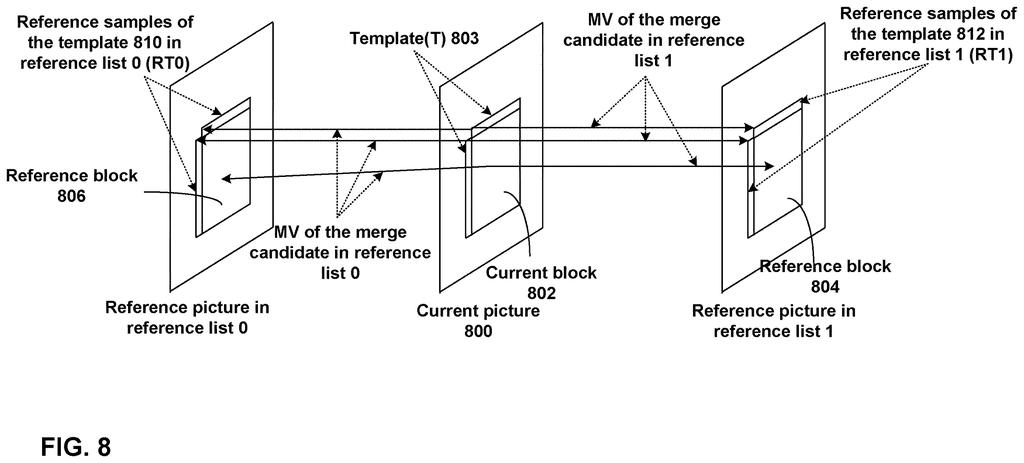
In template matching, the encoder and decoder both look at already-decoded pixels next to the current block (the template) and search for other spots whose neighbors look the same. Claim 1 covers building a template matching candidate list from more than one template pattern, with a pruning process so the same reference block never shows up twice. The patterns include:
- Rows above and columns left of the block.
- Only the rows above.
- Only the columns on the left.
Each pattern produces its own ranked list, sorted by matching cost (how much the neighboring pixels differ). The lists are merged and duplicates dropped. Dependent claims add a shortcut that estimates the combined pattern's cost from the other two, and a rule that blocks on a picture's edge only use patterns needing no pixels outside the picture.
The decoder then reads an index into the list, or takes the lowest-cost entry, and adds the residual. The filing also describes fusing several candidates into one weighted average, with weights from the matching costs or from mean-squared-error minimization (a fitting method that shrinks the squared differences).
Why better video guesses matter for streaming
If a video format predicts each block more closely, less leftover data has to be sent, which the filing says promotes bandwidth efficiency. For you, that could eventually mean lighter streams or smaller downloads, but only if a codec maker or standards group adopts something like it.
The description says the techniques could work with existing formats such as HEVC and VVC, or with future standards, including the experimental ECM test model. The filing names no product. More patterns also mean more comparisons, which is why it includes shortcuts that reuse earlier math instead of starting over for every pattern.
This is the 553rd Qualcomm filing in our Qualcomm coverage since May, adding to work like face-hiding video and phone-to-headset video limits.
Claim 1 is wide. It covers any encoder or decoder that builds a candidate list from several template shapes and skips duplicate entries before coding a block. It does not require the blending step, a particular set of shapes, or any one video format.
The narrower ideas sit in the dependent claims: the IntraTMP mode, the edge-of-picture rule, the weighted blending. If granted, the claim's wording would cover any design that pairs several template shapes with a duplicate check, which is an easy combination for a codec engineer to reach for. That breadth is the main source of the filing's value.
For you as a viewer, nothing changes tomorrow. It reads as a careful engineering refinement of an existing compression tool, useful to people who build codecs and invisible to nearly everyone else.
Get our take in your Top Stories
Liked this breakdown? Add Patentlyze as a preferred source on Google, and our plain-English take shows up more often in your Top Stories the next time Qualcomm patent news breaks.
There are more where this came from
We read every patent application Big Tech publishes and send you the ones worth knowing. Plain English, free, every week.
The drawings
16 drawing sheets from US 2026/0342967 A1 · click any drawing to enlarge


Show the other 8 sheets


Want this weekly breakdown for a company we don't cover? Patentlyze Pro →
Be the first to weigh in