
Qualcomm · Filed Jun 26, 2026 · Published Oct 29, 2026

Qualcomm Files Patent to Let a Phone Tell a Headset How Much Video to Send

Qualcomm describes a headset that doesn't have to guess how much video protection it needs. The phone on the other end tells it, based on how well the phone can predict what comes next.
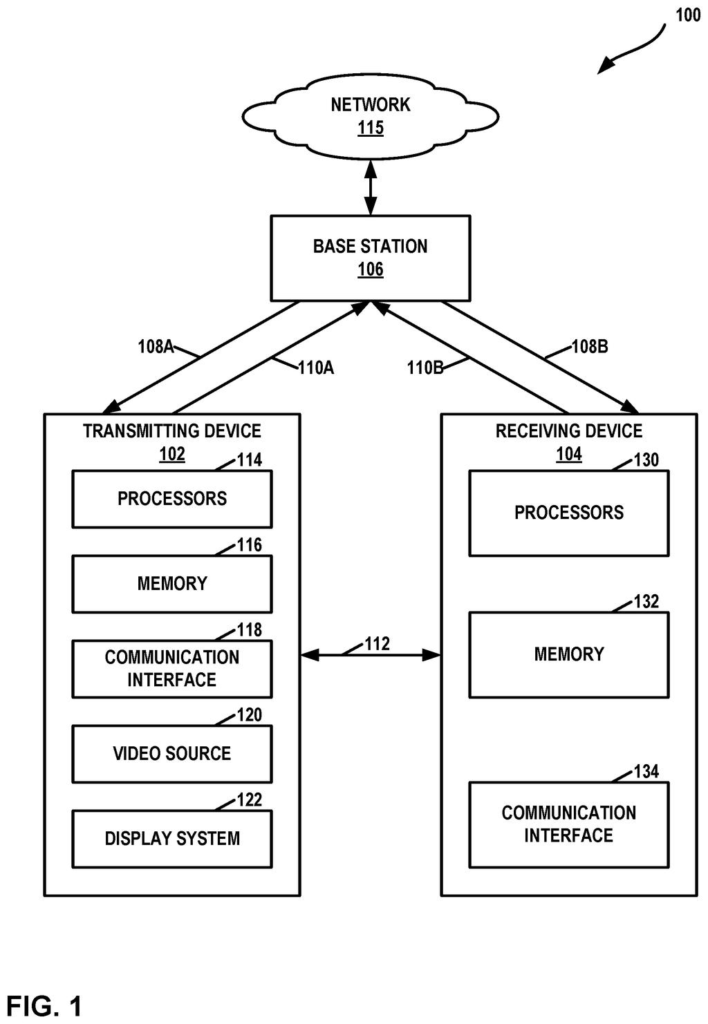
Two connected devices exchange video wirelessly, either straight to each other or routed through a nearby cell tower. Drawing from patent filing US 2026/0343004 A1.
Two connected devices exchange video wirelessly, either straight to each other or routed through a nearby cell tower.
See all 27 drawings from this filing ↓
Publication number US 2026/0343004 A1 US20260343004A1
Applicant QUALCOMM Incorporated
Filing date Jun 26, 2026
Publication date Oct 29, 2026
Inventors Amit Bar-Or Tillinger, Gideon Shlomo Kutz, David Yunusov, Shay Landis, Assaf Touboul, Yehonatan Dallal, Idan Michael Horn
US classification 375/240.12
Status when we published Waiting for an examiner (Jul 22, 2026)
Parent application is a Division of 18640692 (filed 2024-04-19)
Document 12 claims

What Qualcomm's headset-to-phone video feedback does

An augmented reality headset films the room in front of you, and every frame has to reach your phone in a hurry. Squeezing video down to a small size takes serious processing power, and a headset sitting on your face can't carry much battery or weight. Qualcomm's filing builds on a workaround: the headset does only light compression, and the phone fills in the gaps by guessing what the next frame looks like from the ones it already has.

This patent adds a feedback loop. The phone keeps track of how good its guesses are, then reports that back to the headset. When your head is turning fast or the scene is busy, the guesses get worse, so the headset can send more repair data or keep more detail. When the scene is calm, it can send less.

The result is a headset that spends effort only where the phone actually needs help.

From the filing · CLAIM 1
… adapt one or more of video encoding parameters or channel encoding parameters based on the prediction quality feedback …

Translation: The transmitter adjusts how it compresses the video depending on how well the receiver predicts future frames.

How the phone's guess scores steer the headset

The claims cover the sending side. A device, such as a headset, collects video and also receives prediction quality feedback from the device it is sending to. That feedback measures how reliable the receiving device's guesses at upcoming pictures have been.

Based on that feedback, the sender changes one or both of two dials, then encodes and transmits as normal:

  • Video encoding settings, such as the quantization parameter (a setting that controls how coarsely the numbers describing a picture get rounded, which trades detail for size).
  • Channel encoding settings (how the video is wrapped in error-correction data for the wireless trip), such as which LDPC graph is used (the wiring pattern of a common error-correcting code) and how much of the repair data is trimmed away, a step called bit puncturing.

The filing explains why this feedback is useful. The leading digits of the numbers describing a picture are easier to guess than the trailing ones, and busy, fast-moving regions are harder to predict than calm ones. The receiver can report this per bit position, per region of a picture, every set number of pictures, or as a few numbers describing a noise model, which takes less data than detailed statistics.

In the larger system the filing describes, the sender skips some video entirely, and the receiver rebuilds it by combining its own guess with the error-correction data.

From the filing · THE ABSTRACT
… scale bits of the transform coefficients of the transform blocks based on reliability values for bit positions …

Translation: Certain parts of the data are adjusted in importance based on how reliable their transmission paths are.

Why a lighter headset needs a helpful phone

If this works the way the filing describes, the practical payoff is a headset that does less video work on your head. The description says a headset worn on the face needs to stay light and use little power, and handing the heavy lifting to a phone is one way to get there. The feedback loop means the headset adds protection or detail only when the phone's guesses are shaky.

The filing assumes a fast wireless link between the two devices and names 5G, 6G, Wi-Fi and Bluetooth as options. For you, that would mean the headset and phone work as a pair, with your phone carrying more of the load. The filing ties this to extended reality headsets, though it also lists wearables, sensors and other devices as possible senders.

This is the 59th Qualcomm filing we've tracked in the AR glasses race since July, following one cutting duplicate pixels and one on 3D video shrinking.

Editorial take

Anyone who has worn a headset for an hour knows the problem: it gets heavy, it gets warm, and the battery drains. Video is one of the biggest chores a headset has, so moving work off your face and onto a phone attacks a real cost.

The feedback idea fits that problem well. A phone that guesses upcoming frames only helps if the guesses are good, and this filing gives the headset a way to find out when they are not. It can then send extra repair data right when it is needed, instead of paying for heavy protection all the time.

The plan needs a second device nearby and a fast wireless link, and the filing assumes both. For a headset meant to be worn and used with a phone, that is a fair assumption, and the approach is sized sensibly for the weight and battery problem it targets.

Get our take in your Top Stories

Liked this breakdown? Add Patentlyze as a preferred source on Google, and our plain-English take shows up more often in your Top Stories the next time Qualcomm patent news breaks.

There are more where this came from

We read every patent application Big Tech publishes and send you the ones worth knowing. Plain English, free, every week.

The drawings

27 drawing sheets from US 2026/0343004 A1 · click any drawing to enlarge

How a headset and phone connect through a cell tower, drawing sheet 1 from US 2026/0343004 A1
Sheet 1 How a headset and phone connect through a cell tower
Hardware parts that shrink and protect video over the air, drawing sheet 2 from US 2026/0343004 A1
Sheet 2 Hardware parts that shrink and protect video over the air
Skipping video frames and using predictions to fill the gaps, drawing sheet 3 from US 2026/0343004 A1
Sheet 3 Skipping video frames and using predictions to fill the gaps
Transmitting video alongside extra error repair signals, drawing sheet 4 from US 2026/0343004 A1
Sheet 4 Transmitting video alongside extra error repair signals
Rebuilding missing video frames by guessing what changed, drawing sheet 5 from US 2026/0343004 A1
Sheet 5 Rebuilding missing video frames by guessing what changed
A checkerboard pattern marking image sections to skip, drawing sheet 6 from US 2026/0343004 A1
Sheet 6 A checkerboard pattern marking image sections to skip
Compressing image pieces and transmitting relationship data, drawing sheet 7 from US 2026/0343004 A1
Sheet 7 Compressing image pieces and transmitting relationship data
Restoring skipped picture details from nearby saved blocks, drawing sheet 8 from US 2026/0343004 A1
Sheet 8 Restoring skipped picture details from nearby saved blocks
Show the other 19 sheets
Picking irregular video blocks to skip across a picture, drawing sheet 9 from US 2026/0343004 A1
Sheet 9 Picking irregular video blocks to skip across a picture
How wireless parts use signal feedback to fix transmission errors, drawing sheet 10 from US 2026/0343004 A1
Sheet 10 How wireless parts use signal feedback to fix transmission errors
Pinpointing which digital bits are most prone to transmission errors, drawing sheet 11 from US 2026/0343004 A1
Sheet 11 Pinpointing which digital bits are most prone to transmission errors
Adjusting video compression based on feedback from the other device, drawing sheet 12 from US 2026/0343004 A1
Sheet 12 Adjusting video compression based on feedback from the other device
Rebuilding a picture after adjusting and correcting received data, drawing sheet 13 from US 2026/0343004 A1
Sheet 13 Rebuilding a picture after adjusting and correcting received data
How two devices coordinate multiview video compression, drawing sheet 14 from US 2026/0343004 A1
Sheet 14 How two devices coordinate multiview video compression
Sending multiview camera video tailored by receiver feedback, drawing sheet 15 from US 2026/0343004 A1
Sheet 15 Sending multiview camera video tailored by receiver feedback
Analyzing received video to return compression hints to the camera, drawing sheet 16 from US 2026/0343004 A1
Sheet 16 Analyzing received video to return compression hints to the camera
Hardware units that selectively drop video blocks to save bandwidth, drawing sheet 17 from US 2026/0343004 A1
Sheet 17 Hardware units that selectively drop video blocks to save bandwidth
How the receiving device requests a specific frame-skipping rate, drawing sheet 18 from US 2026/0343004 A1
Sheet 18 How the receiving device requests a specific frame-skipping rate
Steps a camera uses to drop video frames on demand, drawing sheet 19 from US 2026/0343004 A1
Sheet 19 Steps a camera uses to drop video frames on demand
Ways a receiving device chooses and requests video reduction patterns, drawing sheet 20 from US 2026/0343004 A1
Sheet 20 Ways a receiving device chooses and requests video reduction patterns
Sending compression instructions back to the original video transmitter, drawing sheet 21 from US 2026/0343004 A1
Sheet 21 Sending compression instructions back to the original video transmitter
Timing messages that guide compression choices frame by frame, drawing sheet 22 from US 2026/0343004 A1
Sheet 22 Timing messages that guide compression choices frame by frame
Applying received compression instructions to future video frames, drawing sheet 23 from US 2026/0343004 A1
Sheet 23 Applying received compression instructions to future video frames
Predicting future pictures to help senders compress them, drawing sheet 24 from US 2026/0343004 A1
Sheet 24 Predicting future pictures to help senders compress them
How compressed video breaks down into smaller parts, drawing sheet 25 from US 2026/0343004 A1
Sheet 25 How compressed video breaks down into smaller parts
Headset circuits that sort and stream video over the air, drawing sheet 26 from US 2026/0343004 A1
Sheet 26 Headset circuits that sort and stream video over the air
Phone circuits that rebuild the stream and send feedback, drawing sheet 27 from US 2026/0343004 A1
Sheet 27 Phone circuits that rebuild the stream and send feedback
Browse all the drawings 27 drawing sheets
Patent filing page

Source. Full patent text and figures from the official USPTO publication PDF.
Reader comments

Be the first to weigh in

Start the discussion

Real name or a handle, either is fine. Comments are read by a person before they appear, so allow a little time. Keep it about the filing.