
A New Qualcomm Patent Lets 3D Video Pick How Much to Shrink Before Sending
3D video is built from millions of dots per frame, and shrinking it for the trip is a balancing act. This Qualcomm filing lets the amount of shrinking change with the job.
What Qualcomm's adjustable 3D shrinking does
Every time a 3D scan streams to a headset, millions of tiny dots per frame, up to 60 frames per second, have to squeeze through your connection. Compression makes that possible, and one common recipe shrinks the 3D shape by the same fixed amount every time.
Qualcomm's patent application turns that fixed setting into a dial. The sender picks how many times to shrink the shape, based on the job, how many bits it can spend, or what kind of scan it is. It then tags the file with that number, so your device knows how many times to enlarge the shape back to full size.
Why bother? The filing says that at low quality settings, the shrunken outline alone eats most of the data budget. Shrinking a bit more would free up room for detail. At the highest quality settings, shrinking less helps instead.
determining a number of times to upscale a downscaled encoded representation of a point cloud geometry …
Translation: Figuring out how many times to enlarge a compressed 3D data set.
How the decoder rebuilds detail step by step
A point cloud is a 3D picture made of points, each with x, y and z coordinates (called the geometry) and sometimes extra details like color. The claims cover the decoding side. A device works out how many times to upscale a shrunken version of the geometry, decodes it, enlarges it that many times, and rebuilds the point cloud.
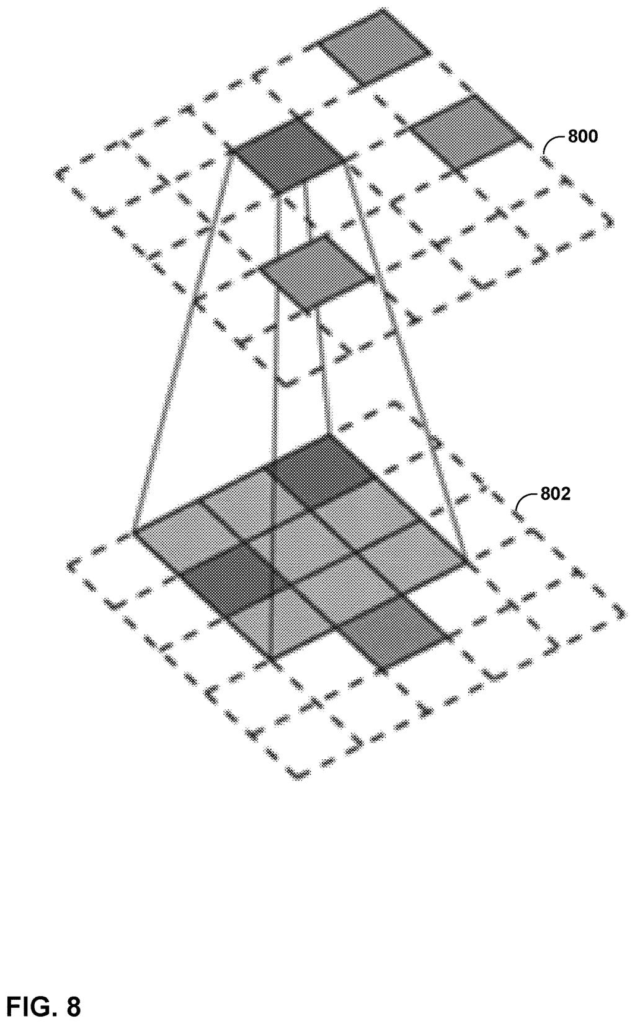
The setup the filing starts from shrinks the geometry three times, cutting each axis in half each round, for 8x total. The new idea is that this count can vary.
- The encoder writes a value into the bitstream (the compressed file). The filing calls it ds_level_minus1. The decoder reads it to learn how many times to enlarge.
- The decoder can be a neural network (software trained on examples) built as a chain of stages, one per enlargement. Each stage decodes, then upscales.
- After each enlargement, a pruning step uses a yes-or-no classifier to throw out false voxels (tiny 3D cells wrongly marked as filled).
- It works for frames coded on their own, from a previous frame, or from frames on both sides. In the predictive cases, a predictor network guesses the current frame's features from the previous frame, and only the leftover differences (the residual) are sent.
The claims also say the shrink count can depend on the use case, the bit requirements, or the type of point cloud.
Why a fixed shrink setting leaves savings behind
If you ever stream a 3D scan to a headset or phone, the bits per second decide how sharp it looks and whether it stutters. A decoder that can match its shrink level to the job lets a service spend fewer bits on the outline and more on detail, or the reverse when quality matters most. The filing lists cameras, computers, mobile devices, broadcast receivers and set-top boxes as places this could run.
The description also names communication between autonomous vehicles and geographic mapping as uses for point clouds, and says the same idea could extend to color and other point details. In the company's own tests of the fixed-shrink version, it saved large amounts of data against older standards. The flexible setting is meant to squeeze out more.
Qualcomm's 57th filing we've tracked in our AR glasses race watch since July adds to a pattern that includes offloading video to a phone and freezing background apps to save battery.
Claim 1 is short and wide. It asks for four steps: work out how many times to enlarge a shrunken 3D shape, decode it, enlarge it that many times, and rebuild the points. Nothing in it names a neural network, a file format or a rule for picking the number.
Those details appear only in the later claims, which add where the number comes from, the frame types, and the cleanup step that removes wrongly filled cells. If granted, the core claim would reach any decoder that treats the enlarge count as a choice.
Every claim here sits on the decoding side. The encoder, which does the shrinking, shows up in the description but not in these claims. For a reader, the practical picture is a modest efficiency tweak to 3D video compression, wrapped in a broad opening claim.
Get our take in your Top Stories
Liked this breakdown? Add Patentlyze as a preferred source on Google, and our plain-English take shows up more often in your Top Stories the next time Qualcomm patent news breaks.
There are more where this came from
We read every patent application Big Tech publishes and send you the ones worth knowing. Plain English, free, every week.
The drawings
15 drawing sheets from US 2026/0330699 A1 · click any drawing to enlarge


Show the other 7 sheets


Want this weekly breakdown for a company we don't cover? Patentlyze Pro →
Be the first to weigh in