
Sony Files Patent for a Laser Distance Sensor That Learns From Its Own Errors
A laser sensor that scans the road ahead can only be as accurate as its laser sweep is straight. Sony's patent describes a sensor that remembers where its laser drifts and fixes it before the next sweep.
What Sony's self-correcting laser sensor does
Ever tried to draw a perfectly straight line without a ruler? Your hand tends to drift in the same spots every time, and after a few tries you could learn to lean against those drifts before they happen.
A laser distance sensor has the same problem. Sensors of this type, which can be mounted on a vehicle, measure distance by sweeping the frequency of a laser beam up and down in a smooth, straight pattern. If that sweep bends even slightly, the distance reading gets fuzzier. Sony's patent describes a sensor that checks each sweep against the next, works out where it drifts, and stores a correction for each tiny slice of the sweep.
On the following sweeps, the sensor applies those saved corrections up front, adjusting the laser's control signal so the sweep comes out straighter. You would never see any of this happen, but the payoff should be more accurate distance readings.
… a signal processor configured to generate a first signal on a basis of the beat signal converted into a digital signal, the first signal being regarding a correction amount of a frequency of the optical signal; …
Translation: The system figures out how to fix its own light frequency errors based on digital measurements.
How the sensor stores a fix for every sample
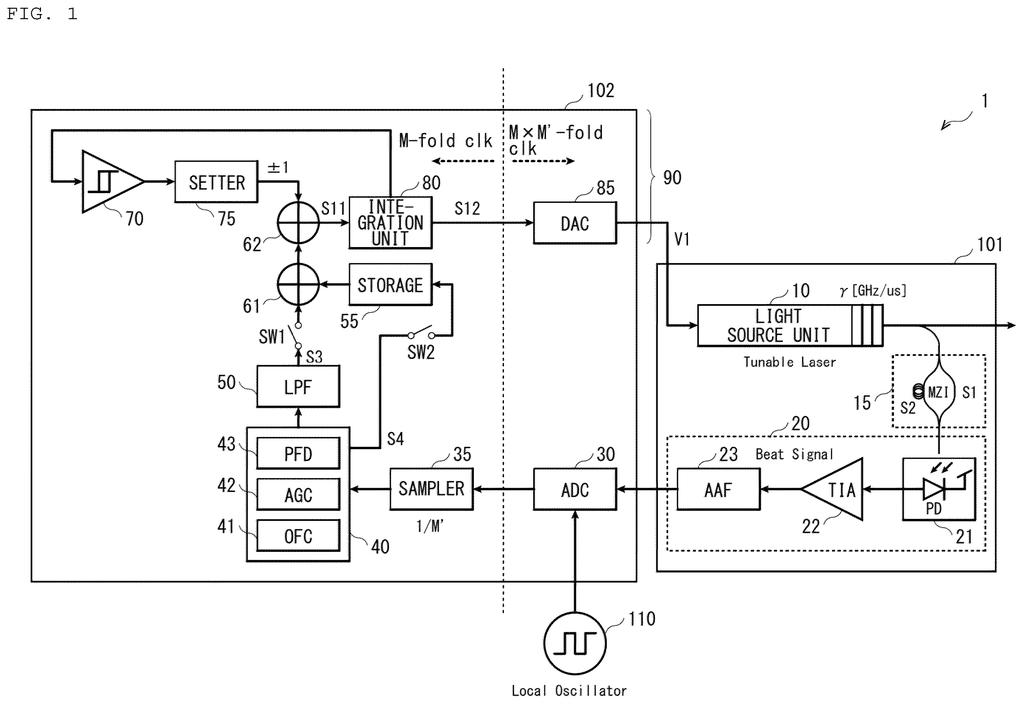
The device is an FMCW (frequency-modulated continuous wave) LiDAR, a kind of laser radar. Its laser frequency is swept up, then down, in a triangle pattern. Part of the light is delayed and mixed with the original, which produces a beat signal (a signal whose frequency equals the gap between the two light frequencies). If the sweep is perfectly linear, the beat signal holds a fixed, known frequency. Any drift in the sweep shows up as an error in that signal.
The filing then describes these steps:
- An analog-to-digital converter oversamples the beat signal, taking 16 x 20 = 320 samples per beat cycle in the example given. A downsampler then thins the data for processing.
- The signal processor builds an ideal reference signal using eight parallel filters, picks the closest match, and measures the phase error (how far the timing is off).
- It compares each up-sweep with the next up-sweep, and each down-sweep with the next down-sweep, to find the sweep-rate error.
- It writes a correction into a memory cell assigned to each sampling point.
The controller then adds the stored correction to the voltage that drives the laser. The filing calls this pre-distortion based on memory-learning iterative learning control: the device improves by repeating the same task and remembering the mistakes.
The filing also describes a real-time feedback loop (an optical phase-locked loop) that can run instead of, or alongside, the stored approach. The claims center on the stored per-point corrections. The filing says the design works with a delay of 3 nanoseconds or less and a sweep range of 1 GHz or less, which allows smaller parts.
The controller controls the frequency modulation of the optical signal on the basis of the first signal stored in the storage.
Translation: The controller uses saved correction data to adjust how the laser outputs light.
Why a straighter laser sweep matters for cars
Cars that rely on laser sensors need clean distance and speed readings, and a laser sweep that drifts blurs both. If a sensor can learn and fix its own drift, the readings stay sharper without needing larger or more expensive parts. The filing says the design still works when the internal delay and sweep range are small, which points toward smaller sensors. It also notes that stable feedback is hard on chips built with silicon photonics (light circuits etched on silicon) when mounted in a vehicle.
Sony's document gives no measured accuracy gains, and it describes no specific product. It is a patent application, so it may never become hardware. Still, the problem it targets, keeping a laser sweep straight, sits at the heart of how this kind of sensor measures distance at all.
This is the 35th Sony filing we've tracked since July in the self-driving sensing race, after ones on keeping range lights equally bright and tagging who sent a road warning.
Most people will never see this part of a car, and that is fine. A laser sweep that drifts gives blurrier distance readings, and blurrier readings could mean a sensor that is less sure about what is ahead of you. Saving a fix and applying it before each sweep goes after that blur at its source.
The filing gives no measured numbers, so how much sharper the readings get is unknown. It covers one narrow piece of the sensor, the part that keeps the laser sweep straight.
For a driver, the best outcome is an invisible one: the same car, with a distance sensor that stays accurate in a smaller, cheaper package. That makes this routine engineering with a plausible, useful payoff.
Get our take in your Top Stories
Liked this breakdown? Add Patentlyze as a preferred source on Google, and our plain-English take shows up more often in your Top Stories the next time Sony patent news breaks.
There are more where this came from
We read every patent application Big Tech publishes and send you the ones worth knowing. Plain English, free, every week.
The drawings
9 drawing sheets from US 2026/0338920 A1 · click any drawing to enlarge


Show the other 1 sheets

Want this weekly breakdown for a company we don't cover? Patentlyze Pro →
Be the first to weigh in