
Samsung Files Patent for a Voice Assistant That Picks the Right-Sized AI for Each Request
Ask your voice assistant one simple thing and this Samsung filing says a small AI should answer. Pile on more requests and a bigger one steps in.
What Samsung's model-picking voice assistant does
You ask your phone's assistant what the weather is today. Easy. Then you add a second request about your schedule, and suddenly the job is bigger than the first one. Right now, either one AI model handles everything, or you have to pick one yourself.
Samsung's filing describes a system that counts how many separate requests are in what you said (the filing calls them intents) and uses that count to judge how much AI muscle the job needs. One quick question goes to a small, cheap model. A pile of requests goes to a bigger one.
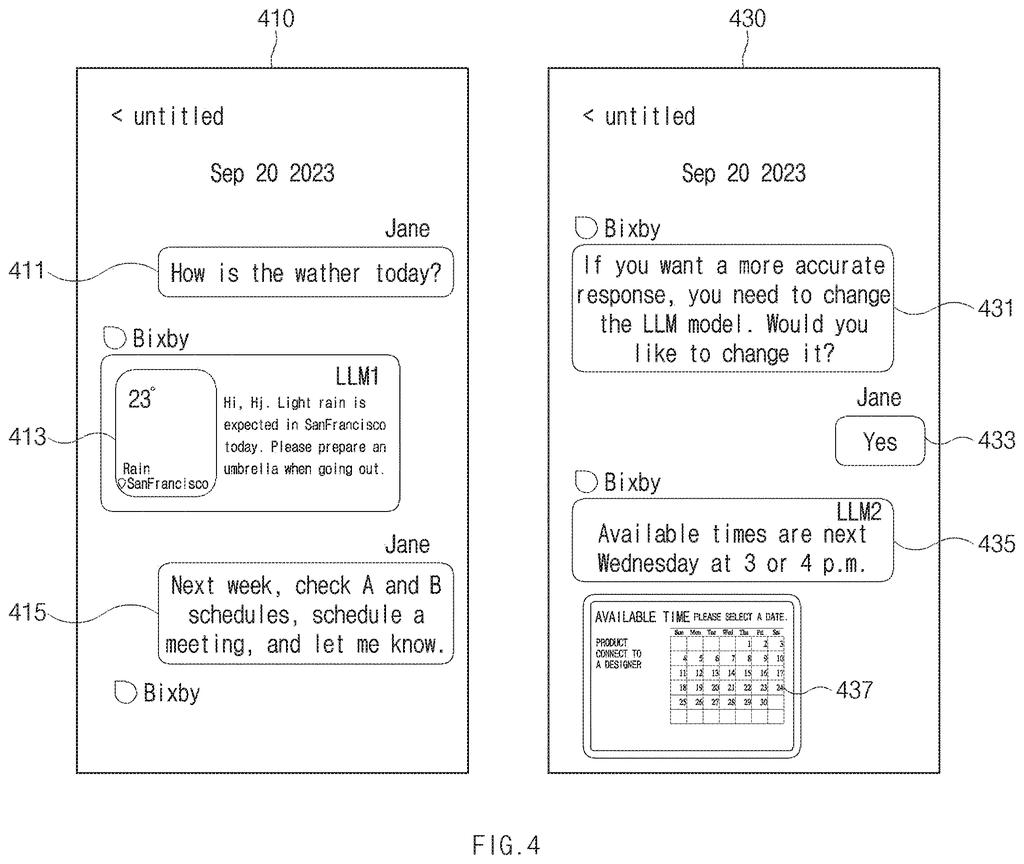
If the conversation grows halfway through, the system can switch to a bigger model and hand it a short recap so it doesn't start from scratch. In the filing's screen examples, it asks you before it makes the switch.
… identify at least one intent included in the at least one user utterance and a number of intents included in the at least one user utterance …
Translation: The system figures out what the user wants and how many tasks are in the request.
How the request count picks small, medium or large
The system first counts how many separate things you asked for. The filing calls each one an intent (a single goal, like checking the weather or setting a reminder). That count becomes a processing level, basically a difficulty score.
The score picks the model. In the filing's example, fewer than 2 intents goes to a small model (about 1B, meaning roughly a billion adjustable settings inside the AI), 2 or 3 goes to a medium one (13B), and 4 or more goes to a large one (70B). A trained predictor can instead guess the number of steps a job needs, with its own cutoffs of 3 and 5.
Other inputs can nudge the choice:
- Your device's context, such as your schedule or available plug-ins
- Input type: text, image or video
- Topic: coding, chat or device control can each route to a matching group of models
- Your settings: a maximum model size, topic experts, and an on/off switch for automatic changes
If a job outgrows its estimate, the system swaps in a second model. The first model's work is boiled down to a short summary (fewer tokens, meaning fewer chunks of text to read) and handed over. Finished jobs are logged to retrain the predictor.
… determine a processing level required to process the at least one user utterance, select a first LLM having performance corresponding to the determined processing level from among the plurality of LLMs …
Translation: It decides how much brainpower is needed and picks the right sized AI model for the job.
Why Samsung's patent could cut AI waste on your phone
For you, the payoff is an assistant that matches effort to the question. A quick weather check would not wake up a giant model, and a tangled request such as a market analysis would not get stuck on a tiny one. The filing says the aims are better accuracy, lower service cost and better efficiency, with no need for you to pick a model by hand.
The filing lists phones, TVs, smart speakers, wearables and home appliances as possible devices, and says the sorting can run on the device or on a server. It is a patent application, so none of this means a feature is on the way.
That makes this Samsung's 14th filing we've tracked since July in our AI models working in teams watch, adding to work like blending AI skills and giving each model an ID.
From a shipping standpoint, this is pure software. It needs no new chip, sensor or gadget, just a voice assistant with access to several AI models of different sizes. The filing's own example logic is a few if-then cutoffs, which is about as simple as product plumbing gets.
What has to exist first is the hard part: a reliable way to count what someone asked for. Miscount, and a big request lands on a tiny model, which is exactly the bad answer the patent aims to prevent. The filing answers that with a trained predictor that learns from past jobs, plus a prompt that asks you before switching mid-task.
The shortest route to a product is a plain version: two or three model sizes, a request counter, and a fallback to the bigger model when a job grows. That sounds buildable with software alone. The idea is modest and sensible, and the fine print will decide whether it wins or loses.
Get our take in your Top Stories
Liked this breakdown? Add Patentlyze as a preferred source on Google, and our plain-English take shows up more often in your Top Stories the next time Samsung patent news breaks.
There are more where this came from
We read every patent application Big Tech publishes and send you the ones worth knowing. Plain English, free, every week.
The drawings
17 drawing sheets from US 2026/0341278 A1 · click any drawing to enlarge


Show the other 9 sheets


Want this weekly breakdown for a company we don't cover? Patentlyze Pro →
Be the first to weigh in