
Samsung Files Patent for Giving Every AI Model on a 5G Phone Its Own ID
Your phone may soon run several AI models, and the mobile network runs its own, so everyone needs a way to tell them apart. Samsung's filing lays out a shared system of ID numbers so no two models ever collide.
What Samsung's AI model ID tags actually do
You're walking across town, and an AI model on your phone is helping the network figure out where you are. Meanwhile the network runs its own AI models, and some jobs are split between your phone and the network. All of them need names, and no two can share one.
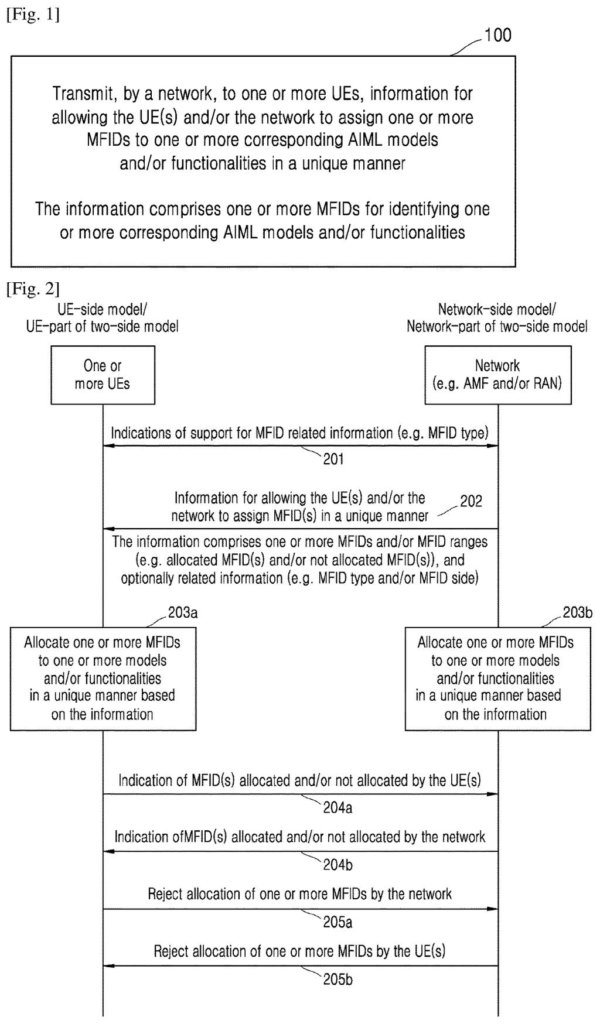
Samsung's filing describes how a 5G network hands out those names, called model and functionality IDs. The network sends your phone a list of ID numbers that are taken and ones that are still free. Your phone picks from the free ones for its own models and reports back, and the network can assign IDs too. Either side can say no to an ID it doesn't like.
The result is that when a model gets switched on, swapped, or retired, both sides know exactly which one is meant.
transmitting, by the network, to one or more user equipment (UEs), information for allowing at least one of the UE or the network to assign one or more MFIDs to at least one of one or more corresponding models or functionalities in a unique manner …
Translation: The network sends instructions so phones and cell towers can give every AI model its own unique ID number.
How the network hands out and tracks IDs
The patent covers how a mobile network keeps AI/ML model IDs (labels for AI models and the jobs they do, which the filing calls MFIDs) from colliding. The network sends phones information that lets either side assign IDs uniquely. That information includes the IDs themselves, often as a list of allocated IDs and a list of not allocated ones.
Based on the claims, the process can include:
- The AMF (Access and Mobility Management Function, a core network part that keeps track of connected devices) doing some or all of the assigning.
- The phone choosing from the free IDs, then telling the network which ones it used.
- Either side rejecting an ID the other assigned.
- Both sides telling each other which types of IDs they support.
- IDs sent along as a model is delivered or managed through its life cycle, with an optional priority level.
- Requests to release an ID, plus updated lists.
- One base station passing the information to the next during a handover.
The description adds details the claims don't spell out. An ID can be unique worldwide or only inside one area, such as a cell, a tracking area (a cluster of cells), a slice, or a country. Some IDs can be reserved for uses like public safety. If IDs run short and both sides pick the same one at random, one example lets the network win the tie, while other variants give it to the phone.
The present disclosure relates to a 5G communication system or a 6G communication system for supporting higher data rates beyond a 4G communication system such as long term evolution (LTE).
Translation: This patent describes advanced mobile networks designed to handle much faster data speeds than standard 4G.
Why unique AI model IDs matter for 5G and 6G
For you, none of this shows up on a screen. If phones and networks lean on AI to manage connections and location, they need an agreed way to say which model is running, which one to switch to, and which to turn off. Without a shared naming scheme, a phone and a network from different makers could talk past each other, and a model update could land on the wrong target.
The filing is written around open questions the description says were still unsettled in the working groups that shape 5G standards. It is aimed at the rulebook that 5G and 6G gear would follow. Whether any of it ends up in that rulebook is outside what this document can tell us.
Samsung's 89th filing we've tracked since May in our 5G and network push builds on work like 3D location in cell networks and satellite handoff connectivity.
Every ID in this scheme costs messages: lists, confirmations, rejections, releases, and handoffs between towers as you move. The description even says an ID tied to one area gets dropped and replaced when you cross into the next, so a phone could be doing paperwork all day.
The filing also offers many ways to do the job: the network assigns, the phone assigns, or both split it, with IDs that are global, local, temporary, or grouped. A standard usually needs one answer, and this many options leave the hard choice to someone else.
Still, the trade looks worth making, since a mix-up between two AI models would cost more than a few extra messages. As patents go this one is routine plumbing, useful if the industry adopts it and invisible if it doesn't.
Get our take in your Top Stories
Liked this breakdown? Add Patentlyze as a preferred source on Google, and our plain-English take shows up more often in your Top Stories the next time Samsung patent news breaks.
There are more where this came from
We read every patent application Big Tech publishes and send you the ones worth knowing. Plain English, free, every week.
The drawings
3 drawing sheets from US 2026/0322705 A1 · click any drawing to enlarge


Want this weekly breakdown for a company we don't cover? Patentlyze Pro →
Be the first to weigh in