
Samsung Files Patent for a Way to Blend AI Skills for Multi-Part Requests
Ask an AI to summarize a long article in Spanish, and it normally does two jobs back to back. Samsung's patent application describes a way to blend two specialist add-ons into one and do both jobs in a single pass.
What Samsung's blended AI skills actually do
Ever asked your phone to summarize a long English article and then give it to you in Spanish? That is really two jobs: shrinking the text, then translating it. Most AI setups handle them one after the other, which takes extra time and extra computing power.
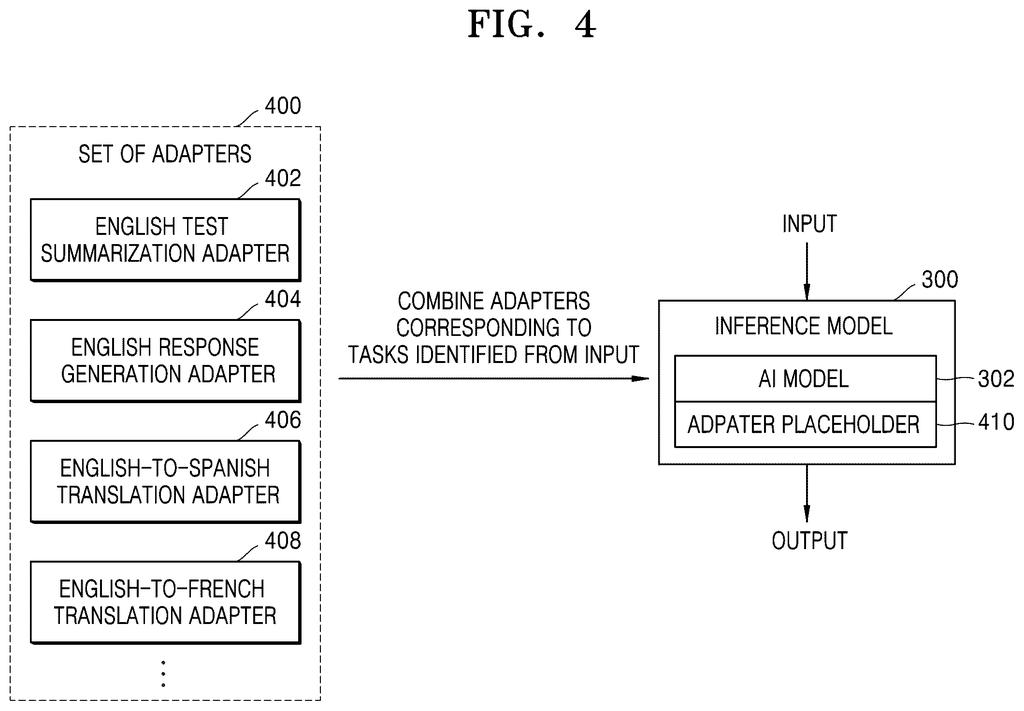
Samsung's patent application describes a shortcut. The device keeps a library of small, specialist add-ons (the filing calls them adapters), each trained for one skill, such as summarizing English text or translating English into Spanish. When your request needs two skills, the device spots that, blends the two add-ons into one, and gives the blend a small tune-up so the mix works well together.
Then it answers your request in one go, without running the AI twice.
… combining a first adapter corresponding to the first task with a second adapter corresponding to the second task to generate a combined adapter; calibrating the combined adapter by using one or more calibration parameters; …
Translation: The system merges two specialized AI modules and tunes them so they can work together.
How Samsung merges and tunes its AI add-ons
The filing starts from a common setup: one large pre-trained base model (a general-purpose language AI) plus small add-ons called adapters. Each adapter is a compact set of extra numbers, trained for a single job, that nudges the big model toward that job without retraining the whole thing.
When a user request arrives, the device works out the goal and breaks it into separate tasks. In the filing's main example, a request for a Spanish summary of English text becomes two tasks: summarize, then translate. The device loads the matching adapter for each task.
The two adapters are then combined, by averaging their numbers. The claims cover equal weighting or different weights for each adapter. That blend is then corrected with calibration parameters (a small set of extra numbers that fix what the plain average gets wrong). The filing describes two forms:
- A single column of numbers added to the blended adapter.
- A pair of small matrices (grids of numbers) added to it.
The calibrated adapter is merged into the base model, and the user's request runs through it once. The filing says the calibration numbers can be trained on a server beforehand. Its example sizes: about 20 to 160 thousand calibration parameters, versus roughly 30 million for a full adapter.
Why this matters for on-phone AI assistants
If your phone or TV runs AI on the device itself, storage and speed are real limits. Samsung's approach tries to cover many combined requests without saving a separate specialist for every pairing, such as summarize-and-translate into Spanish or into French. The filing says the calibration data is small, so the device saves storage space, and one pass instead of two should mean quicker replies.
The filing mentions virtual assistants and smart home control as settings where this kind of AI is useful. It does not name a Samsung product. It describes a general method, so the practical result depends on whether it is built into a future assistant or on-device AI feature.
Samsung's 13th filing we've tracked since July in AI models working together, it builds on giving each model its own ID and a fact-checking voice assistant.
The trade here is easy to see. Samsung saves storage and time by blending two specialists instead of keeping one for every possible pairing. What it gives up is some of the sharpness a dedicated specialist would have, which is why the calibration step exists: it patches the blur that averaging creates.
The weak spot is that the patch still has to be learned, per pairing or shared across pairings. A shared fix is cheaper to store but may fit any one pairing less well. A custom fix per pairing fits better but brings back some of the storage cost the design was trying to avoid.
On balance the trade reads as sensible for phones, where memory is tight and answers need to come fast. It is a practical engineering fix for on-device AI, not a headline feature, and its real test is whether blended answers stay as good as the specialists' answers.
Get our take in your Top Stories
Liked this breakdown? Add Patentlyze as a preferred source on Google, and our plain-English take shows up more often in your Top Stories the next time Samsung patent news breaks.
There are more where this came from
We read every patent application Big Tech publishes and send you the ones worth knowing. Plain English, free, every week.
The drawings
13 drawing sheets from US 2026/0320435 A1 · click any drawing to enlarge


Show the other 5 sheets


Want this weekly breakdown for a company we don't cover? Patentlyze Pro →
Be the first to weigh in