
Google Files Patent to Fix Blurry, Grainy Photos by Training AI on Fake Flaws
Google's filing trains one compact photo-fixing model by having several specialist models teach it, each an expert in a different flaw like hand-shake blur, grain, or compression damage.
What Google's photo-sharpening patent does
A photographer snaps a picture of a moving toddler. The result is a little smeared, a little grainy, and has the blocky look that comes from being saved and shared a dozen times. Everyone has taken that shot.
Google's patent describes a way to build an AI that cleans those flaws up. Because it's hard to find real photos that come in both blurry and perfectly sharp versions, Google makes the blurry versions itself. It takes sharp photos and adds fake hand-shake blur, lens blur, noise, compression damage and blown-out bright spots.
Several AI models then each learn from one flavor of damage. Finally, a smaller model learns from all of them using real photos, so it can run on your phone instead of a big server.
… each training dataset comprises a plurality of pairs of sharp images and corresponding synthetically degraded versions of the sharp images …
Translation: The system learns by comparing clear photos with artificially ruined versions of them.
How a team of teacher models trains one student
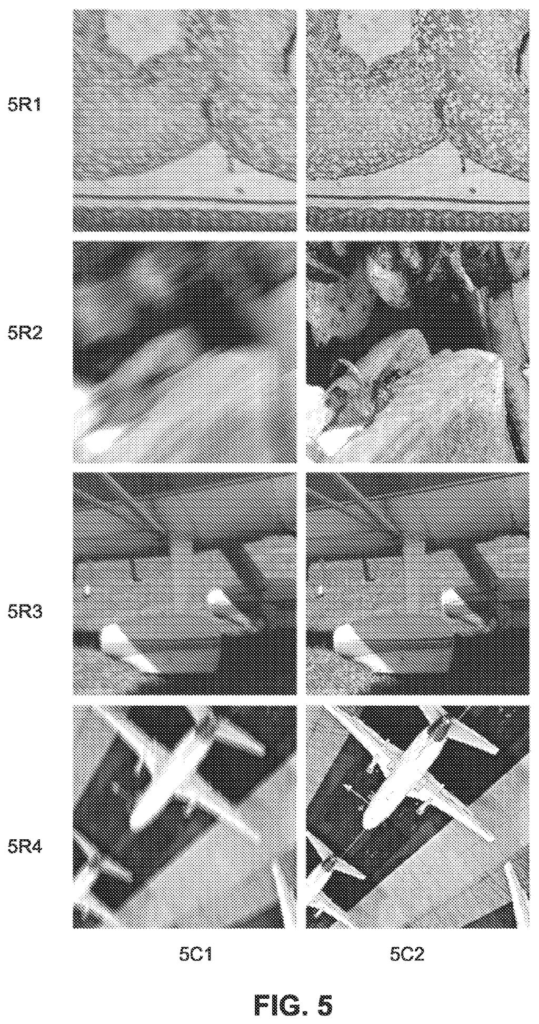
The filing covers a training recipe and the finished photo-fixing model that comes out of it. The first step is to build synthetic training pairs: a sharp photo plus a copy that has been deliberately damaged. The damage types named are motion blur, lens blur, several kinds of noise (grain), compression artifacts (the blocky look of a heavily saved JPEG), and distortion around saturated pixels (spots too bright for the sensor).
The description explains how some of these are faked. Motion blur is made by simulating a shaky hand with a random path, scaled to mimic different exposure times. Lens blur uses a flexible blur shape. Bright pixels are scaled up by a random amount before blurring so the fake looks more realistic.
Next, several intermediate models (the teachers) are each trained on one of these synthetic datasets. Then a final image transformation model (the student) is trained on real photos while learning from the teachers, a method called knowledge distillation (a big, careful model passing its skills to a smaller, faster one).
The filing also describes running every teacher on about 500 real blurry photos, picking the best result for each (by a quality score or by hand), and fine-tuning the student on those pairs. The student can then be trimmed to run in low-precision math for phones.
… training of a plurality of intermediate machine learning models to remove the image degradations …
Translation: The AI uses helper models that each specialize in fixing a specific type of photo flaw.
Why your blurry phone photos may look better
If this ends up in a phone camera or photo app, you could rescue shots that are too blurry or noisy to share today, including old pictures already in your library. The description says the fix could run live on the phone, happen automatically, or be applied as an adjustment you can undo.
The patent office has approved this application, and once Google pays the final fee it should be issued as a granted patent. For Google, the practical win is a photo cleaner small enough for a phone yet trained on real-world messiness, which is where synthetic-only training usually falls short. The filing doesn't name a product, so treat any specific launch as speculation.
That makes this Google's 74th filing we've tracked since May in the AI photo editing race, joining earlier applications like one on pre-shoot color tuning and one on blocking fake detail fill-ins.
The central trade here is honesty about the data. Fake blur is cheap and unlimited, but real photos are messier than any simulation, and the filing admits that models trained only on fakes can behave differently on real pictures. The fix is to bring in real photos as a second step, which costs extra work.
That second step has its own cost. The "correct" answers for the 500 or so real photos aren't ground truth, since they're the best guess of the teacher models, picked by a scoring system or by a person. If every teacher gets a photo wrong in the same way, the student will inherit that mistake.
Shrinking the student for phones also gives something up: a smaller, low-precision model has less room to be careful than the heavy teachers. Still, learning from many specialists beats one model trying to do everything. The trade is worth it for everyday snapshots, and a bigger risk for photos where faces or fine detail matter.
Get our take in your Top Stories
Liked this breakdown? Add Patentlyze as a preferred source on Google, and our plain-English take shows up more often in your Top Stories the next time Google patent news breaks.
There are more where this came from
We read every patent application Big Tech publishes and send you the ones worth knowing. Plain English, free, every week.
The drawings
20 drawing sheets from US 2026/0340776 A1 · click any drawing to enlarge


Show the other 12 sheets


Want this weekly breakdown for a company we don't cover? Patentlyze Pro →
Be the first to weigh in