
Samsung Files Patent to Turn Sounds Into Matching Vibrations on Your Phone or Watch
A Samsung patent application describes a phone or watch that listens to its own audio and builds a matching vibration on the spot. It can even pick which sound gets the buzz when two play at once.
What Samsung's sound-to-vibration patent does
You're listening to a podcast on your watch when a text arrives and a voice reads it out. Your wrist buzzes right as the voice speaks, in step with the words. Nobody recorded that buzz ahead of time. The watch made it from the sound itself.
That's what Samsung describes in this patent application. The device looks at an audio clip and decides whether it needs a matching vibration. If it does, it builds one on the spot and plays it alongside the sound, lined up using small timing markers.
The reason is practical. Older setups needed an extra connection inside the phone to carry sound over to the vibration motor. Samsung says this approach gets a good-feeling buzz without adding that hardware, so the device stays slim and cheaper to build.
… identify whether to generate haptic data based on the audio data, generate the haptic data based on the audio data in response to the identification, synchronize the audio data and the generated haptic data based on one or more markers included in at least one of the audio data and the generated haptic data …
Translation: The device figures out when to make vibrations from sounds and lines them up with the audio using markers.
How the device picks which sound gets a buzz
The claims cover a device with a speaker (or earpiece) and a vibration motor. When audio arrives, along with a signal to start playing it, the processor first decides whether to make a vibration for it. That choice can depend on a user setting, the app that's running, or the audio itself.
If the answer is yes, it builds haptic data (a digital recipe telling the motor how to vibrate) from the audio. The filing describes a few ways to do that:
- Reading the sound's frequency (pitch), amplitude (loudness), duration and waveform (its shape).
- Changing, sampling or filtering the audio signal itself.
- Stitching together stock vibration patterns from a stored library.
The core claim then lines the sound and vibration up using markers, small timing tags in either stream, so they land together. If the audio file already carries its own vibration track (called integrated audio data, where chunks of sound and buzz alternate in time), the device skips generating and plays what's there.
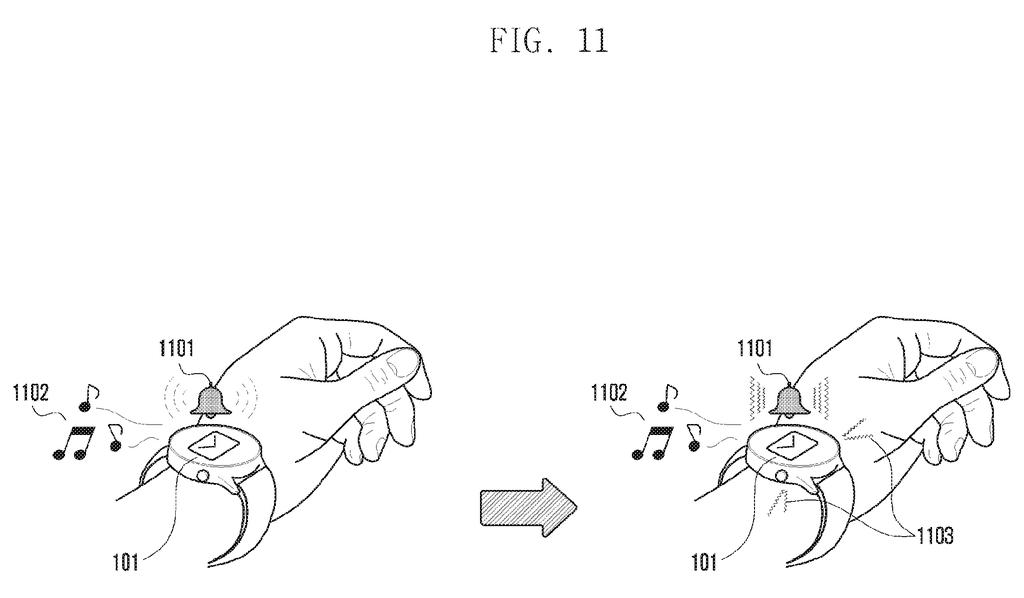
A later step post-processes the vibration, tuning it to the audio. The description says touch is less sensitive than hearing, so the tuned buzz exaggerates the gap between loud and quiet, even leaving silent stretches. It can also buzz for only one of two sounds, such as a message voice alert played over music.
… reproduce the audio data based on a signal related to the audio data reproduction through the sound output module; control the haptic module; and output the tactile signal based on the generated haptic data.
Translation: It plays the sound through the speaker while simultaneously controlling the motor to create matching vibrations.
Why Samsung wants buzz without extra parts
For you, this is about the small buzzes that go with sound: a voice reading your texts, a ringtone, an alert on your wrist. A vibration that follows what you're hearing can make those moments easier to notice and feel more natural than a generic pulse.
For Samsung, the selling point in the filing is cost and space. Carrying sound straight to the vibration motor used to call for an extra hardware connection, which takes room and money. Doing the work in software means the same idea can run on phones, tablets and watches, and the figures show both a smart watch and a smartphone.
That makes this Samsung's 284th filing in our cell phone coverage we've tracked since May, following work on a twice-folding phone and keeping multi-camera images intact.
Few patents sit this close to a shelf. A speaker and a vibration motor already exist in most phones and watches, and the filing's whole pitch is that nothing new has to be added.
The route to a product runs through software. Samsung's description spreads the work across the layers of the operating system, from the app playing the sound down to the driver that runs the motor, so a system update could carry it. What has to exist first is tuning: someone must decide how each motor should feel for speech, music or alerts, and apps need to opt in.
The weak spot is taste. Buzzing along with every song would wear thin fast, which is why the choice of whether to generate a vibration, and for which sound, matters as much as the generation itself.
Get our take in your Top Stories
Liked this breakdown? Add Patentlyze as a preferred source on Google, and our plain-English take shows up more often in your Top Stories the next time Samsung patent news breaks.
There are more where this came from
We read every patent application Big Tech publishes and send you the ones worth knowing. Plain English, free, every week.
The drawings
13 drawing sheets from US 2026/0341130 A1 · click any drawing to enlarge


Show the other 5 sheets


Want this weekly breakdown for a company we don't cover? Patentlyze Pro →
Be the first to weigh in