
Qualcomm Files Patent to Let Cars Pinpoint Each Other Using Painted Lane Lines
On a bare highway, a car's camera has almost nothing to latch onto, but the painted lane lines are always there. Qualcomm's patent application turns those lines into a shared reference so two cars can work out where they sit relative to each other.
What Qualcomm's lane-line patent does for cars
You're cruising down a long, empty stretch of highway. No signs, no buildings, just asphalt and painted lines. The car ahead and your own car both have cameras, and each one needs to know exactly where the other is and which way it's pointing.
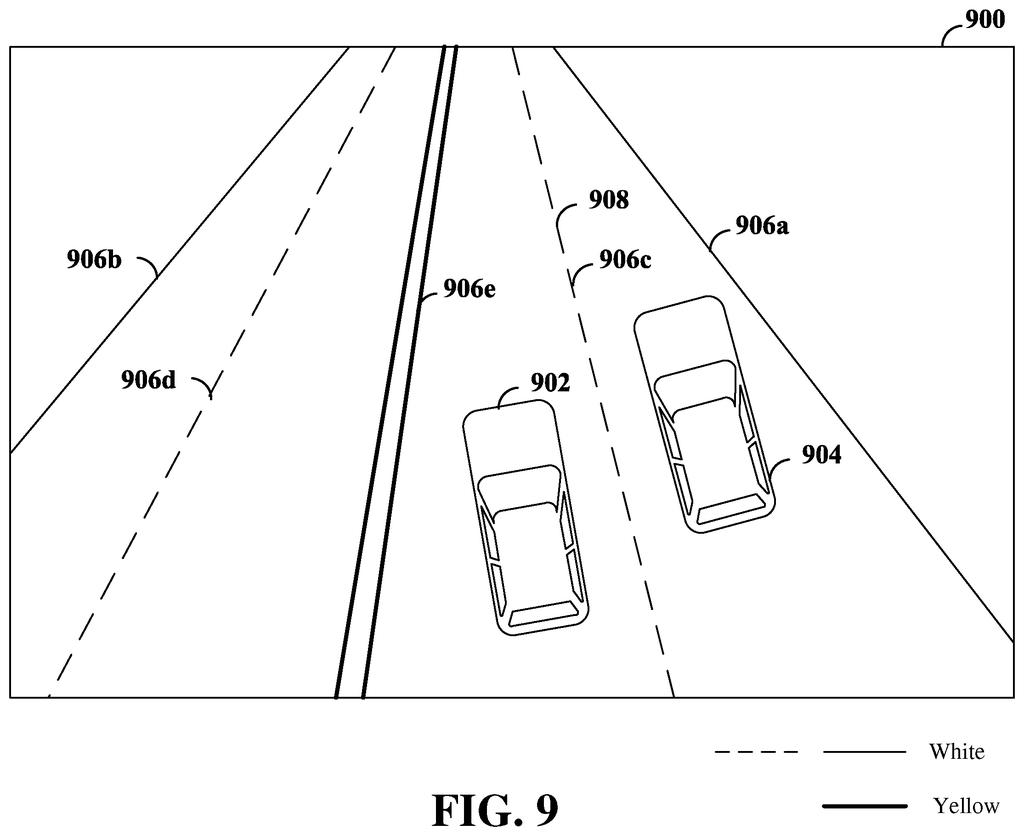
That's hard when there's almost nothing interesting to look at. In Qualcomm's patent application, the car ahead sends your car a short message: a handful of distinctive spots from its camera image, a description of two lane lines (their color and type), and a number describing how those spots sit relative to the lines. Your car finds the same spots in its own view and checks whether the number still adds up. Spots that pass are probably true matches, and your car uses them to work out the other car's position and angle.
The payoff is less data over the air. The filing says matching images normally needs between 8,000 and 15,000 shared points.
receive lane features identifying two traffic lane markers from a second wireless communication device via the transceiver …
Translation: Car one gets data about painted road lines from another vehicle wirelessly.
How two cars check each other's lane-line math
Two vehicles each carry a camera and a wireless link. The sending car shares keypoints (distinctive spots in a camera image, such as the corner of a painted lane dash), lane features (the color, type, and viewing order of two lane markers), and a 2L2P metric for pairs of keypoints.
The 2L2P (two-line, two-point) metric is a ratio built from how far two points sit from two lines. Its value stays the same when the scene is seen from a different camera angle, so both cars should compute roughly the same number for the same two spots.
The receiving car then:
- Finds keypoints in its own camera image.
- Pairs them with the sender's keypoints.
- Recomputes the metric for each pair and keeps only pairs close to the original (the filing's example: an original value of 0.5, accepted within 0.05).
- Uses the survivors to calculate the other car's relative position and angle.
If too few pairs survive (the filing gives five as an example), the receiving car asks for more metrics and names a point that already matched. The sender replies using that point plus a third lane marker, without resending image descriptions. The loop repeats until enough points match. The filing says corners of broken lane dashes make good keypoints because they stand out in images.
… calculate a relative pose of the first wireless communication device with respect to the second wireless communication device based on the matching features …
Translation: The system figures out how two cars are positioned relative to each other by comparing their views.
Why Qualcomm's lane-line trick could cut car chatter
Cars that can pin down where a neighbor is, and how it's angled, can react sooner to lane changes and avoid collisions. The filing says driver-assistance systems that lack precise relative position tend to assume other cars are going straight in their lanes, which slows the reaction.
The practical gain is lighter traffic on the car-to-car radio link. Sending thousands of image points is heavy, and the filing says it could limit adding visual data to routine safety messages. It also targets bland roads where a camera finds few features, which is exactly where plain image matching struggles. For you, that would mean the safety features in a connected car could keep working on a quiet highway.
This is the 49th Qualcomm filing we've tracked in our self-driving sensing race watchlist since July, adding to work like one on corner car warnings and one on pedestrian phone alerts.
Cars that talk to each other need to agree on who is where, down to a small angle, and they need to do it fast. On an empty highway the camera sees little to latch onto, and the filing's own numbers show the alternative is heavy: 8,000 to 15,000 shared image points. That is a real cost on a radio link that also has to carry safety alerts.
The fix fits the size of the problem. Lane paint is on nearly every road where this matters, and the system asks it to confirm a few spots instead of rebuilding the whole scene.
The open question is how often the paint is there to use. Faded lines, snow, or a dirt road remove the one thing the method relies on, and the filing shares no accuracy results. Still, a targeted fix for a clearly costly problem is sensible engineering.
Get our take in your Top Stories
Liked this breakdown? Add Patentlyze as a preferred source on Google, and our plain-English take shows up more often in your Top Stories the next time Qualcomm patent news breaks.
There are more where this came from
We read every patent application Big Tech publishes and send you the ones worth knowing. Plain English, free, every week.
The drawings
15 drawing sheets from US 2026/0340866 A1 · click any drawing to enlarge


Show the other 7 sheets


Want this weekly breakdown for a company we don't cover? Patentlyze Pro →
Be the first to weigh in