
Qualcomm Files Patent to Shrink Photo-Editing AI Enough to Run on Your Phone
Qualcomm's filing teaches a small photo-editing AI by having it copy a big one at every internal step, with a deliberately flawed 'fake teacher' thrown in for contrast. The goal is adding objects to your pictures on the phone itself.
What Qualcomm's student-teacher photo AI does
Imagine you want to add a sailboat to an empty patch of ocean in a vacation photo, and your phone does it on the spot, without sending the picture to a company's server. Right now, the AI behind this kind of photo inpainting (filling in or adding to part of an image) is usually too big for a phone.
Qualcomm's filing describes a way to teach a small AI to copy a big one. The big model acts as the teacher. The small student is graded not just on its final picture but on what happens at every step inside it. The student is also built lighter, with some of its processing layers cut out.
There's an odd twist. A deliberately flawed fake teacher, trained on synthetic images, helps show the student what to avoid. The filing says the training can even run on the device itself.
… determine, based on a comparison of the first plurality of outputs to a second plurality of outputs associated with a second machine learning system, a layer-by-layer loss associated with the first machine learning system; and adjust parameters of one or more layers of the first machine learning system based on the layer-by-layer loss.
Translation: It compares the outputs of both AI models step by step to fine-tune the smaller version.
How the student is graded at every layer
The claims cover training one AI (the "student") by comparing what each of its layers (stages of processing) produces against matching outputs from a second AI (the "teacher"). The gap is called a layer-by-layer loss (a score of how far off the student is at each stage), and the student's settings are adjusted to shrink it. This general approach is called distillation.
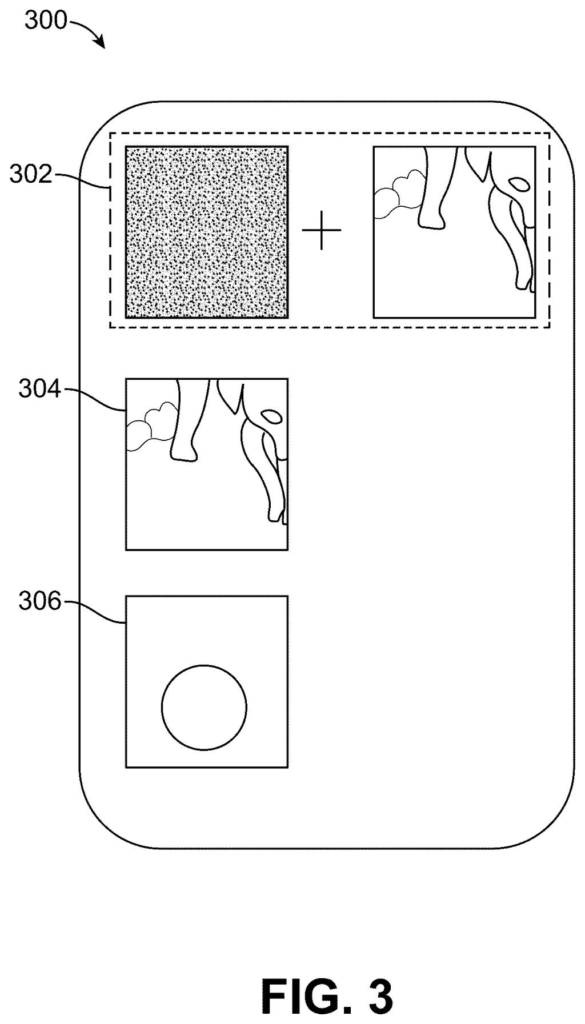
The description applies it to inpainting with diffusion models (AI that builds an image by removing noise step by step), using a design called a U-Net. Training data is a noisy image plus a mask, a grid of 1s and 0s marking which pixels to edit, such as where to add an object. The student is a trimmed version of the teacher with fewer self-attention and cross-attention layers (the parts that weigh which regions of the image or words of a prompt matter) in its upsampling half.
Further claims add two refinement phases:
- Phase one: the student's cleaned-up image is compared against the teacher's and a "fake teacher's" (a model trained on synthetic images), producing a distribution loss.
- Phase two: the fake teacher and an adversarial network (a judge that tries to tell real outputs from fake ones) are trained, so the student's pictures become hard to tell from the teacher's.
The judge is dropped when the finished student is actually used, and one claim covers training on the device itself.
Why on-phone photo edits could stay private
If you've ever waited for a photo to upload so an app could remove a stranger or add an object, this is the problem being attacked. The filing says phones often lack the computing power for these edits, so the work gets sent to servers. Some people avoid that because they don't want personal photos shared or used to train someone else's AI.
The filing's example hardware is a phone-class chip with a built-in AI processor, plus tablets, laptops, headsets and cars. A smaller model that stays close to the big one's quality would let those devices handle edits locally. The filing also describes training on the device, which would let a model adjust after it ships. It gives no speed or quality figures, so the size of the gain is unknown.
This is the 16th Qualcomm filing we've tracked since July in our AI photo editing race watchlist, building on filings like erasing objects from photos and cutting grain with a shrunk copy.
If this works, you would notice it in two places: object adding and removing in your photo app would happen on your phone, and your pictures would stay with you. Many of these tools send your photo to a server today, and the filing itself names privacy as a reason some people skip them.
The catch is that a smaller AI usually makes worse pictures, and the filing offers no numbers on how close the student gets to the teacher. The whole promise lives in that gap. You would never see the training method directly. You would see an edit button that works without a signal and without a wait, or you would not.
Shrinking a big model to fit a small device is a well-known idea, and these claims are broad. The fake-teacher detail is the one unusual touch, and it only matters if it makes the phone version look noticeably better.
Get our take in your Top Stories
Liked this breakdown? Add Patentlyze as a preferred source on Google, and our plain-English take shows up more often in your Top Stories the next time Qualcomm patent news breaks.
There are more where this came from
We read every patent application Big Tech publishes and send you the ones worth knowing. Plain English, free, every week.
The drawings
9 drawing sheets from US 2026/0340778 A1 · click any drawing to enlarge


Show the other 1 sheets

Want this weekly breakdown for a company we don't cover? Patentlyze Pro →
Be the first to weigh in