
Qualcomm Files Patent for Training AI to Erase Objects From Photos Cleanly
Erasing a stranger from your photo is easy to ask for and hard to do well. Qualcomm's new patent covers how to train an AI for the job by showing it the same scene with and without the object, then grading its work.
What Qualcomm's photo-eraser training does
You're looking at a great vacation photo, except a stranger is standing right in the middle of it. You type "remove the man from the image," and you want the spot behind him to look like nobody was ever there.
Qualcomm's patent application is about how to train an AI to make that edit well. The recipe uses pairs of photos of the same scene: one with the object and one without. The AI gets the first photo, a mask (an outline marking exactly which pixels to erase), and your typed request, then tries to produce the clean version. Its attempt is compared with the real clean photo, and the AI is adjusted to do better next time.
The filing says the goal is to make this practical on devices like phones, which often lack the power for heavy AI editing, and to avoid sending private photos off to a server.
… process, using a first machine learning system, the first embedding, the second embedding, a user prompt, and a mask associated with a pixel location of the object represented in the first image representation, to generate a third image representation of the scene not including the object …
Translation: The AI combines image features, user instructions, and object location data to recreate the photo without the unwanted item.
How before-and-after photos train the eraser
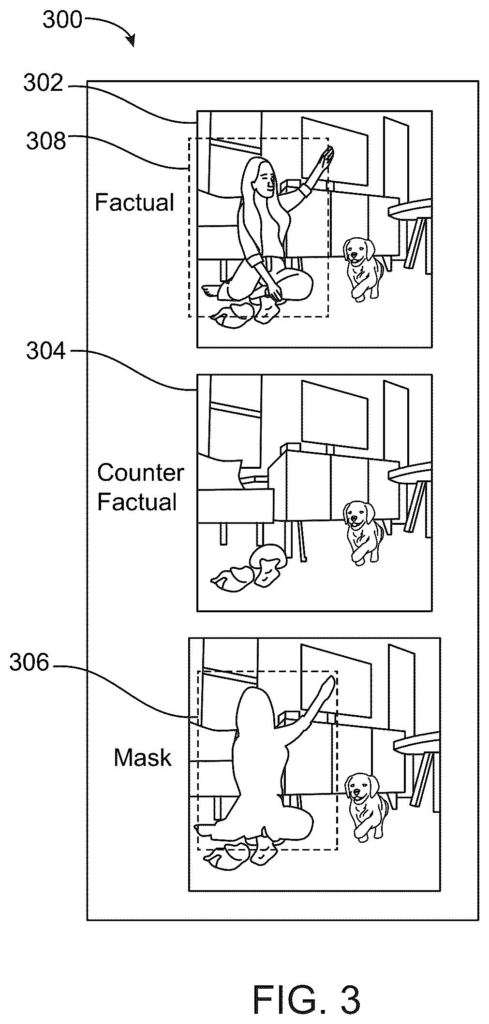
Claim 1 covers a way of training an object-removal AI. The training data comes in pairs: a photo of a scene with an object in it, and the same scene with the object gone. The filing calls these factual and counterfactual images.
- An encoder (a program that squeezes an image into a compact numeric summary, called an embedding) processes both photos.
- The main model, a diffusion model (a type of AI that builds images by cleaning up random noise step by step), receives both summaries, the user's text request, and a mask marking the object's pixels. Random noise is added to the summaries along the way.
- It generates its best guess at the scene without the object. That guess is compared with the real object-free photo to produce a diffusion loss (a score of how far off it was).
- The model's internal settings are adjusted to shrink that score.
The filing also describes a second AI that finds the object and draws the mask automatically, and a U-Net design (a common image-model layout) for the main model. Most training requests do not ask for removal at all; in one example about 60% are empty prompts, which the filing says helps prevent overfitting (memorizing training examples).
An extra training step removes an object, asks the model to add it back, and checks the result against the original. Claim 10 covers using the trained model on a new photo, and claim 9 mentions training on the device itself.
… determine, based on a comparison of the second image representation and the third image representation, a diffusion loss; and adjust parameters of the first machine learning system based on the diffusion loss.
Translation: The system checks its work against the original clean photo and corrects itself to improve future object removals.
Why Qualcomm's eraser training matters for phones
If you edit photos on your phone, the practical hope here is cleaner erasing: a background that fills in believably instead of leaving a smudge. The filing's stated motivation is that heavy AI editing is hard to run on phones and laptops, so many apps send your pictures to a server. Some people avoid that because of privacy worries about faces and other personal details.
The filing describes a system-on-a-chip (the main processor package in a phone) as one place this could run. The training method is the real subject, though. Whether it ends up in any product is not something the filing says, and a patent application does not promise a feature.
That makes this Qualcomm's 15th filing we've tracked since July in the AI photo editing race, joining earlier applications like one to fix grainy photos and one to shift camera angles.
Claim 1 locks down a specific sequence: encode two photos of the same scene (one with the unwanted object, one without), combine them with a typed request and a marked region, generate a cleaned-up result, then score that result against the clean photo and adjust. Every one of those steps must be present simultaneously for the claim to apply.
That specificity makes the claim narrow. Object removal in general sits outside its fence. What the claim actually protects is this precise training loop, where paired photos, a typed request, a marked region, and a grading step all work together at once.
One detail embedded in the claim structure signals real engineering care: most of the typed requests the system trains on do not ask for removal at all. The filing explains this prevents the model from simply memorizing its examples, a small but concrete safeguard against a well-known failure mode baked directly into what the claim covers.
Get our take in your Top Stories
Liked this breakdown? Add Patentlyze as a preferred source on Google, and our plain-English take shows up more often in your Top Stories the next time Qualcomm patent news breaks.
There are more where this came from
We read every patent application Big Tech publishes and send you the ones worth knowing. Plain English, free, every week.
The drawings
9 drawing sheets from US 2026/0341007 A1 · click any drawing to enlarge


Show the other 1 sheets

Want this weekly breakdown for a company we don't cover? Patentlyze Pro →
Be the first to weigh in