
Apple Files Patent for Entering a Passcode by Looking at Your Fingertips
Your own hand could become a five-key keypad. In this Apple filing, smart glasses with no screen watch which fingertip you look at and treat each glance as a number.
What Apple's fingertip-code patent actually does
Glasses with no screen have nothing to tap, so entering a passcode or answering a question usually means saying it out loud, where everyone nearby can hear. Apple's filing describes a way to do it in silence, using your own hand as the keypad.
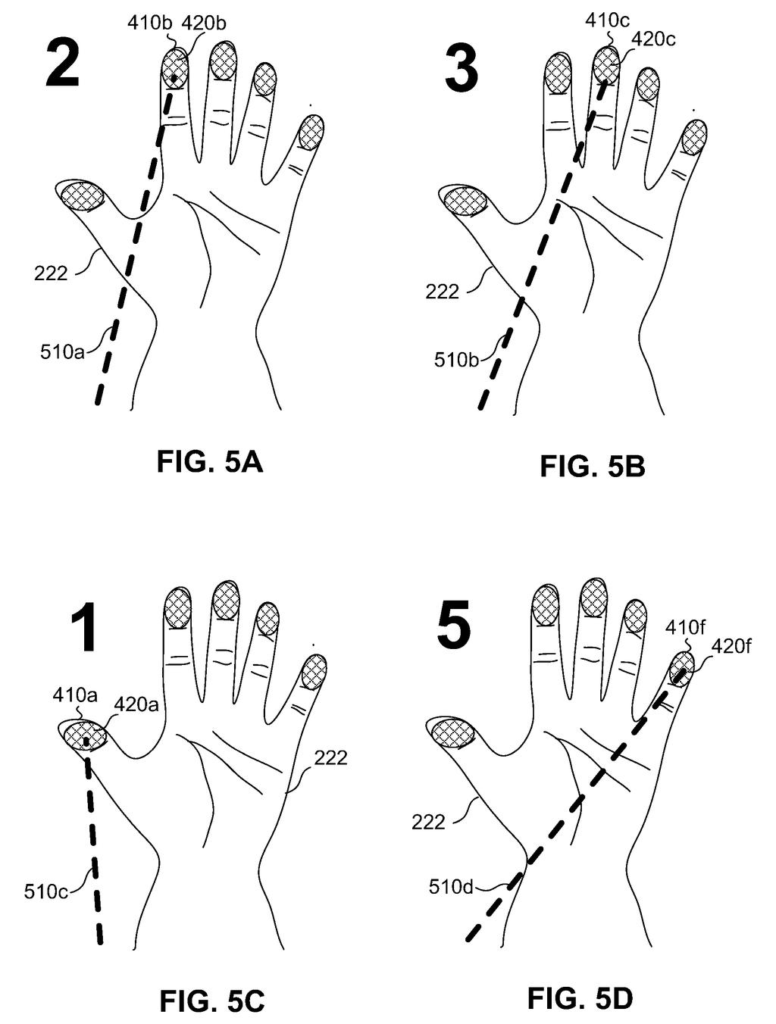
Each fingertip on one hand gets a number, say 1 through 5. You hold your palm up facing you and look at the fingertips in order. Look at 2, then 3, then 1, then 5, and the glasses read it as the code 2315. Cameras on the glasses track both your fingers and your eyes to work out which fingertip you are looking at.
If staring at your hand feels awkward, you could touch the fingertips with your other hand instead. Either way, a sound, a buzz or a small light confirms each entry. Someone watching would see you looking at your hand and would have a hard time telling which finger means which number.
detecting three-dimensional (3D) positions of each body part of a set of multiple body parts of a user, the 3D positions determined based on data from a first sensor of the HMD, each body part of the set of multiple body parts associated with a different value …
Translation: The headset uses sensors to track the physical locations of your fingers or other body parts.
How glasses match your gaze to each fingertip
The method in the claims has four steps. An outward-facing camera on the headset finds the 3D position of each fingertip (or another body part), and each one is tied to a different value, such as a number. An inward-facing camera tracks the direction your eyes are pointing. The device then checks which fingertip your gaze lands on and generates an input for that fingertip's value.
The filing describes building a hand skeleton (a simplified stick-figure model of your hand) about 30 times a second from camera and depth data. Around each fingertip the device defines a small target zone sized to your finger, and a look counts as input when your gaze line crosses a zone. Holding your palm out flat in front of you switches the mode on.
The filing also describes these details:
- Feedback: a sound, buzz or LED blink confirms each value. A sound can grow louder the longer you stare, so you can look away before the input counts.
- Adjustable targets: zones can grow when your fingers are spread apart or change with room lighting, and the device can ask you to spread your fingers.
- Other uses: yes/no answers using two fingertips, multiple-choice options read aloud, and picking a saved value such as your first name on a form.
- Touch option: touching fingertips with your other hand, for accessibility or when eye tracking is unsure.
… detecting that the user has sequentially gazed at (or used the other hand to touch) the fingertips corresponding to the values of a numerical code …
Translation: You can enter a passcode by looking at or touching your fingers in a specific order.
Why screenless glasses need a new way to type
Screenless smart glasses still need a way to take a passcode, confirm something or answer a yes-or-no question without a touchscreen or keyboard. Fingertip entry gives you a silent option, which matters most in public places where saying a code out loud is a bad idea. The touch version could also help people for whom eye tracking works poorly.
The filing does not name a product, and it also applies to headsets that do have displays. What it shows is the idea of using your own body as the interface for gadgets that lean on cameras and eye sensors instead of screens. Whether anything like it ever ships is unknown, since this is a patent application.
This is the 49th Apple filing we've tracked since May in our eye and hand controls watchlist, after applications on separate hand tracking and eye-scan login nudges.
Glasses with no screen still need to know it's you. Saying a passcode out loud on a crowded train is a bad idea, so a silent option that takes a few glances at your own hand would be a welcome fix.
You would notice the catch quickly. With five fingertips acting as five keys, a four-digit code has only 625 possible combinations, compared with 10,000 on a typical phone PIN, so you would want longer codes to match that strength. The filing says a sequence can be any length, which helps.
The feedback design decides whether this feels good to use. A sound that grows louder the longer you stare at a finger lets you look away before a stray glance counts, and the touch option covers the days when eye tracking misreads you.
Get our take in your Top Stories
Liked this breakdown? Add Patentlyze as a preferred source on Google, and our plain-English take shows up more often in your Top Stories the next time Apple patent news breaks.
There are more where this came from
We read every patent application Big Tech publishes and send you the ones worth knowing. Plain English, free, every week.
The drawings
7 drawing sheets from US 2026/0339433 A1 · click any drawing to enlarge


Want this weekly breakdown for a company we don't cover? Patentlyze Pro →
Be the first to weigh in