
Apple Files Patent for Headset Controls That Treat Each Hand Separately
Your headset could treat your left and right hands as two separate controllers, each with its own way of choosing things. Apple's patent application describes pairing a pinch with where you look, for either hand or both, while keeping track of which hand is doing what.
What Apple's two-hand headset input actually does
Right now, a headset has two quite different ways to read what you mean. You can reach out and poke a floating button with your finger, or you can look at a button and pinch your fingers together from across the room. Both are messy in their own way: hands move in arcs instead of straight lines, and eyes jitter from spot to spot.
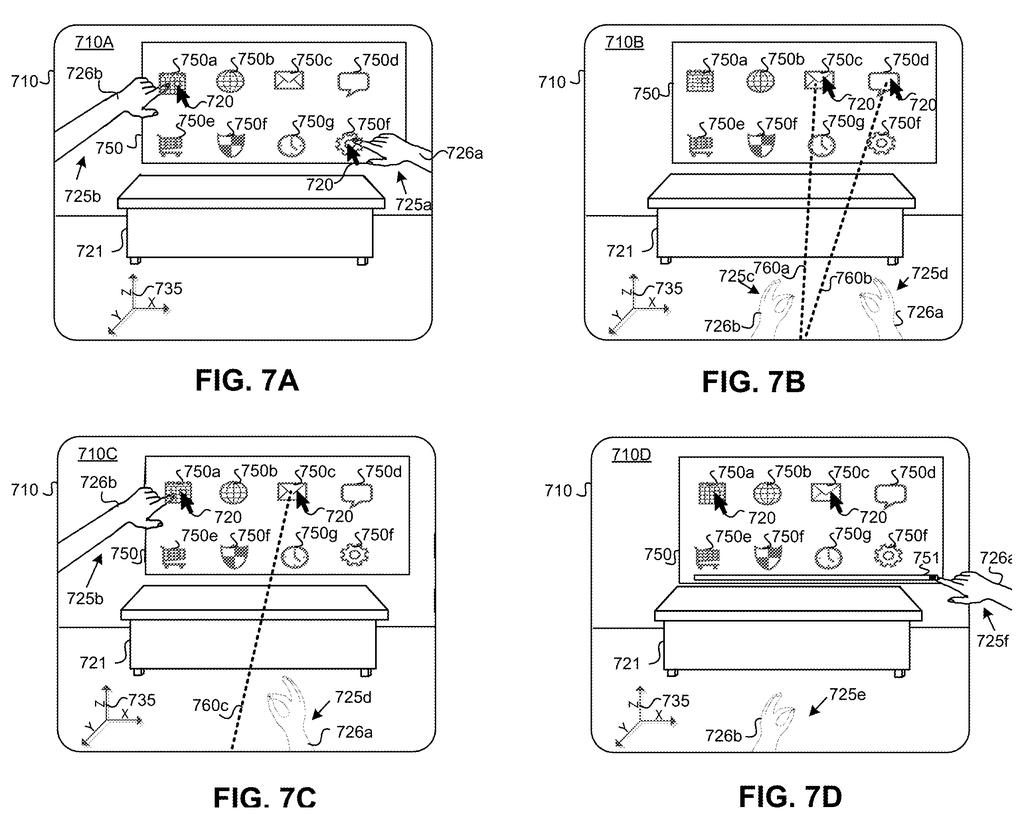
Apple's patent application is about giving each hand its own job. One hand could poke a nearby control while the other pinches at something far away, guided by where you're looking. Or both hands could pinch at two different things during the same stretch of time.
The headset works out which mode each hand is in, based on things like how you move and where you look. It can also show you which hand is doing what, so you aren't left guessing.
… associating a first action of the actions performed by a first hand of the of the two hands with a first instance of an interaction mode based on a hand gesture performed by the first hand in combination with a first user gaze location …
Translation: The system links your first hand movement and where you are looking to a specific virtual interaction.
How the headset tells a tap from a look-and-pinch
The headset collects sensor data about both of your hands in 3D space and identifies what each hand is doing. Before acting, it checks that the movements meet a criterion (a test for whether the motion looks like a deliberate attempt to interact, rather than a fidget).
The claims center on indirect mode for both hands at once. In indirect mode, a hand gesture such as a pinch (fingertips touching) is combined with a gaze location, the spot where the lines of sight from your two eyes meet. The first hand and its gaze target work one virtual object, while the second hand and its own gaze target work a different virtual object, during the same time period.
The description adds other options:
- Direct mode: a finger virtually touches a control, judged by how close it gets or whether it follows an approach, touch and retreat path.
- Mixed mode: one hand works directly while the other works indirectly, such as dragging a scroll bar with one hand while the other pinches and rotates an object.
- Intent prediction: the mode can be chosen from your motion, your context, and where interface elements sit relative to your gaze, possibly using a machine learning model (software trained on examples to make predictions).
- Hand roles and feedback: a left hand could always be direct and a right hand always indirect, with a visual cue showing each hand's mode.
The operating system does this work and hands apps only a simplified event, like a tap at one point, so apps don't see raw gaze data.
… interpret user activity involving both hands based on determining an interaction mode associated with each hand of a user.
Translation: The software figures out what you are doing by tracking both of your hands independently.
What this means for Apple's headset controls
If you've used a headset where you look at a button and pinch, you know it works best with one hand and one target. Handling each hand on its own terms could let you adjust a slider with one hand while you rotate an object with the other, without stopping to switch modes.
For Apple, the payoff is a more natural feel in creative and work apps, plus a privacy angle. The document describes the operating system handling gaze so apps never see where you're looking, only the result of a deliberate selection. It also says apps built for touchscreens could run in a headset with little rework, because the system turns hand and eye input into the taps those apps already understand.
That makes this Apple's 48th filing we've tracked since May on our eye and hand controls watchlist, building on earlier applications like positioning you for eye-scan logins and reading gaze in 3D.
The path from this filing to a working feature is unusually short, because it asks for no new hardware. The sensors it describes, cameras that watch your hands and eyes, already exist in devices like this.
What has to come first is software reliable enough to tell a deliberate gesture from an accidental one, and that is the real engineering bet this document is making.
The open design question is attention: you can only look at one spot at a time, and the filing acknowledges that two gestures land at two different moments, so how the system stitches those moments together will decide whether using both hands feels effortless or awkward.
Get our take in your Top Stories
Liked this breakdown? Add Patentlyze as a preferred source on Google, and our plain-English take shows up more often in your Top Stories the next time Apple patent news breaks.
There are more where this came from
We read every patent application Big Tech publishes and send you the ones worth knowing. Plain English, free, every week.
The drawings
8 drawing sheets from US 2026/0339444 A1 · click any drawing to enlarge


Want this weekly breakdown for a company we don't cover? Patentlyze Pro →
Be the first to weigh in