
Apple Patents a Way to Control Nearby Devices Just by Looking at Them
Apple has filed a patent for a system that figures out which device you want to control by tracking where you're looking, then sends the command to that device automatically, no tapping or naming required.
What Apple's gaze-based device control actually does
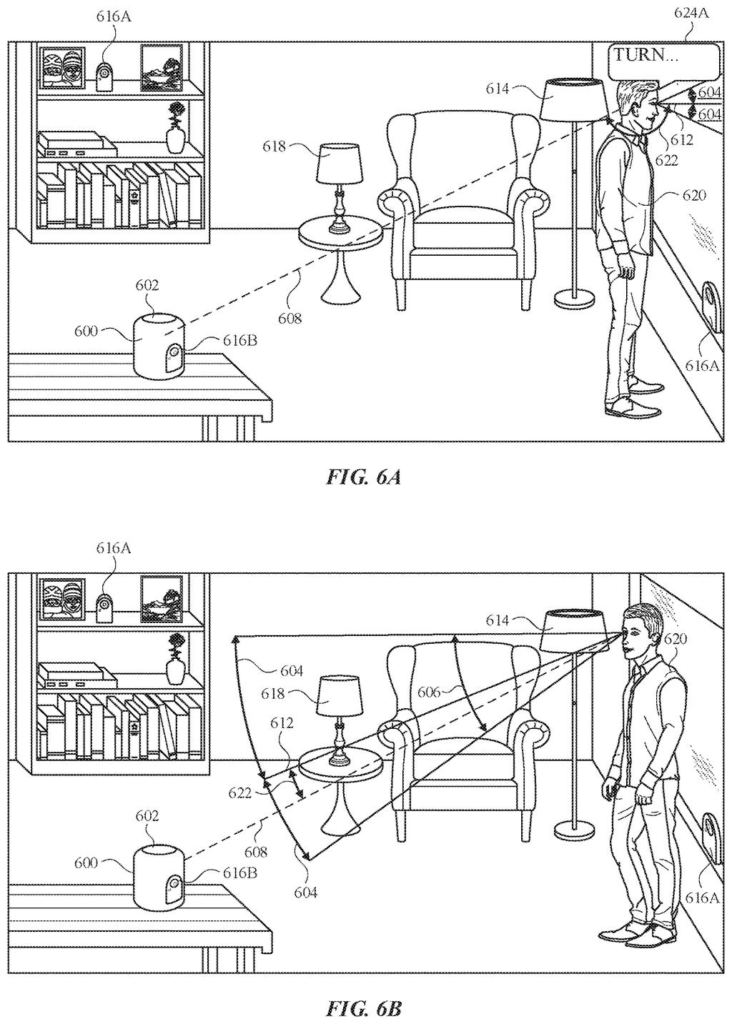
You're standing in your living room and you want to turn off a lamp, but your hands are full of groceries. Right now, you'd have to say "Hey Siri, turn off the floor lamp" and hope it picks the right one. Apple's patent describes a better way: you look at the lamp, say something (or press a button), and the system figures out that that lamp is what you mean.
The idea is that your gaze direction acts like a pointer. The device you're wearing or holding tracks where your eyes are aimed, checks whether you're actually focused on a specific gadget, and then sends the control command to exactly that one. No need to name it, tap it, or walk over to it.
This could matter most in situations where you have multiple similar devices nearby, like several smart lights or two TVs in the same room, and picking the right one with voice or touch alone gets awkward. Your eyes already go to the thing you want; this patent just lets the system follow along.
… in accordance with a determination, based on information from the one or more sensors, that a set of one or more gaze criteria are met for the first external device, transmitting, to a second external device that is different from the first external device, an instruction to transition the first external device from the first state to a second state …
Translation: The system checks where you are looking to decide which device should send a command to change another device's settings.
How the gaze criteria trigger the right device
The patent describes an electronic device (likely a phone, watch, or wearable with a camera or sensor) that monitors gaze information from one or more sensors to determine what the user is looking at.
Here's how the core loop works:
- The device receives some kind of input from the user, such as a button press, a voice command, or a gesture.
- At the same time, it checks whether a set of gaze criteria are met for a specific external device. Think of gaze criteria as pass/fail rules: are your eyes pointed at the target long enough, at the right angle, within a certain distance?
- If the criteria are satisfied, the device sends an instruction to a second external device (not the one in your hand) telling it to change state, for example, switching from off to on.
The claim structure is deliberately layered. The device doing the sensing is separate from the device receiving the command, which is itself separate from the device being controlled. That three-way split matters because it suggests a hub-and-spoke model: your Apple Watch or Vision Pro reads your gaze, communicates through a home hub or over a network, and changes the state of a smart bulb or thermostat.
The patent also mentions providing indications that distinguish between different speakers, hinting at multi-user scenarios where the system needs to know whose gaze (and whose voice) is issuing the command.
In some examples, the electronic device uses gaze information to activate a digital assistant. In some examples, the electronic device uses gaze information to identify an external device on which to act.
Translation: The device can wake up a virtual assistant or select a specific gadget to control simply by tracking your eye movements.
What this means for hands-free smart home control
For anyone who has wrestled with voice assistants in a room full of similar devices, the frustration is real. "Turn off the light" in a space with four smart bulbs is a coin flip. A gaze-based approach turns your natural attention into an unambiguous selection mechanism, which could make hands-free control feel much less like a guessing game and more like pointing with your eyes.
Apple has been building toward this kind of spatial awareness across its devices, and the patent fits neatly into the Vision Pro and AirPods ecosystem where eye-tracking and head-orientation data are already available. The new Big Tech patents in the AR and smart-home space increasingly treat your body's natural signals (where you look, how you tilt your head) as first-class inputs, and this filing is a clear step in that direction.
Accuracy is the concrete win: if Apple ships something like this, the moment you notice it will be the first time you look at a single lamp and it turns off without any ambiguity. That fixes one of the most common smart-home complaints, the system acting on the wrong device. The gaze-criteria model also suggests the team is thinking carefully about false triggers, since simply glancing at a light should not be enough to turn it off; there has to be intent. Whether Apple can make that intent-detection reliable in real lighting conditions, with glasses or a Vision Pro on, is the open engineering question this patent does not answer.
There are more where this came from
We read every patent application Big Tech publishes and send you the ones worth knowing. Plain English, free, every week.
The drawings
31 drawing sheets from US 2026/0236096 A1 · click any drawing to enlarge


Want this weekly breakdown for a company we don't cover? Patentlyze Pro →
Be the first to weigh in