
Microsoft Files Patent for a Touchscreen That Feels Body Heat to Ignore Your Palm
Microsoft's new patent filing gives a touchscreen a sense of temperature, so a palm resting on it or a splash of rain stops counting as a tap.
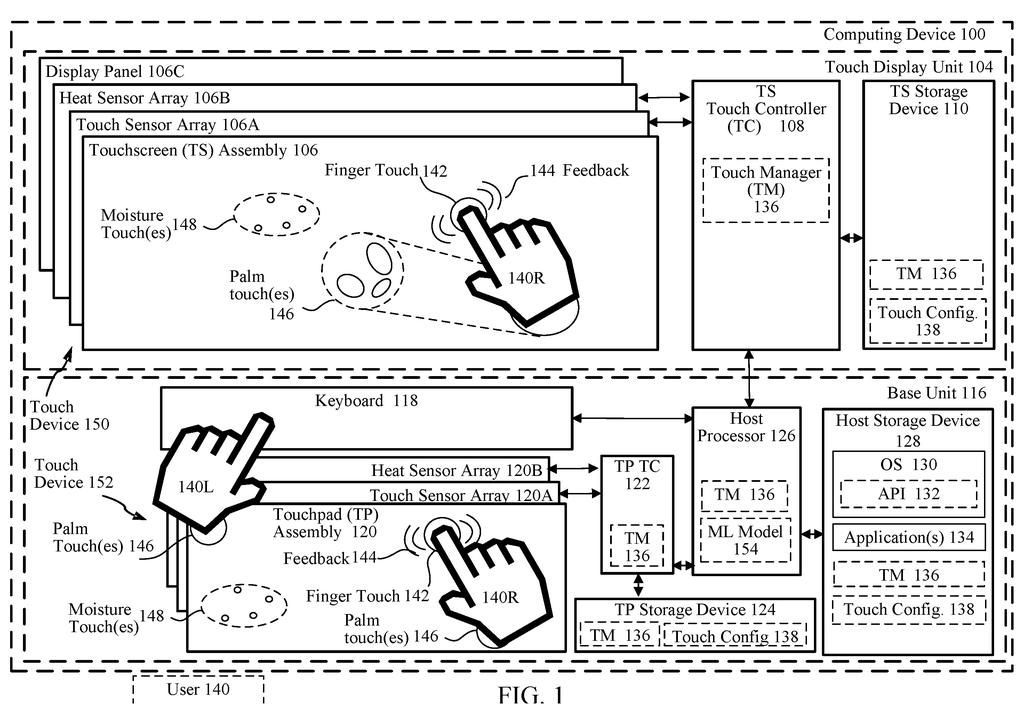
What Microsoft's heat-sensing touchscreen does
A man types on a laptop while the heel of his hand rests on the edge of the touchpad, and the cursor jumps somewhere he never meant. A woman checks her phone in the rain, and the droplets start tapping buttons for her.
That is the mess Microsoft is trying to fix. Screens and touchpads sense touch through electrical charge, and water and the side of your hand can both fool them. A palm can even show up as several small blobs that look just like fingertips.
So this patent adds a grid of tiny heat sensors to the screen. Rain reads colder than your finger, and a palm reads warmer, so the device can ignore both and respond only to the fingertip you meant. It can also adjust to your habits, and you could tune it yourself.
… a classifier configured to filter non-user input from the touch data based on the thermal data to generate classified touch data corresponding to user input.
Translation: The system uses temperature readings to figure out which screen touches are intentional and which are accidental.
How the screen tells fingers from palms and rain
The claims cover three pieces working together: a touch sampler (reads the normal touch sensors), a thermal sampler (reads a grid of heat sensors built into the same screen), and a classifier (software that decides which touches count). The classifier uses the heat readings to filter out non-user input. The same idea is claimed as a device, a method and stored software.
In the description, the heat layer sits between the display panel and the touch layer, and the screen version uses see-through sensors. One example resolution is 100 sensors per square centimeter. The filing sorts touches into temperature bands:
- Moisture reads cooler than a finger, so it gets dropped.
- A palm reads warmer than a finger, so it gets dropped even when it shows up as several small, finger-sized touches.
- Fragments with similar temperatures can be grouped as one source, so scattered blobs are judged together.
The classifier can work in one step, perhaps with a machine learning model (software trained on examples), or in two steps: touch first, heat second. The heat array can stay off until a touch is detected, which saves battery. Temperature ranges can shift with screen and room temperature, and users can customize them for accessibility or gaming. Confirmed touches can get visual or haptic feedback.
Palm touches can be classified as non-user input, even when appearing as fragmented touches resembling finger touches, when thermal data associated with the palm touchpoint(s) exceeds the temperature range profile for finger touches.
Translation: A resting hand can look like multiple fingers, but temperature checks reveal it is just a warm palm.
Why a warmer palm matters for your tablet
If you have ever had a cursor leap across the page because your hand brushed the touchpad, or watched a phone go haywire in the rain, this is the fix on paper. Instead of guessing from the shape of a touch, the device also checks its temperature. The filing points to outdoor use, kitchens, medical settings and industrial sites, places where screens get wet and touch matters.
There is a battery angle too. The heat sensors only wake up after a touch is detected, and fewer false touches mean less processing. The filing also describes settings you could tune for limited hand or finger use, or for gaming, so the screen adapts to how you touch. It names Surface-style 2-in-1 devices, phones and tablets as places the idea could go.
This is the 20th Microsoft filing in our Display coverage we've tracked since May, adding to earlier applications like one on telling a stylus from a finger and one on handling sweat and dirt.
You can't ship this as a software update. The whole idea depends on a grid of heat sensors built into the screen or touchpad, which means a new layer in the hardware and a new part for the factory to order.
The shortest route to a product looks like a laptop touchpad. A touchpad doesn't have to be see-through, so a heat layer is easier to add there than over a display, and a palm resting while you type is a daily annoyance. Screens would need see-through sensor materials, which the filing lists as options.
Once the hardware exists, the software is the easy part: the filing describes sorting touches by temperature, with an option to use a trained model. The open question is cost, since a heat layer has to earn its place in a phone or laptop where every added part is a bill.
Get our take in your Top Stories
Liked this breakdown? Add Patentlyze as a preferred source on Google, and our plain-English take shows up more often in your Top Stories the next time Microsoft patent news breaks.
There are more where this came from
We read every patent application Big Tech publishes and send you the ones worth knowing. Plain English, free, every week.
The drawings
5 drawing sheets from US 2026/0339468 A1 · click any drawing to enlarge


Want this weekly breakdown for a company we don't cover? Patentlyze Pro →
Be the first to weigh in