
Samsung Files Patent for a Ring That Projects a Touchscreen Onto Your Palm
Samsung's patent puts a tiny projector and camera inside a ring, so your own palm becomes the screen. Wear two rings and you can pinch their pictures together into one bigger display.
What Samsung's palm-projecting ring actually does
A woman carries grocery bags up the stairs while the ring on her finger buzzes with a text. Her phone is buried in a pocket, and the ring has no screen to read.
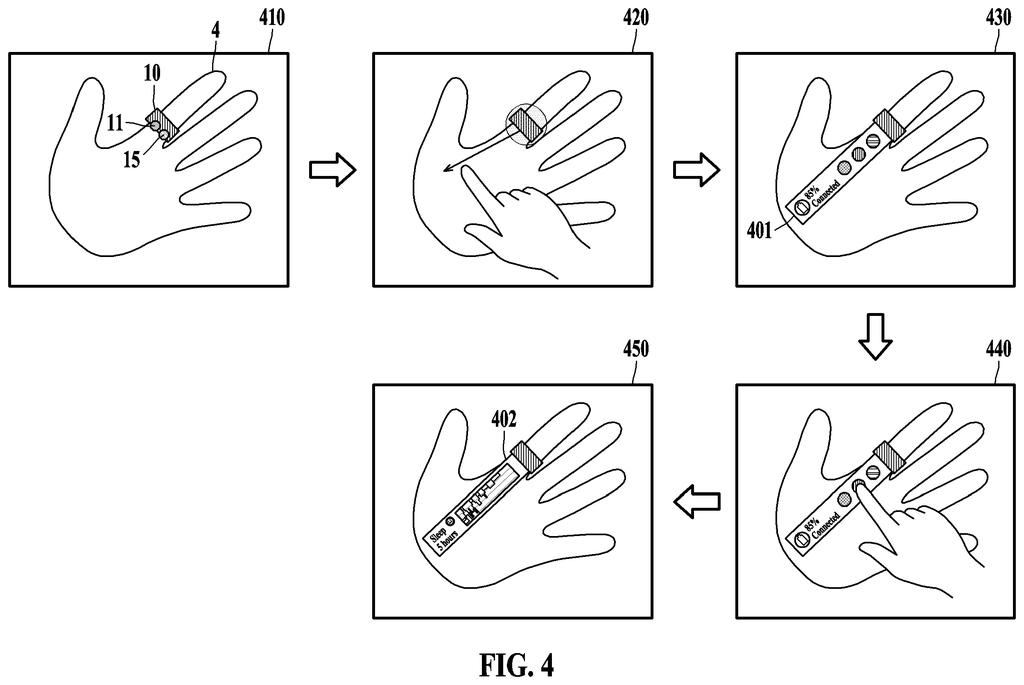
Samsung's patent application describes a ring that fixes that problem by projecting a screen onto your hand. A small camera and projector sit in the ring. Swipe a finger of your free hand along the ring finger on your palm, and a screen shows up there. You can tap it to open things, much like a phone.
The ring also watches your other hand. If the picture lands crooked or too small, you can hold your hand over your palm for a second or two to show where the screen should end, and the ring reshapes it. Wear two rings and you can pinch across both pictures to merge them into one larger screen, with a music app's song title on one part and its controls on the other.
… control the projection circuitry to output a first projection screen on a surface of the user while the first ring electronic device is worn on the finger of the user, wherein the first projection screen has a left side, a right side, a near side, and a far side …
Translation: The ring projects a four-sided screen directly onto the wearer's skin.
How the ring reads your gestures and resizes
The patent describes a ring with a camera, body sensors, a small projector and a processor. The sensors first confirm the ring is on a finger. The filing mentions checking for a heart rate, or for light bouncing back off skin. If you take the ring off, projection stops.
To start, you make a trigger motion. The main example is swiping a finger of your free hand along the finger wearing the ring, away from the ring. The projector then shows a screen on your palm or the back of your hand. It can display a home screen with battery and connection status, an app, or content sent from your phone, and tapping it changes what is shown.
The core of the claims is what happens next. While the screen is up, the camera watches your motions, and the ring can adjust the length of any of the screen's four edges (left, right, near and far), its position, or its rotation angle. Two examples from the filing:
- Hold your free hand or fingers over your palm for about 1 to 2 seconds to mark an alignment line, and the far edge of the screen moves to meet it.
- Press and hold one finger on the screen for about 1 to 3 seconds to enter an adjustment mode, then move or rotate the picture.
The filing also covers two rings on different fingers that combine into a unified screen, and a handoff where the ring stops projecting once a connected phone is picked up.
… based on a motion of the user detected while the first projection screen is output, control the projection circuitry to adjust a length of at least one of a left side, a right side, a near side, and/or a far side of the first projection screen, the position of the first projection screen, and/or the rotation angle of the first projection screen …
Translation: Users can resize, move, or rotate the projected display simply by moving their hand.
What this means for screenless smart rings
Rings today track your sleep, heart rate and activity, and they pass along notifications, but they have no screen. A projected one would let you read a text or skip a song without pulling out your phone or looking at a wrist. That matters most when your hands are busy.
The two-ring setup hints at a design where more rings mean more display space, since the screens merge into one bigger picture. The filing also lists watches and bands as other devices that could do the projecting. For you, the practical question is whether a projector can fit in something you wear all day.
Samsung's 410th filing in the Display patents we've tracked since May follows one shrinking pixels for AR and one for glasses-free 3D screens.
A ring projector trades battery life and brightness for the convenience of leaving your phone in your pocket. Neither figure appears in this filing, so both stay real unknowns, and a picture thrown onto skin in sunlight could easily become unreadable.
The other cost is attention. Your free hand has to be still and visible, which means the screen exists only when you stop whatever that hand was doing.
The self-adjusting picture is what makes the trade look reasonable. Palms curve and shift, and a screen that reshapes itself after a short hand signal keeps quick glances usable without fumbling. For anything longer than a notification, the phone still wins.
Get our take in your Top Stories
Liked this breakdown? Add Patentlyze as a preferred source on Google, and our plain-English take shows up more often in your Top Stories the next time Samsung patent news breaks.
There are more where this came from
We read every patent application Big Tech publishes and send you the ones worth knowing. Plain English, free, every week.
The drawings
19 drawing sheets from US 2026/0331012 A1 · click any drawing to enlarge


Show the other 11 sheets


Want this weekly breakdown for a company we don't cover? Patentlyze Pro →
Be the first to weigh in