
Apple Files Patent to Help Its 3D Sensors Tell a Smudge From a Nearby Object
Apple's filing teaches a laser depth sensor to tell a smudge on its own window from a real object a few inches away. It does this by watching how the laser's grainy glow shifts from moment to moment.
What Apple's laser speckle patent actually does
Imagine a 3D camera that spots something just inches from its lens. Is it a hand reaching in, or a smudge stuck to the cover glass? Up close, both bounce the laser light back so fast that the sensor's timing can't separate them.
Apple's filing leans on a quirk of lasers. Laser light scattering off a surface forms a grainy speckle pattern, and that pattern scrambles at the slightest movement. A smudge fixed to the device never moves relative to it, so its pattern holds still. Anything separate, even one drifting a little, makes the pattern change from one moment to the next.
So the sensor compares readings taken a short time apart. If the pattern changes, the object is mobile. If it stays put, the object is stationary, and the device can tell you to wipe the window.
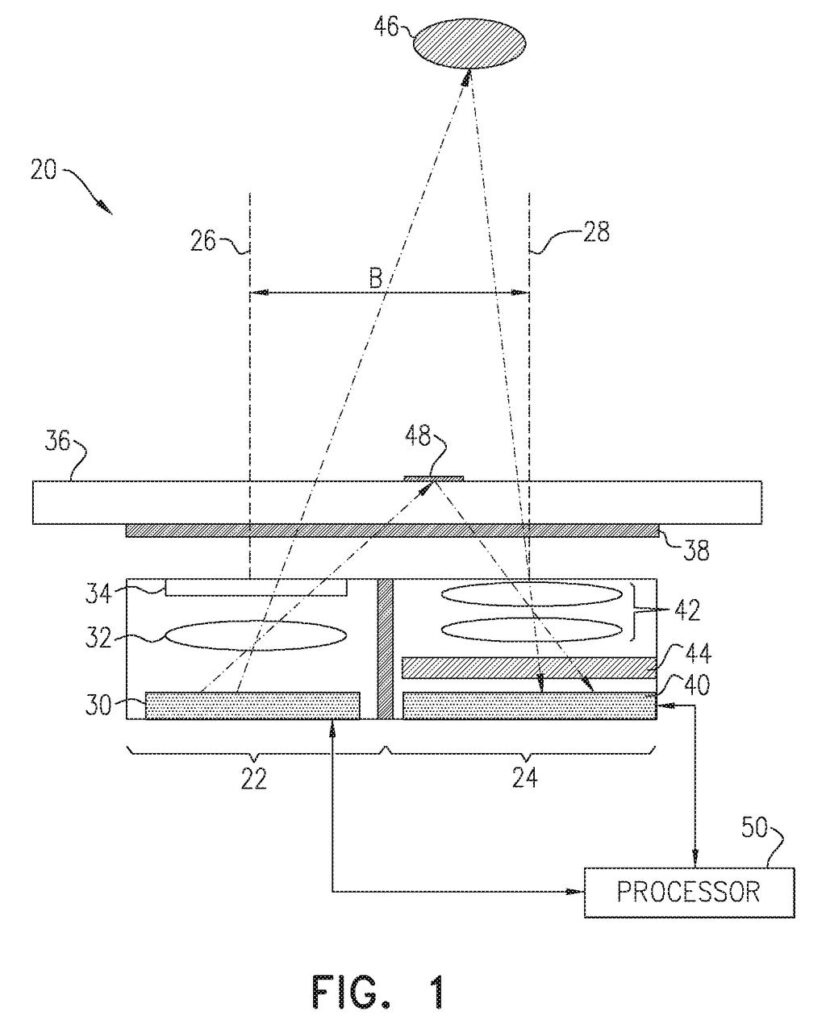
… an array of detectors configured to detect reflected light including a speckle pattern created by scattering of the coherent light from an object …
Translation: A grid of sensors catches light bouncing off a target to form a scattered visual pattern.
How Apple's sensor compares pulse counts over time
The device fires pulses of laser light at a scene and catches the reflections with a grid of detectors. In the main example, those are single-photon avalanche diodes (SPADs, chips sensitive enough to register individual particles of light). Timing each pulse's round trip, called time of flight, gives distance, and that builds a 3D map.
The trouble starts up close. For an object under about 10 cm (roughly four inches), the echo returns in under a billionth of a second, and a smudge on the cover window returns in the same sliver of time. Timing alone can't say which is which.
The claims cover a different test:
- Count the electrical pulses from the detectors across several time intervals. In the description, these are separate bursts of a few thousand laser pulses with a pause between.
- Subtract one interval's counts from another's and adjust for overall brightness.
- Compare the differences to a threshold. The description suggests a small multiple of the shot noise (the random flicker that comes from counting light). Above it, the object is mobile; if no difference passes it, the object is stationary.
Nearby objects found this way go into the 3D map at their distance. Areas with fixed reflections can be marked as unknown depth, and a large, lasting patch can trigger an alarm asking the user to clean the window.
Why a smudged lens matters to depth sensors
Depth cameras only help if they can see clearly. A smudge or scratch on the cover window can bounce the laser straight back and drown out the signal from a real object in front of the sensor. Telling the two apart lets a device mark the blocked patch as unknown depth and, if the problem lasts, send you a message to clean the window.
The filing doesn't name a product, so it reads as a general fix for pulsed-laser depth sensors of this design. The same check also treats reflections from the window itself as stationary, so a device could mark that patch as unknown instead of reporting a wrong distance.
This is the 116th Apple filing we've tracked in our AR glasses watchlist since May, adding to work like overlapping lens brightness and eye tracking through lenses.
Of the ideas a depth sensor could pick up, this one sits near the easy end of the ship path. The hardware it needs is a pulsed laser, a grid of light detectors and counters, which the filing describes as a standard setup. What changes is the math: subtract one set of counts from another and compare the result to a threshold.
That makes the shortest route to a product a software update on a sensor that already works this way, though the filing never says which device. The remaining work is tuning. The document says the threshold has to be chosen and refined by trial and error for each design, and a real window with real fingerprints will need plenty of testing.
As a feature, it is modest and useful: a prompt that says wipe the lens. Few people will notice it working, and plenty would notice its absence when a smudged sensor starts measuring distance wrong.
Get our take in your Top Stories
Liked this breakdown? Add Patentlyze as a preferred source on Google, and our plain-English take shows up more often in your Top Stories the next time Apple patent news breaks.
There are more where this came from
We read every patent application Big Tech publishes and send you the ones worth knowing. Plain English, free, every week.
The drawings
2 drawing sheets from US 2026/0338957 A1 · click any drawing to enlarge


Want this weekly breakdown for a company we don't cover? Patentlyze Pro →
Be the first to weigh in