
Waymo Files Patent to Grade a Self-Driving Car's Route One Step at a Time
Most driving AI learns by imitation. Waymo's filing describes grading the AI's own planned path, point by point, for crashes, comfort and traffic rules.
What Waymo's reward-scored route planning does
Today, a lot of driving AI learns by copying. It studies recorded examples and tries to produce something that looks like them, with no check on whether its own plan would bump into a car, drift off the road, or send your coffee into your lap.
Waymo's patent application describes a different way to teach it. The AI looks at a scene (a picture of the road plus a short text instruction) and writes out a planned path as a string of numbers. Then a scoring system grades that path point by point on things like avoiding collisions, staying on the road, passenger comfort, and following traffic rules.
The AI gets rewarded or penalized, and over many rounds it adjusts. The twist is that the score lands on each stretch of the path, so the AI can tell which part of its plan caused the problem.
… applying a reward function to the trajectory data to determine a respective reward for each of a plurality of tokens in the output sequence; and training the multi-modal neural network using the respective rewards for the plurality of tokens through reinforcement learning.
Translation: The system scores each step of the planned route and uses those grades to teach the AI how to drive better.
How each waypoint gets its own score
The patent covers training a multi-modal neural network (an AI model that can take in more than one kind of input, such as images and text) to plan a vehicle's route. In the filing's example, one input is a picture of the road built from three color channels: the road layout, the car's past path, and other vehicles' past paths. Alongside it goes a text instruction, such as "generate a trajectory in the vehicle coordinate system for the next 8 seconds."
The model answers with an output sequence of tokens (small chunks, like pieces of words or numbers). Those chunks are read as waypoints, meaning positions the car should reach at future moments. A reward function then scores the path against driving goals:
- Collision avoidance
- Staying on the road
- Passenger comfort
- Traffic rule compliance
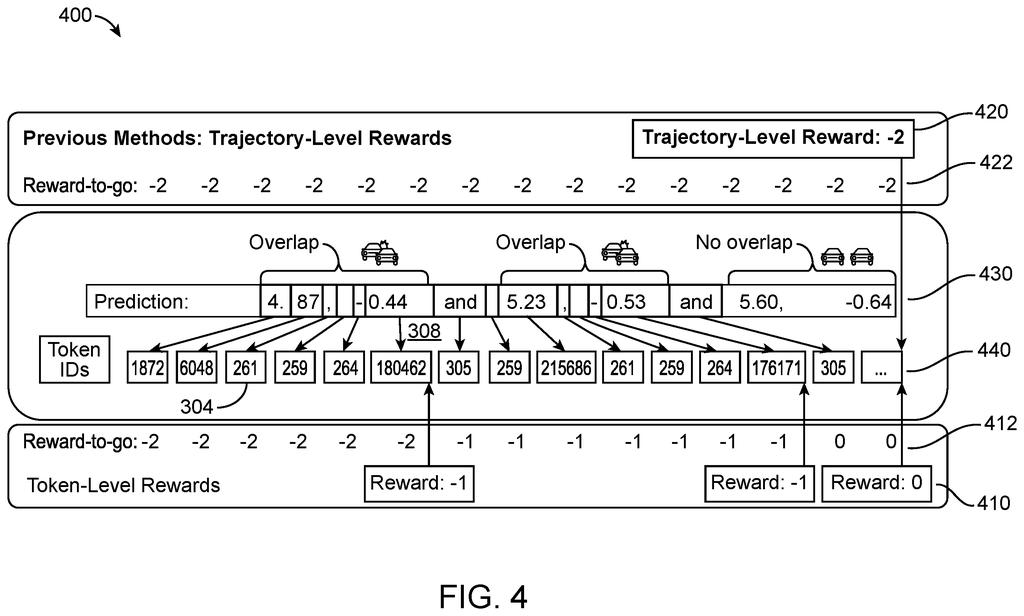
The scores are combined, for example as a weighted sum, and attached to the tokens that make up each waypoint. In the filing's example, a path has three waypoints; the first two overlap another vehicle and get -1 each, and the third gets 0. A single whole-trip score would have been -2 for every token. The model is then updated through reinforcement learning (learning from scores rather than from a answer key).
The filing also describes pre-training and fine-tuning the model first. If the model is too big for a car, a smaller one can be trained from it through distillation (a small model learning to mimic a big one).
Methods, systems, and apparatus, including computer programs encoded on a computer storage medium, for training a multi-modal neural network that generates motion plans for vehicles.
Translation: This patent covers software designed to teach artificial intelligence how to map out safe driving routes.
Why grading each step matters for driverless cars
If you ride in a driverless car, the path it picks decides what you feel: whether it brakes late, hugs a curb, or takes a corner too hard. This patent application is about how that planning model gets taught. It uses scores for collisions, leaving the road, comfort and traffic rules instead of only matching recorded drives. The filing says matching recorded examples gives no check on whether a path is feasible, comfortable or efficient.
There is a cost angle too. The filing says the reward stage can need less than 5% of the training steps of the earlier copy-based stage. A large model can also be shrunk into a smaller one that fits in the car and answers fast enough. The filing describes a training recipe and names no product.
That makes this Google's 72nd filing we've tracked since May in our self-driving sensing race watchlist, building on their earlier applications on avoiding false braking and smarter rider pickup spots.
Claim 1 is short and wide. It covers any method that feeds a driving scene into an AI model that handles more than one kind of input, turns the model's answer into a planned path, scores that path, and retrains the model on the scores. It names no sensor, no scoring formula and no model design. Those details appear only in the later claims.
The detail that gives claim 1 its shape is a separate reward for each of several tokens in the answer. In practice, each stretch of the path gets its own grade, and the filing's three-waypoint example shows why that helps the AI find its mistake.
If granted, the wording would reach any driving model trained with per-piece rewards, whatever its internal design. For a filing that reads like a training recipe, that is a broad claim, and the broadness is the most notable thing about it.
Get our take in your Top Stories
Liked this breakdown? Add Patentlyze as a preferred source on Google, and our plain-English take shows up more often in your Top Stories the next time Google patent news breaks.
There are more where this came from
We read every patent application Big Tech publishes and send you the ones worth knowing. Plain English, free, every week.
The drawings
4 drawing sheets from US 2026/0336637 A1 · click any drawing to enlarge


Want this weekly breakdown for a company we don't cover? Patentlyze Pro →
Be the first to weigh in