
OpenAI Patents an AI Bug Hunter That Tests Its Own Findings Before Reporting Them
Before OpenAI's system tells a human that a piece of software has a security hole, it tries to break a copy of the code to prove it. If it can't reproduce the problem, the alert gets muted.
What OpenAI's AI bug-hunting patent does
Every time a software team ships an update, somebody has to wonder whether the new code left a door open for hackers. Checking every line of a big app by hand is slow, and older automated scanners often get confused by programs written in several different languages.
OpenAI's patent application describes an AI-driven checker that works like a triage desk. It first lists every chunk of code in an app, maps which chunks call on which, and ranks the ones that look riskiest. Then AI agents study the top of that list in detail, guided by a profile of how this particular app is likely to be attacked.
Before anything reaches a human, the system tries to reproduce the flaw on a copy of the code. If the flaw doesn't show up, the alert gets muted instead of cluttering someone's inbox.
… generating, utilizing a large language model of a generative artificial intelligence (AI) system, a threat model comprising a structured data object defining threat parameters corresponding to the computer application …
Translation: The system uses AI to map out potential security risks for the software application.
How the system ranks and tests risky code
The claims cover a pipeline with four main steps, all built around large language models (the same kind of AI behind chatbots).
- Index the code. A "code indexing subroutine" finds every function (a self-contained block of code that does one job) in the app, using a tagging tool or an AI model. It can handle several programming languages and doesn't need the code compiled first.
- Rank the functions. The system builds a call graph, a map of which functions call which others, and scores each function's risk so the worst get checked first.
- Write a threat model. An AI model produces a structured data object listing the app's likely attack surfaces (such as network ports or file uploads), the flaw types to watch for (such as SQL injection), and how to weigh them. Users can edit these settings.
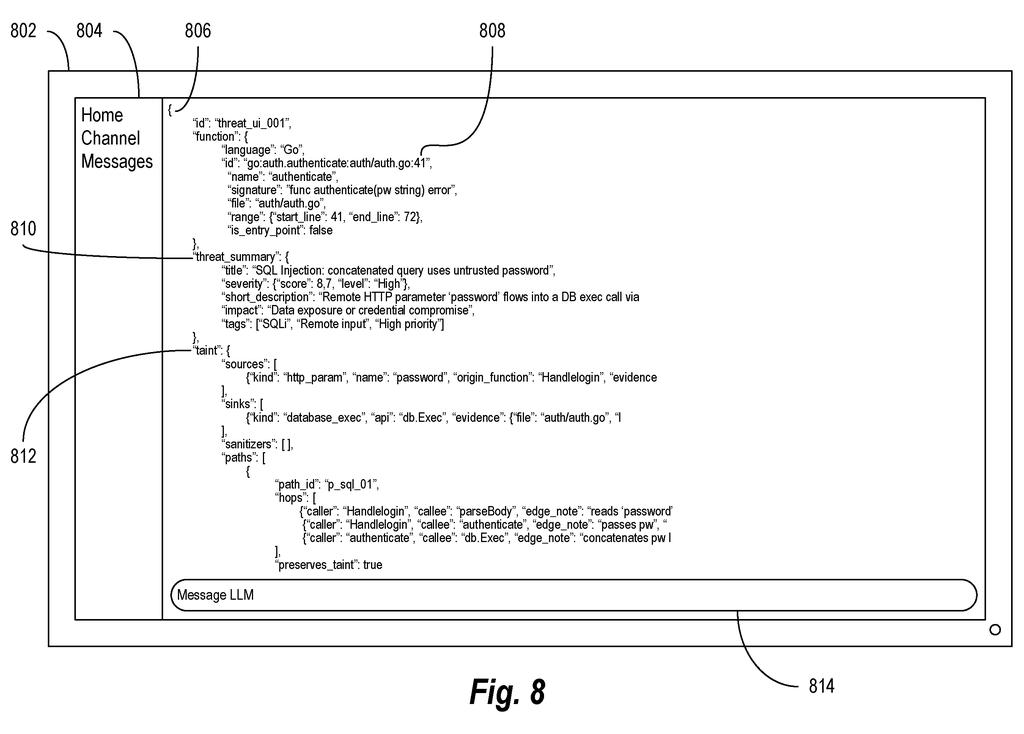
- Produce a threat object. The AI studies each high-ranked function alongside the threat model and outputs a report with a summary, severity, evidence, and a suggested fix.
The filing also describes running the AI inside an isolated container, a walled-off workspace with no access to the system's control code. That guards against malicious instructions hidden in the code being scanned.
A validation agent can then run a cloned copy of the function to confirm the flaw is real. One claim even has multiple AI agents coordinate by leaving shared notes in a common store instead of messaging each other.
… determine a vulnerability ranking for the computer function based on a call graph …
Translation: It prioritizes which parts of the code are most likely to have security flaws by looking at how functions connect.
Why confirmed findings matter for security teams
If you use apps or websites that hold your data, you care whether their makers catch security holes before attackers do. This filing describes a way to point AI at that job and keep the results usable: a ranked list, a plain summary for each suspected flaw, a severity label, and a proposed fix, posted to a chat channel such as Slack or a web page.
The most practical piece is the confirmation step. A flaw that can be reproduced gets reported; one that can't gets muted or pushed down the list, which could spare busy engineers from chasing false alarms. The filing also says the approach suits automated build-and-release pipelines, where code changes constantly. And because the AI works inside walled-off containers, a booby-trapped file in the scanned code has a harder time hijacking the tool itself.
OpenAI's ninth filing we've tracked since September in our AI guardrails race watchlist builds on earlier work like one on topic-sensitive rules and one on hunting security holes.
Of all the patents you could read, this one sits close to something a company could ship. It needs no new hardware, and every building block it names already exists: AI models, a free code-tagging tool, isolated containers, chat alerts.
The hard part is trust. The filing offers no accuracy figures, so there's no way to tell how often the AI cries wolf or misses a real flaw. The test-it-on-a-copy step is the clever answer to false alarms, and it will have to carry most of the weight.
The shortest route to a product would be a tool that watches a company's code as developers change it and posts confirmed findings to a chat channel, which the filing itself describes. Whether it becomes more than a patent depends on how well it performs on real, messy code.
Get our take in your Top Stories
Liked this breakdown? Add Patentlyze as a preferred source on Google, and our plain-English take shows up more often in your Top Stories the next time OpenAI patent news breaks.
There are more where this came from
We read every patent application Big Tech publishes and send you the ones worth knowing. Plain English, free, every week.
The drawings
11 drawing sheets from US 2026/0350180 A1 · click any drawing to enlarge


Show the other 3 sheets


Want this weekly breakdown for a company we don't cover? Patentlyze Pro →
Be the first to weigh in