
Qualcomm Patents a Phone Radio That Guesses When Your Data Is Coming
Your phone's radio spends the day guessing whether data is about to arrive. Qualcomm's patent application hands that guess to an AI model trained on how wireless networks behave.
What Qualcomm's radio-prediction patent does
Imagine you're reading an article on your phone while your connection sits mostly idle. Inside the phone, the radio hardware that catches signals from the cell tower may still be running at a ready-for-anything power level, just in case a burst of data shows up. That costs battery.
Qualcomm's patent application describes a different approach. Your phone would run an AI model, built on the same family of technology as chatbots, that looks at recent radio activity and predicts when the next chunk of data will arrive and how heavy it will be. If nothing is expected soon, the radio parts drop into a low power mode. If a rush is coming, they power up early.
The goal is to save battery without slowing your connection, because the radio gets ready before the data lands instead of after.
input, to a machine learning model, configuration information associated with a wireless communications link; obtain predictive traffic information as an output from the machine learning model …
Translation: The phone feeds network settings into an AI to guess when data will arrive.
How the AI forecasts incoming data bursts
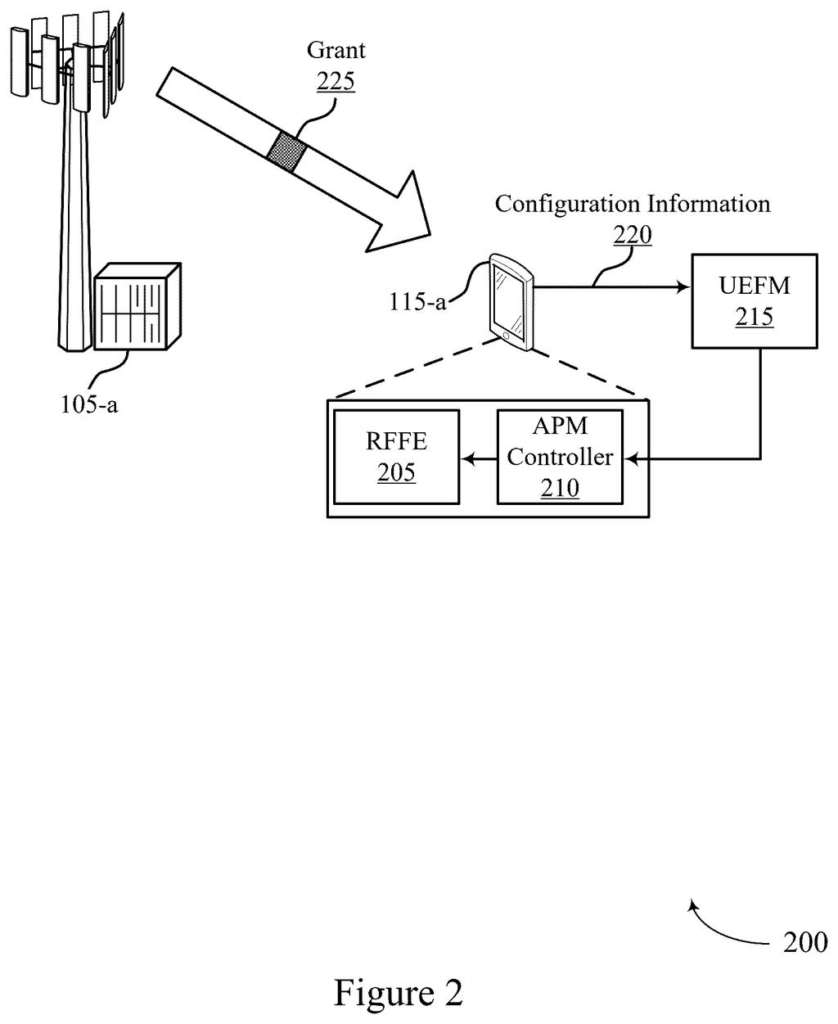
Every phone has a chain of radio parts between its antenna and its processor, called the front end (amplifiers, filters and converters that catch and clean up incoming signals). Phones already switch these parts between low, default and high power modes, a setup called adaptive power mode. Today that switching mostly reacts to what just happened, using fixed rules and statistics from a set time window.
Qualcomm's filing adds a prediction step. The phone feeds information about its connection into a machine learning model, which the filing calls a UE-side foundation model (a large AI model, possibly a language model, trained on data that models how a wireless protocol behaves). Inputs can include:
- Recent signal quality readings and error rates
- Grant history and the number of receive antennas in use
- Battery level, location and which apps are running
The model forecasts when the next grant (the network's message that data is on its way) will arrive, how many parallel data streams it will use, the expected error rate, and how long the phone can sleep. It works one small time slot at a time and feeds its own predictions back in to explore possible futures.
A controller then adjusts the radio: the converter that turns radio waves into digital numbers, gain settings (which manage signal volume), which receive antennas are active, and filter settings. If no grant is predicted within a set number of slots, the radio drops to low power.
… the UE may configure one or more front-end radio frequency components according to an adaptive power mode based on the predicted traffic information.
Translation: The device adjusts its internal radio hardware power based on the AI predictions.
What this could mean for your phone battery
The practical payoff is battery life. A phone's radio is one of its steadier power drains, and a radio that can safely rest when no data is coming, then wake up early when a download is on the way, could trim that drain without making your connection feel slower. The filing says the approach supports improved throughput and reduced power use, though it gives no numbers.
The description is not limited to phones. It lists tablets, laptops, wearables, car components, cameras, smart meters and industrial equipment as devices that could use it. It also mentions applying the idea to Wi-Fi and to future 6G networks, so the concept is built to travel across wireless standards.
Qualcomm's 26th filing we've tracked since July in our on-device AI privacy watch covers new ground beyond blurring faces in videos and glasses that log your day.
You will never see this feature. If it works, you would notice it as a phone that holds its charge a little longer, especially on a day when your signal is weak and the radio works hardest.
The failure it aims to prevent is a familiar one: a radio that stays on high alert all day to avoid missing data, or one that dozes off right when a download arrives and slows things down. Guessing ahead lets the phone avoid both.
The filing gives no battery numbers, so how much you would gain is unknown. It also does not say how much power the AI model itself needs, which matters for any battery saving. Using a prediction model on a job this narrow is a sensible fit, and a small gain on something your phone does all day adds up.
Get our take in your Top Stories
Liked this breakdown? Add Patentlyze as a preferred source on Google, and our plain-English take shows up more often in your Top Stories the next time Qualcomm patent news breaks.
There are more where this came from
We read every patent application Big Tech publishes and send you the ones worth knowing. Plain English, free, every week.
The drawings
9 drawing sheets from US 2026/0353166 A1 · click any drawing to enlarge


Show the other 1 sheets

Want this weekly breakdown for a company we don't cover? Patentlyze Pro →
Be the first to weigh in