
Intel Files Patent to Train Big and Small AI Models Together on One Device
Small AI models that run on your phone usually learn from a giant model that had to be trained first on expensive hardware. Intel's patent application describes training both at the same time, right on the small device.
What Intel's train-together AI patent does
Today, if you want a small AI that runs on your phone, someone usually has to train a huge teacher AI first, on a powerful and expensive machine. Only after that can the small student AI learn from it. The wait is long, and the student keeps leaning on the teacher.
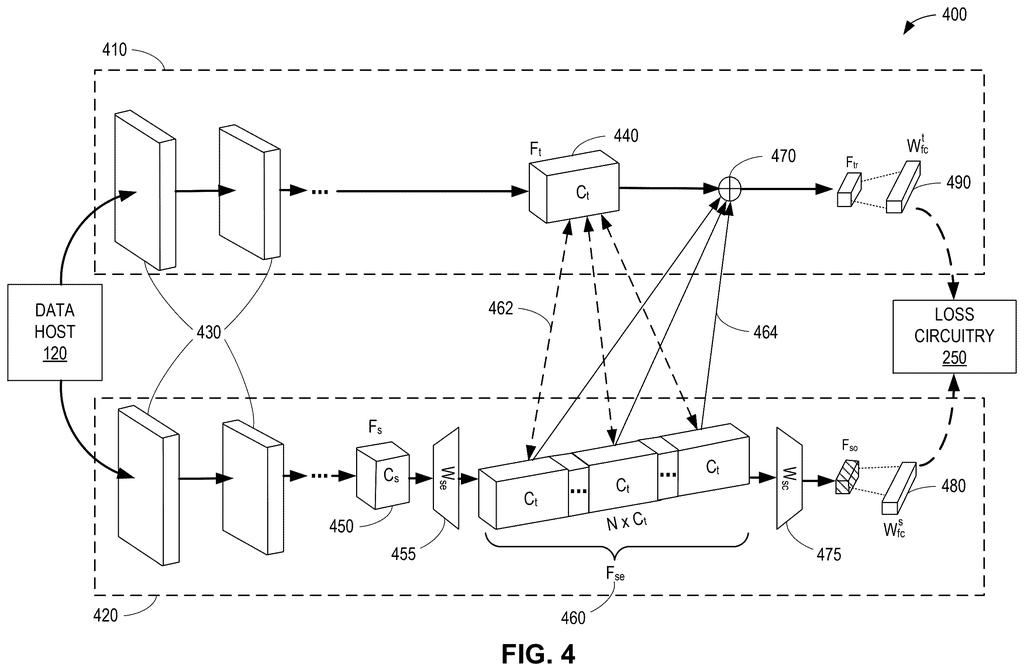
Intel's filing describes a way to skip that wait. The teacher and the student get trained at the same time, and the whole process can happen on the small device itself. The trick is a translation step: the student's internal notes are stretched out and chopped into several equal pieces, each sized to fit the teacher's notes. The teacher then learns from all of those pieces at once, instead of matching things one-to-one.
Both AIs share a combined score for how well they are doing, and every round of training pushes that score down. The filing says this should mean less delay and better accuracy, though it gives no test results.
… split the second feature map into segments having the first channel dimension; train the teacher network using the segments of the second feature map; and train the student network by applying a total loss value to the student network …
Translation: It chops up the smaller model data to help train both models together.
How Intel slices one AI's data to teach another
The patent covers a form of knowledge distillation, a method where a large AI (the teacher) helps train a smaller one (the student). Normally the teacher is fully trained first. Here, both are trained together on an edge device (a local gadget such as a phone, not a data center server).
For the same question, each network produces a feature map, which is a grid of numbers describing what the network noticed in the input. The two grids have different channel dimensions (how many kinds of features each one tracks). The claims then cover these steps:
- The student's feature map is stretched to a preset size, then split into non-overlapping segments, each the same size as the teacher's map.
- The teacher is trained by matching those segments to its own map (a many-to-one match). It is also reparametrized, meaning its settings are rebuilt from a combination of the segments, such as their sum.
- The student applies the result of that matching, and the two steps can run in parallel.
- The student's map is then shrunk back to its original size.
A total loss value (a single error score) ties it together. It combines a matching loss, a teacher loss and a student loss, each with its own weighting. The description says eight or fewer segments favor speed, while more than eight favor accuracy.
… train a teacher network and a student network simultaneously without a pre-trained teacher model …
Translation: Both artificial intelligence models learn at the same time without needing a finished model ready first.
Why this matters for AI running on your devices
If this works as described, small devices could build their own compact AI models without waiting for a separate, expensive teacher-training step. That could mean quicker setup, less reliance on data centers, and models that fit on the phones, cameras and laptops you already own.
The filing says the approach cuts delay and raises accuracy compared with older methods, but it includes no benchmark numbers to back that up. It also does not explain how a modest device handles the heavy job of training a teacher. For now, it is a design for how to organize the training, not proof that it works faster.
That makes this Intel's seventh filing we've tracked since July in our on-device AI privacy work, following earlier patents on learning speech from chatter and 5G AI training access.
The problem here is real. Shrinking AI to run on a phone is how most people actually meet it, and the usual route needs a big, fully trained model first, which costs time and powerful hardware. Anyone who ships AI to millions of small devices feels that cost.
Intel's answer is to train both models together, and that fits the size of the problem. It cuts out a whole stage rather than shaving a few percent off it. The catch is that the filing itself says teacher training normally needs high-end machines, and it never shows how a small device carries that load while also managing up to eight or more extra pieces of data.
So the idea is well aimed, but the paper offers no measurements to show the savings. Until someone publishes speed and accuracy numbers, this is a sensible plan rather than a proven fix.
Get our take in your Top Stories
Liked this breakdown? Add Patentlyze as a preferred source on Google, and our plain-English take shows up more often in your Top Stories the next time Intel patent news breaks.
There are more where this came from
We read every patent application Big Tech publishes and send you the ones worth knowing. Plain English, free, every week.
The drawings
12 drawing sheets from US 2026/0340410 A1 · click any drawing to enlarge


Show the other 4 sheets


Want this weekly breakdown for a company we don't cover? Patentlyze Pro →
Be the first to weigh in