
Samsung · Filed Jul 6, 2026 · Published Nov 5, 2026

Samsung Patents a Rubber Edge Guard for Phones That Fold Three Times

A phone that folds twice has to leave a gap in its frame wherever the screen bends, and dust loves a gap. Samsung's patent application describes a rubber edge guard, stiffened with firmer inserts, to plug it.
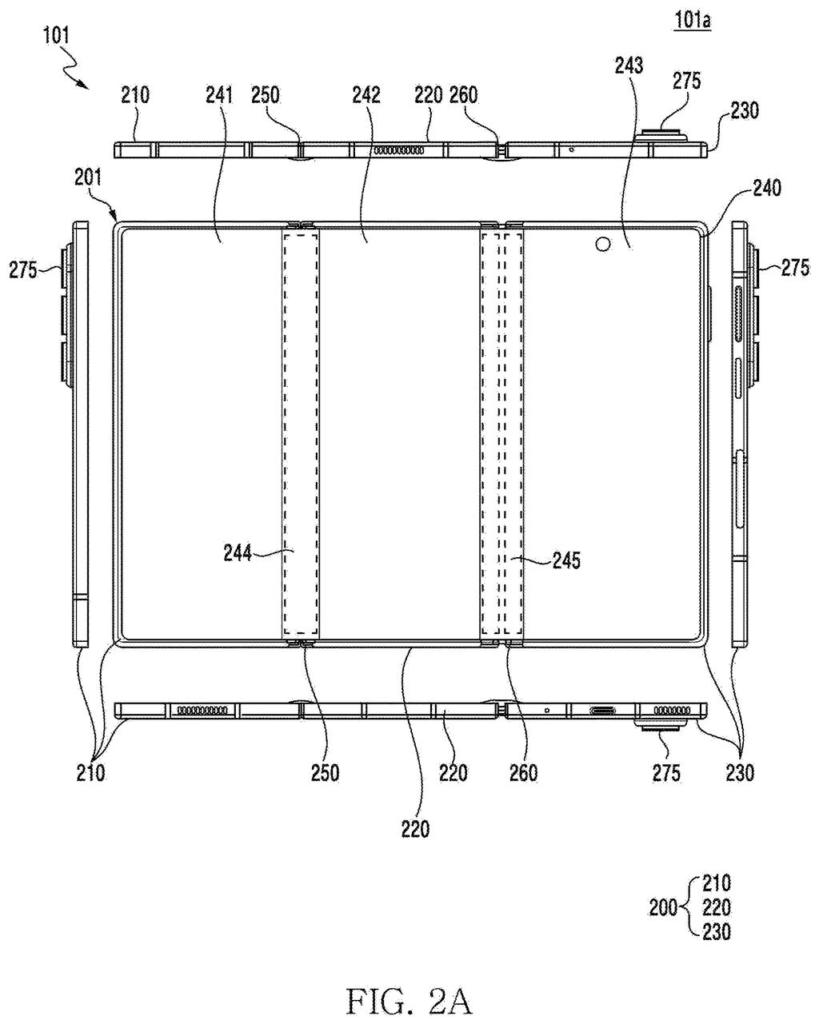
An unfolded multi-hinged smartphone with three screen sections that fold down into a compact handheld device. Drawing from patent filing US 2026/0352751 A1.
An unfolded multi-hinged smartphone with three screen sections that fold down into a compact handheld device.
See all 33 drawings from this filing ↓
Publication number US 2026/0352751 A1 US20260352751A1
Applicant SAMSUNG ELECTRONICS CO., LTD.
Filing date Jul 6, 2026
Publication date Nov 5, 2026
Inventors Jihoon KIM, Jeongho KANG, Namwoo KIM, Minho KIM, Changi PARK, Minsuk SONG, Jaeuk AHN, Yeonggyu YOON, Soli JUNG, Junyoung CHOI
US classification 455/575.1
Status when we published Waiting for an examiner (Sep 1, 2026)
Parent application is a Continuation of PCTKR2025000961 (filed 2025-01-16)
Document 20 claims

What Samsung's triple-fold edge guard does

Imagine a phone that opens into a tablet-sized screen with two bends, like a brochure folded in thirds. Each time you fold it, the screen curls around a hinge, and the trim that normally guards the screen's edge has to step aside at those spots. That leaves a gap where crumbs, lint and grit can slip in.

Samsung's patent application describes a strip of rubber that runs along the exposed edge and bends with the screen, plus thin, firmer inserts that help guide how it bends and protect the flat areas next to the bend. The middle hinge is wider than the outer one so a whole panel can tuck inside the fold, so that stretch gets the longer strip.

A soft bumper on the hinge cover also stops the folded panel from scuffing as it closes. In short, Samsung is building a small shock absorber and dust plug around the screen's most exposed spots.

From the filing · CLAIM 1
a housing including a first housing, a second housing, and a third housing; a first hinge assembly rotatably connecting the first housing and the second housing; a second hinge assembly, rotatably connecting the second housing and the third housing, having a width wider than the first hinge assembly; …

Translation: The phone uses three connected sections and two hinges of different widths to fold up multiple times.

How the rubber and hard inserts share the job

The filing describes a phone with three housing sections joined by two hinges. The second hinge is wider than the first, which makes room for one section to sit between the other two when the phone is folded shut. Where the screen bends, the frame trim (the border pieces that normally cover the display's edge) has to be left out, and that opens a gap for dirt.

To close it, the patent adds a cover made of an elastic member (a rubbery strip that stretches and springs back) with a rigid member (a firmer insert) attached. The inserts can be metal, plastic sheet or tougher silicone, and they are glued on or molded together with the rubber. The strip wraps the front and the side of the screen edge.

The description adds several details:

  • The strip is thickest over the flat middle of the bend and has slits that widen as it curves.
  • Slots in the inserts let the frame trim slide along as the rubber moves.
  • A lip on the hinge cover presses the strip down into a U shape as the phone folds, and it is wider on the wide hinge.
  • A rubber or sponge patch on that cover touches the side of the first section when folded, so the two do not rub.
From the filing · THE ABSTRACT
… a cover disposed in a partial area of the flexible display so as to prevent the introduction of foreign substances from the outside. The cover can include an elastic member, and a rigid member coupled to a partial area of the elastic member.

Translation: A protective guard made of flexible and rigid parts blocks dust and debris from getting inside the screen.

Why the wide hinge is the weak spot

A phone with two bends has twice as many places where the screen's edge is exposed, and Samsung's own description says the trim has to be left out at each bend. For you, the payoff would be a folding screen that is less likely to pick up grit or take damage from a knock or from the phone's own panels.

For Samsung, a filing like this shows the engineering effort that goes into making multi-fold hardware survive daily use. It is a patent application, so it does not mean a product with this exact design is coming, but it shows the problems the company is working through: dust, impact and wear around a wide hinge.

Samsung's 94th filing we've tracked on our foldable phone watchlist since May follows patents for a phone that folds twice and shrinking the screen gap.

Editorial take

Every layer here costs something. A rubber strip that sits on the screen's edge adds a visible lip around the bend, and rubber can pick up lint or wear down after many folds. The filing also stacks on slits, inserts, a pressing lip and a bumper, so there are more small parts that could loosen or crack.

The trade still reads as worth it. The alternative is an open gap right at the spot where the screen bends hardest, and grit in that gap is a familiar complaint about folding phones. A little extra bulk and a few more parts is a fair price to keep the screen's edge safe.

Get our take in your Top Stories

Liked this breakdown? Add Patentlyze as a preferred source on Google, and our plain-English take shows up more often in your Top Stories the next time Samsung patent news breaks.

There are more where this came from

We read every patent application Big Tech publishes and send you the ones worth knowing. Plain English, free, every week.

The drawings

33 drawing sheets from US 2026/0352751 A1 · click any drawing to enlarge

Parts that power the phone and connect to networks, drawing sheet 1 from US 2026/0352751 A1
Sheet 1 Parts that power the phone and connect to networks
Three screen sections unfold into a wide tablet, drawing sheet 2 from US 2026/0352751 A1
Sheet 2 Three screen sections unfold into a wide tablet
Fully folded phone viewed from every side, drawing sheet 3 from US 2026/0352751 A1
Sheet 3 Fully folded phone viewed from every side
Hinges linking the three body panels without the screen attached, drawing sheet 4 from US 2026/0352751 A1
Sheet 4 Hinges linking the three body panels without the screen attached
Rear chambers holding batteries and cameras across three panels, drawing sheet 5 from US 2026/0352751 A1
Sheet 5 Rear chambers holding batteries and cameras across three panels
Flexible rubber strip lining the rim where two panels bend, drawing sheet 6 from US 2026/0352751 A1
Sheet 6 Flexible rubber strip lining the rim where two panels bend
Cross section of the rubber bumper shielding the display border, drawing sheet 7 from US 2026/0352751 A1
Sheet 7 Cross section of the rubber bumper shielding the display border
First hinge curling the screen tightly inward when shut, drawing sheet 8 from US 2026/0352751 A1
Sheet 8 First hinge curling the screen tightly inward when shut
Show the other 25 sheets
Wider curved hinge leaves space for a third folded screen, drawing sheet 9 from US 2026/0352751 A1
Sheet 9 Wider curved hinge leaves space for a third folded screen
Rubber sealing around the narrower hinge prevents dust from entering, drawing sheet 10 from US 2026/0352751 A1
Sheet 10 Rubber sealing around the narrower hinge prevents dust from entering
Flexible edging cushions the hinge around the deep fold, drawing sheet 11 from US 2026/0352751 A1
Sheet 11 Flexible edging cushions the hinge around the deep fold
Metal strips lock the protective rubber rim onto the frame, drawing sheet 12 from US 2026/0352751 A1
Sheet 12 Metal strips lock the protective rubber rim onto the frame
Flat border view where rubber edges join rigid corner brackets, drawing sheet 13 from US 2026/0352751 A1
Sheet 13 Flat border view where rubber edges join rigid corner brackets
Angled view of the rubber guard resting on the hinge, drawing sheet 14 from US 2026/0352751 A1
Sheet 14 Angled view of the rubber guard resting on the hinge
Samsung Patents a Rubber Edge Guard for Phones That Fold Three Times patent drawing, sheet 15
Sheet 15
Cutaway of the rubber rim fitting into a frame groove, drawing sheet 16 from US 2026/0352751 A1
Sheet 16 Cutaway of the rubber rim fitting into a frame groove
Stiff plates reinforce the rubber guard along phone edges, drawing sheet 17 from US 2026/0352751 A1
Sheet 17 Stiff plates reinforce the rubber guard along phone edges
Thicker rubber pads the hinge area where the phone folds, drawing sheet 18 from US 2026/0352751 A1
Sheet 18 Thicker rubber pads the hinge area where the phone folds
Grooves let the rubber strip bend smoothly around joints, drawing sheet 19 from US 2026/0352751 A1
Sheet 19 Grooves let the rubber strip bend smoothly around joints
Rigid end pieces brace the guard along the frame, drawing sheet 20 from US 2026/0352751 A1
Sheet 20 Rigid end pieces brace the guard along the frame
A middle plate keeps the central hinge area firm, drawing sheet 21 from US 2026/0352751 A1
Sheet 21 A middle plate keeps the central hinge area firm
How rubber and metal supports stack into the frame, drawing sheet 22 from US 2026/0352751 A1
Sheet 22 How rubber and metal supports stack into the frame
Another layout showing the rubber guard locked across the hinge, drawing sheet 23 from US 2026/0352751 A1
Sheet 23 Another layout showing the rubber guard locked across the hinge
Side view of the seal resting above hinge gears, drawing sheet 24 from US 2026/0352751 A1
Sheet 24 Side view of the seal resting above hinge gears
Rigid side plates backing the flexible edge seal, drawing sheet 25 from US 2026/0352751 A1
Sheet 25 Rigid side plates backing the flexible edge seal
Adding a middle support plate to the flexible hinge seal, drawing sheet 26 from US 2026/0352751 A1
Sheet 26 Adding a middle support plate to the flexible hinge seal
Hooking the support plates under the flexible seal, drawing sheet 27 from US 2026/0352751 A1
Sheet 27 Hooking the support plates under the flexible seal
Protective cushioning strip guarding the folded phone edge, drawing sheet 28 from US 2026/0352751 A1
Sheet 28 Protective cushioning strip guarding the folded phone edge
Shaped rubber edge bumper with a top protective liner, drawing sheet 29 from US 2026/0352751 A1
Sheet 29 Shaped rubber edge bumper with a top protective liner
How the inner folded panel clears the rubber bumper, drawing sheet 30 from US 2026/0352751 A1
Sheet 30 How the inner folded panel clears the rubber bumper
Tiny rubber foot resting against the edge bumper, drawing sheet 31 from US 2026/0352751 A1
Sheet 31 Tiny rubber foot resting against the edge bumper
Top view of the foot bracing the fully folded phone, drawing sheet 32 from US 2026/0352751 A1
Sheet 32 Top view of the foot bracing the fully folded phone
Protective rubber seals cushion the folding display edge, drawing sheet 33 from US 2026/0352751 A1
Sheet 33 Protective rubber seals cushion the folding display edge
Browse all the drawings 33 drawing sheets
Patent filing page

Source. Full patent text and figures from the official USPTO publication PDF.
Reader comments

Be the first to weigh in

Start the discussion

Real name or a handle, either is fine. Comments are read by a person before they appear, so allow a little time. Keep it about the filing.