
Apple Patents a Camera Shake Fix With Fewer Moving Parts
Apple's filing replaces the two-layer mechanism that cancels camera shake with a single sliding frame, and some versions rely on parts as simple as a graphite puck.
What Apple's one-piece camera stabilizer does
Right now, the part of a phone camera that cancels out your shaky hands is typically built in two layers. One handles side-to-side wobble, the other handles up-and-down, and each needs its own bearings and tracks. That means more parts, more cost, and more thickness in a device where space is tight.
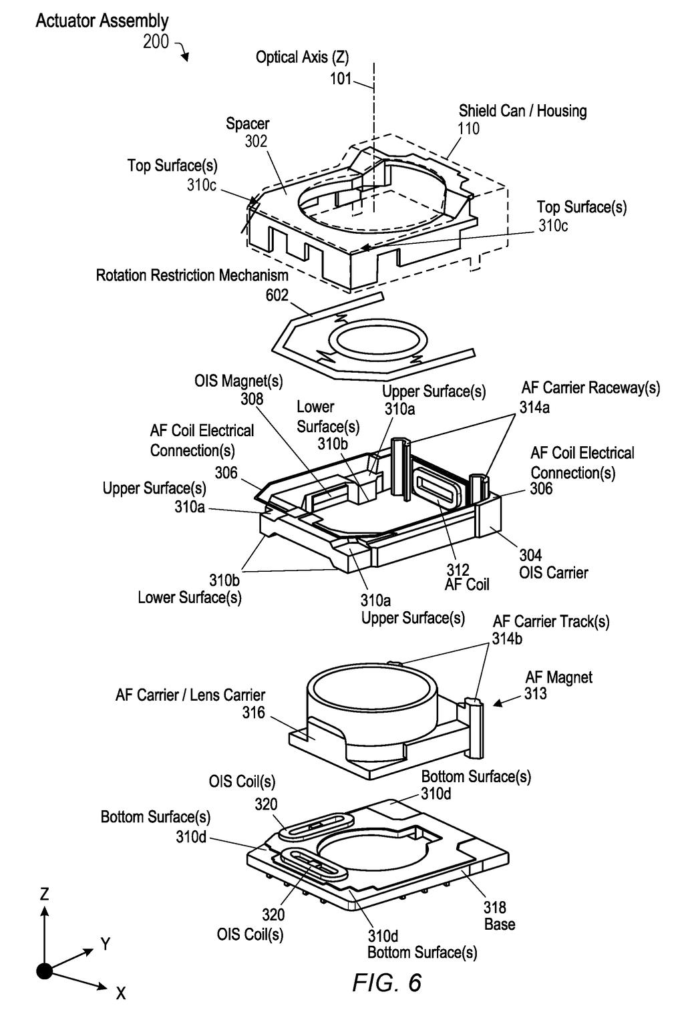
This Apple patent application describes one layer that does both jobs. A single frame holds the lens and slides in any direction on flat, slick surfaces, pushed by tiny magnets and coils. Extra magnets press the frame against its sliding surfaces so it stays put instead of rattling loose.
A springy piece stops the lens from twisting as it slides. Fewer parts also means fewer things that can knock out of line if you drop your phone, according to the filing.
an optical image stabilization (OIS) carrier, wherein the OIS carrier is configured to move one of the image sensor or the optical assembly along two orthogonal axes for OIS …
Translation: A moving frame shifts either the camera sensor or the lenses in two directions to counteract hand shake.
How the lens glides without ball bearings
The core is a single OIS carrier (OIS stands for optical image stabilization, the system that shifts a lens to cancel out hand shake). It holds the lens, or in a variation the image sensor, and moves along two perpendicular directions, usually called x and y.
Two magnets sit in neighboring arms of the carrier, and two coils on the base sit directly beneath them. Send current through a coil and the magnet above it gets pushed, sliding the carrier one way. Position sensors paired with the coils track where the carrier is. Extra preload magnets pull the carrier against its contact surface so it doesn't lift away.
The surfaces where the carrier touches its neighbor are the main design choice. The filing describes:
- Flat surfaces sliding directly on each other, or with a ball bearing, cube, or cylinder between them
- Pucks made of low-friction plastic, ceramic, or graphite
- Hard coatings, such as a diamond-like coating or ceramic
- Lubricant, including a version with tiny particles, fed from a small well
- Mirror-polished surfaces
A rotation restriction mechanism (a thin springy arm, or a magnet paired with a coil or metal plate) lets the lens slide freely but resists twisting. An autofocus layer can ride inside the carrier.
Why a thinner camera stabilizer matters
The practical payoff is a smaller, simpler camera module. The filing says a two-layer stabilizer adds parts, cost, and thickness, and can misalign after a drop. Cutting a layer attacks all of those at once, which matters for any device where the camera competes with the battery and everything else for room.
You would never see this feature, only its effects: a camera that takes up less space or leaves more room for other parts. The filing says the design suits phones, tablets, and AR/VR headsets, though it names no specific product. Whether the sliding surfaces hold up over years of use is the open question.
Apple's 22nd filing in our camera patent coverage since June builds on work like tighter dot depth capture and multi-camera sync among the applications we've tracked.
Camera makers spend a lot of effort on a modest-sounding problem: keeping a lens steady without making the phone thicker. The filing names the costs plainly: extra parts, higher price, more thickness, and pieces that can drift out of line after a drop. Those costs are real when the camera sits in a device people carry everywhere.
The fix is proportionate. Removing one layer of mechanism attacks every one of those costs at once, and the sliding surfaces rely on ordinary engineering choices like coatings and lubricant. The open question is wear, since surfaces that rub for years have to stay slick, and the filing gives no lifetime numbers.
This is a sensible simplification. If it works, you will notice nothing except a camera that fits in less room.
Get our take in your Top Stories
Liked this breakdown? Add Patentlyze as a preferred source on Google, and our plain-English take shows up more often in your Top Stories the next time Apple patent news breaks.
There are more where this came from
We read every patent application Big Tech publishes and send you the ones worth knowing. Plain English, free, every week.
The drawings
21 drawing sheets from US 2026/0352953 A1 · click any drawing to enlarge


Show the other 13 sheets


Want this weekly breakdown for a company we don't cover? Patentlyze Pro →
Be the first to weigh in