
Qualcomm Patents a System That Checks Vehicle Safety Requirements Before Switching Network Coverage
Before your car's wireless connection moves from one cell tower to the next, Qualcomm's filing has the first tower ask the next one a pointed question: can you meet this car's safety level?
What Qualcomm's safety-checked tower handoff does
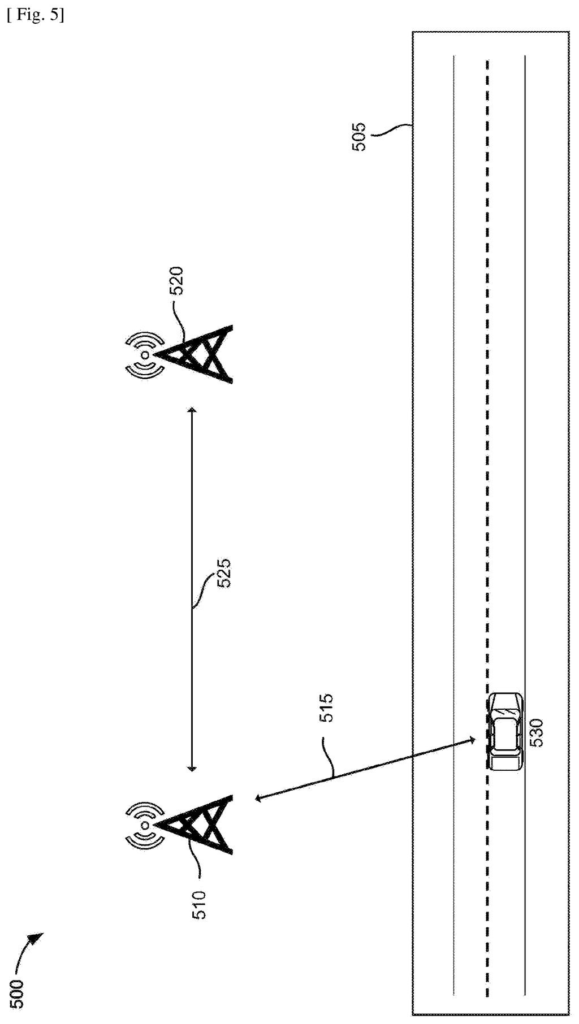
You're riding in a self-driving car on a long stretch of highway, and the car depends on a constant wireless link to the cell network. Every few miles, one cell tower has to pass your car along to the next one.
Qualcomm's patent application adds a safety check to that handoff. The tower you're leaving sends the next tower a message listing the safety level your car's driving features require, plus details like the speed, delay and reliability those features need. The next tower answers whether it can meet the bar.
If several towers are ahead, they all reply and the first tower picks one that qualifies. If none qualify, the work can be split across several towers, and your car can be told the best level on offer so it can adjust, such as by slowing down.
transmit, via at least one transceiver to one or more network devices, a handover message for handing over communication coverage for a vehicle by the first network device to a second network device of the one or more network devices, wherein the handover message comprises one or more safety ratings required for the vehicle; …
Translation: The current tower sends a signal to pass the vehicle to a new tower while including its required safety ratings.
How towers compare notes on a car's safety needs
A handover is the moment one base station (the radio equipment on a cell tower) passes a moving vehicle's connection to the next one. Here, the first base station sends a handover message that includes the safety ratings the vehicle requires. Those ratings are Automotive Safety Integrity Levels (ASIL), an industry grading from A to D. D covers the highest-risk systems, such as airbags and anti-lock brakes, while A covers things like rear lights.
The message can also carry the vehicle's required data rate, delay (latency) and reliability, its route and destination, and antenna details such as how many it has and where they sit. The receiving station uses this to work out whether it can meet the rating, or the best rating it can offer, and replies.
When several towers are candidates, each reply can include:
- Whether each rating can be met
- The highest rating it can reach
- The maximum traffic load at that rating
- Its best data rate, delay and reliability
- How far its coverage reaches along the route
The first station then picks a qualified tower by random choice, best rate, best delay, best reliability, or longest coverage along the route.
If none qualify, it can pick the tower with the best achievable rating and tell the vehicle, or split tasks. With six cameras, two towers could each process video from three. A "deep search" can also pass the question along to towers further down the route.
An apparatus, method and computer-readable media are disclosed for performing wireless communications. For example, a first network device can transmit, to one or more network devices, a handover message for handing over communication coverage for a vehicle by the first network device to a second network device of the one or more network devices.
Translation: The system outlines how a network device transfers a connected vehicle to a different tower.
Why self-driving cars need a safer tower handoff
If you ever ride in a car that drives itself, the link to the network matters as much as the sensors. This filing tries to make sure that as your car moves from one tower's range into another's, the new tower can actually deliver the safety level your car's features call for, and that the car finds out ahead of time when one cannot.
For carmakers and phone network operators, it describes a shared way to state safety requirements during handoffs, including extra fields that could be added to existing tower-to-tower messages. It is a pending application, so nothing here says any real network will work this way.
Qualcomm's 50th filing we've tracked since July in the self-driving sensing race follows its work on lane-line car positioning and blind-corner vehicle alerts.
Every added step costs time. A handoff at highway speed has little room to spare, and this design adds a round of questions, calculations and replies before the car moves on. When several towers are asked at once, the first tower also has to wait for the answers and compare them.
The design also trusts each tower to report its own abilities accurately. A tower that overstates what it can deliver would pass the check and still let the car down.
The fallback shows the thinking best. When no tower meets the bar, the car is told the best level on offer and may have to slow down. For a vehicle whose driving depends on the link, a slower trip beats a dropped connection, so the trade reads as worth it, as long as the extra checking is fast enough that it does not become the weak point itself.
Get our take in your Top Stories
Liked this breakdown? Add Patentlyze as a preferred source on Google, and our plain-English take shows up more often in your Top Stories the next time Qualcomm patent news breaks.
There are more where this came from
We read every patent application Big Tech publishes and send you the ones worth knowing. Plain English, free, every week.
The drawings
9 drawing sheets from US 2026/0353051 A1 · click any drawing to enlarge


Show the other 1 sheets

Want this weekly breakdown for a company we don't cover? Patentlyze Pro →
Be the first to weigh in