
Qualcomm Files Patent for Cameras That Judge Distance With One Lens or Two
A camera can work out how far away things are by looking through one lens, which is cheap but less exact, or through two, which is precise but power-hungry. Qualcomm's patent application lets a device pick between them again for every moment of video.
What Qualcomm's one-lens or two-lens switch does
Ever tried to judge how far away a parked car is with one eye closed? You can do it, using clues like size and shadows, but it's a rougher guess than with both eyes open. Cameras face the same trade-off when they work out how far away things are.
A device with two cameras can compare both views for a precise answer, but that takes more power and time. Qualcomm's patent application describes a chip that checks each moment of video and decides whether to use one camera's view or both. Busy, changing scenes get both. Simple or fast-moving ones can get the cheaper single-view guess.
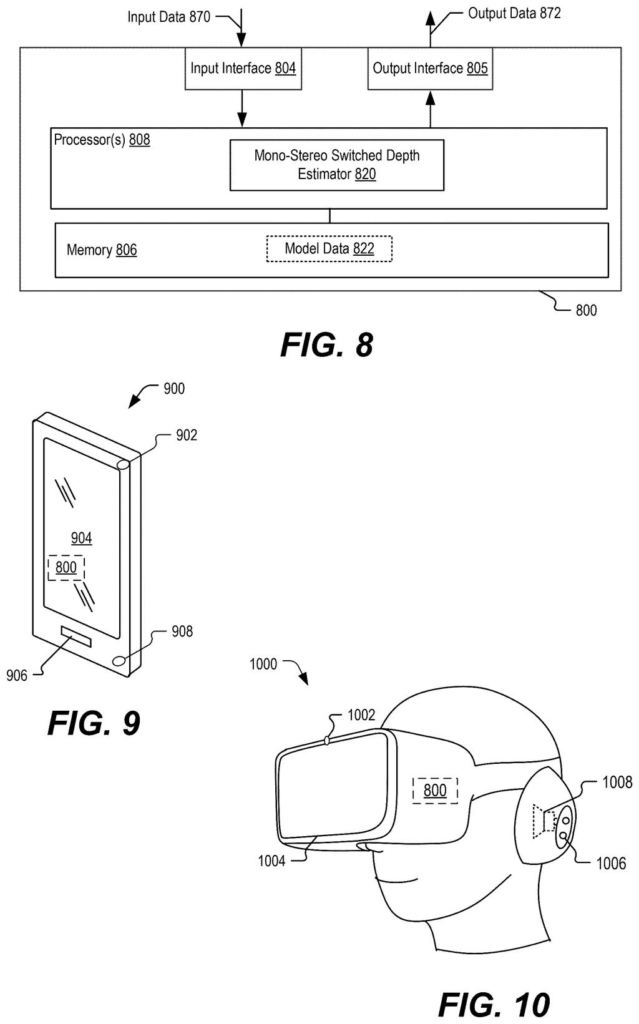
The goal is distance information that stays accurate enough without draining your battery as quickly. The filing lists phones, headsets, smartwatches and cars as places it could run.
… switch between a mono-image depth estimator and a stereo-image depth estimator based on one or more criteria associated with the image data.
Translation: The device changes how it calculates distance depending on whether it is using one camera lens or two.
How the chip decides between one view and two
The claims cover a device with memory and processors that takes image data from one or more cameras and switches between two depth estimators (software that works out how far away each part of a scene is) based on criteria about the image data. The mono version guesses distance from a single picture using cues like texture, shading and perspective. The stereo version compares two pictures taken a short distance apart. An object shifts more between the two pictures when it is closer, and that shift (called disparity) gives the distance.
The filing describes several ways to make the call:
- A fixed schedule, such as alternating mono and stereo. It can adjust, moving from a 50% stereo mix to a 60% mix ("M S S S M") when accuracy dips, or to a 40% mix ("M M M S S") when accuracy is higher than needed.
- A scene score from 0 to 1 compared against a threshold, with higher scores for complex or fast-changing scenes.
- A trained classifier (a model that sorts each frame into "use mono" or "use stereo") fed by the image and earlier results.
The criteria include scene complexity, lighting, camera and object motion, how much the two views overlap, and confidence scores from the previous frame. The description says stereo can struggle in low light and with motion blur, which favors mono there.
The device can also feed the last frame's depth map into the next estimate (a "warm start") and force a fresh start after a set number of warm starts in a row, so mistakes don't pile up.
Why this matters for AR headsets and driver aids
Depth sensing sits behind features you already use or may soon: placing a virtual object behind a real couch in an AR headset, building a 3D model of a room, or triggering a car's collision warnings. The filing says the switch lets a device balance accuracy against power and delay, using the costly two-camera method only when a scene calls for it. For something worn on your face or running on a phone battery, that trade matters.
The description also lists a smartwatch, a camera, a voice-controlled speaker and a car as places it could run, so the idea is meant as a general-purpose technique. It adds that on a very simple scene the device can skip depth calculation and reuse the last result, and can switch off extra frame prediction when the battery runs low.
Qualcomm's 52nd filing we've tracked since July in our self-driving sensing race watchlist follows tagging video with camera details and network handoff safety checks.
Claim 1 is short and wide. It asks for a device with memory and processors that takes pictures from one or more cameras and switches between the two distance-guessing methods based on "one or more criteria" about the image data. It never says what the criteria are, how often to switch, or what kind of chip does it.
That breadth makes the core idea the habit of toggling between one-image and two-image distance estimates. As worded, it would reach any phone, headset or car that does so, whatever its reasons for switching. The narrower ideas sit in the dependent claims: a repeating schedule, a classifier that makes the call, a memory of earlier frames.
The underlying engineering is sensible: spend the extra power only when the scene needs it. Because this is an application, the claim wording could still change.
Get our take in your Top Stories
Liked this breakdown? Add Patentlyze as a preferred source on Google, and our plain-English take shows up more often in your Top Stories the next time Qualcomm patent news breaks.
There are more where this came from
We read every patent application Big Tech publishes and send you the ones worth knowing. Plain English, free, every week.
The drawings
11 drawing sheets from US 2026/0352793 A1 · click any drawing to enlarge


Show the other 3 sheets


Want this weekly breakdown for a company we don't cover? Patentlyze Pro →
Be the first to weigh in