
Qualcomm Patents a Way to Box Objects in Images Without Knowing Which Way They Face
Most object-detection systems get confused when a car is facing left versus right, or a person is walking toward the camera instead of away. Qualcomm's new patent describes a way to draw a tight box around objects in an image without needing to know which direction they're pointing.
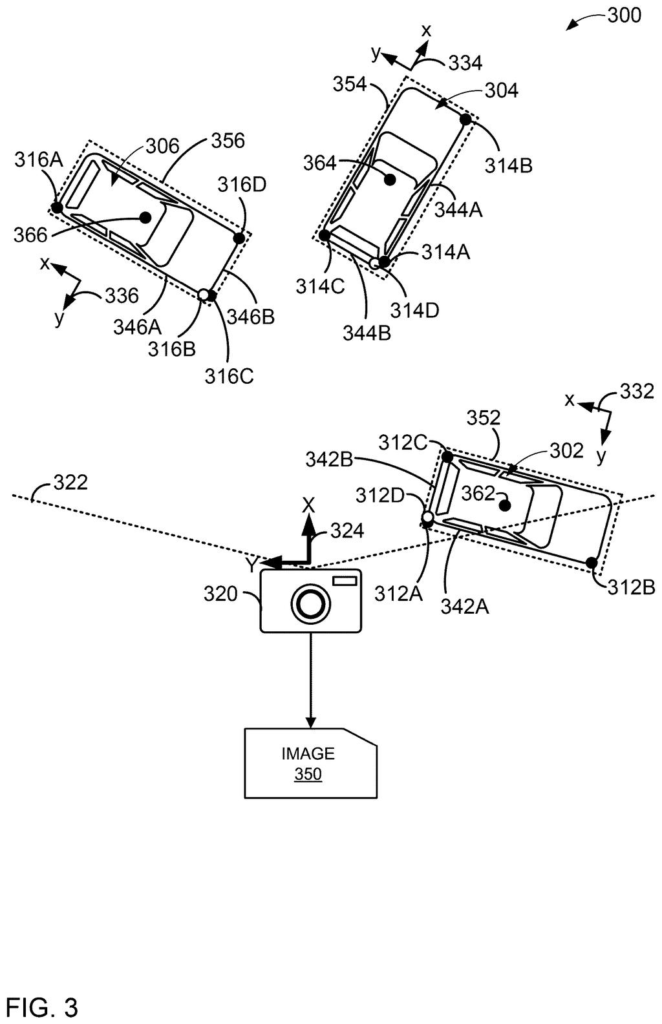
How Qualcomm's corner-detection approach handles flipped objects
A security camera stares at an empty parking lot all night. When a car finally enters the frame, the AI needs to put a box around it, but the car might be pulling in nose-first, reversing, or sitting at an angle. That small difference in direction can throw off a lot of detection systems.
Qualcomm's patent tackles this by teaching a system to find the corners of an object in a way that doesn't depend on which way the object is facing. Instead of labeling a corner "front-left" (which only makes sense if you know the front), the system uses categories that mean the same thing no matter the object's orientation. From those corners, it works out a center reference point, then draws the bounding box around the object.
The practical result: a more consistent box around cars, people, or packages whether they're coming, going, or turned sideways, which is useful in cameras, driver-assistance systems, and any device doing real-time visual detection.
estimating, for an object in an image, positions of one or more corners that correspond to one or more corner categories that are invariant to a direction polarity of the object; …
Translation: The system finds key corners of an object without needing to know which direction it is facing.
How the corner categories stay stable across object directions
Traditional bounding-box systems often rely on knowing an object's orientation before they can correctly label its corners. If a car's "front-left corner" label depends on the car facing a particular direction, the system can misfire when the car faces the opposite way.
Qualcomm's approach introduces what the patent calls direction polarity invariant corner categories (corner labels that stay consistent regardless of which way the object is oriented). The system estimates where each corner of an object sits in an image, assigns each corner to one of these orientation-neutral categories, then uses those corner positions to calculate an estimated reference point (essentially a reliable anchor, like a center point) for the bounding box.
From that reference point, the system generates the full bounding box, a rectangle (or 3D equivalent) that tightly encloses the object. The key steps are:
- Detect one or more corners of the object in the image
- Assign each corner to a category that doesn't change based on object direction
- Compute a reference point from those corners and categories
- Draw the bounding box from that reference point
The patent is written broadly enough to apply to 2D and 3D detection scenarios, meaning it could work on flat images from a single camera or on depth-data outputs from sensors like lidar.
What this means for cameras and on-device AI detection
For driver-assistance systems and security cameras, object detection has to work in the real world, where vehicles and pedestrians move in every direction. A detection method that doesn't require knowing an object's orientation first is a useful building block for more reliable on-device AI, particularly on Qualcomm's own chips used in phones, cars, and cameras.
the pattern in Qualcomm's computer-vision filings points toward tighter integration between detection algorithms and the hardware running them. For you as a user, the downstream effect is simply fewer missed detections or badly drawn boxes around objects in photos, dashcam footage, or live video feeds.
Qualcomm's 35th filing we've tracked since July in the self-driving sensing race builds on earlier work like its false location check and its combined 3D and camera AI.
Claim 1 is broad. It covers any method that estimates corner positions using direction-neutral categories, computes a reference point from them, and outputs a bounding box. There is no restriction on the type of neural network, the number of corners, the object class, or the sensor type. That breadth means, if granted, this claim could cast a wide net over a lot of standard object-detection pipelines that happen to use any form of orientation-invariant corner labeling.
In practice, the claim's reach depends heavily on how similar prior art is interpreted during examination. The core idea, anchoring a bounding box to corners labeled without reference to object direction, is a real engineering choice that addresses a genuine problem in detection systems. But the claim language is abstract enough that the examiner will almost certainly push back and demand narrowing.
For Qualcomm, filing broad and then negotiating down is a standard playbook. Even a narrowed version of this claim, covering specific corner-category schemes or specific reference-point calculations, could be a useful chip-licensing asset given how widely object detection is deployed in automotive and mobile devices.
There are more where this came from
We read every patent application Big Tech publishes and send you the ones worth knowing. Plain English, free, every week.
The drawings
4 drawing sheets from US 2026/0278983 A1 · click any drawing to enlarge


Want this weekly breakdown for a company we don't cover? Patentlyze Pro →