
Google Patents an AI Assistant That Answers Your Messages and Sorts the Rest
A new Google patent application describes an AI helper with its own email address that introduces itself as your assistant. It answers some messages, forwards others, and writes about you in the third person.
What Google's email-answering AI agent does
A note arrives asking whether a busy person can meet tomorrow at 3 PM. Nobody reads it, yet a polite reply goes out within moments. That is the scene in a new Google patent application, and the busy person could be you.
The filing describes an AI helper with its own email address that works on your behalf. You set it up by sending it a plain message about yourself: your name, when you like to meet, what it should pass along to you. It writes a short summary of what it knows and keeps it on file. When someone writes to you, the helper decides whether to answer, forward the note, or save it for later. It writes about you in the third person, so nobody mistakes it for you.
You can change its instructions the same way, just by messaging it. Tell it to stop auto-replying to every colleague, and it rewrites its own notes.
… determining, by the electronic processor, one or more profile settings of the user based on the received electronic communication using the first large language model of the communication agent …
Translation: The AI learns your preferences by reading your initial setup messages.
How the agent learns you and decides to reply
The patent covers three connected pieces. The first is setup. You send a message to the agent, which is an AI program built on a large language model (the same kind of technology behind modern chatbots). The model checks that you are really telling it about yourself, then boils your message down to a short, third-person summary and stores it as your profile settings.
Later messages edit that profile. The agent hands the model both its current notes and your new message, and the model writes a revised version. In the filing's example, 'Respond to Meeting Invites from Colleagues: Yes, always' becomes 'Only if they are a manager.'
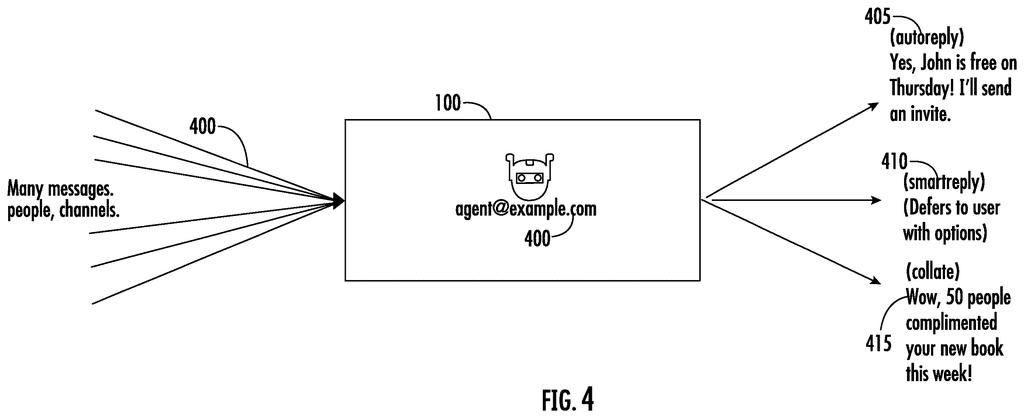
The second piece is deciding whether to answer a message from someone else. The model works out the sender's intent (a meeting request, say, or spam) and produces a confidence score, a number for how sure it is that it should handle the message. In the filing's example, 60% confidence is compared with a set threshold before any reply goes out. Unknown senders start out as untrusted and get less personal detail.
The third piece covers what happens when the agent does not reply:
- Forward the message to you and ask what to do, then learn from your answer.
- Buffer similar messages, such as job postings, and send one summary once enough pile up. The filing's example reads 'Wow, 50 people complimented your new book this week!'
- Schedule a meeting, jot a note, or draft a reply for you to review.
… determine, using a large language model of the communication agent, whether or not to respond to the electronic communi-2024/242672 cation using the communication agent …
Translation: The system decides whether it should reply to a message for you.
What a message-answering AI means for your inbox
If you have ever come back from a trip to hundreds of unread messages, the pitch is easy to see: an assistant sorts the pile, answers the simple questions, and hands you a short summary of the rest. The filing says this could save users hundreds or thousands of hours of reading and replying, though that figure is the company's own estimate. It is built for email, text messages and chat apps alike.
The trust questions matter as much as the time savings. The agent would write as a separate, clearly identified assistant, treat unknown senders as untrusted, and share less personal detail with them. It would also learn from you when you step in on a message it forwarded. How well that works in a real inbox is something a patent application can't tell you.
Google's 61st filing we've tracked since May in our AI agents that act for you watchlist follows earlier applications like answering calls by tapping and commanding a robot dog.
Claim 1 covers the setup of the assistant. A person sends an introductory message, a language model turns it into stored settings, and the same model later reads a new message and edits those settings. The claim never mentions replying to anyone.
The wording is wide open. 'Profile settings' can be whatever the model pulls out of your message, and the claim names no particular app, so email, texts and chat all fit. If granted, it could cover any service where you teach an AI assistant about yourself by chatting with it and it rewrites its own notes after each message.
The tight part is the loop: one model reads the first message, the result gets stored, and that same model revises it after a later message. The more distinctive ideas sit in the other two independent claims, such as holding back a reply when the model's confidence is too low, or saving messages and sending you one summary. Taken together, this is a sensible, fairly routine filing, and its best material is the logic for deciding when the assistant should stay silent.
Get our take in your Top Stories
Liked this breakdown? Add Patentlyze as a preferred source on Google, and our plain-English take shows up more often in your Top Stories the next time Google patent news breaks.
There are more where this came from
We read every patent application Big Tech publishes and send you the ones worth knowing. Plain English, free, every week.
The drawings
10 drawing sheets from US 2026/0352615 A1 · click any drawing to enlarge


Show the other 2 sheets


Want this weekly breakdown for a company we don't cover? Patentlyze Pro →
Be the first to weigh in