
Google Files Patent for Answering Phone Calls by Tapping Instead of Talking
Google's patent has your phone answer an unknown call, talk to the caller for you, and ask you only one thing: which reply to tap. You can follow the whole conversation as text without saying a word.
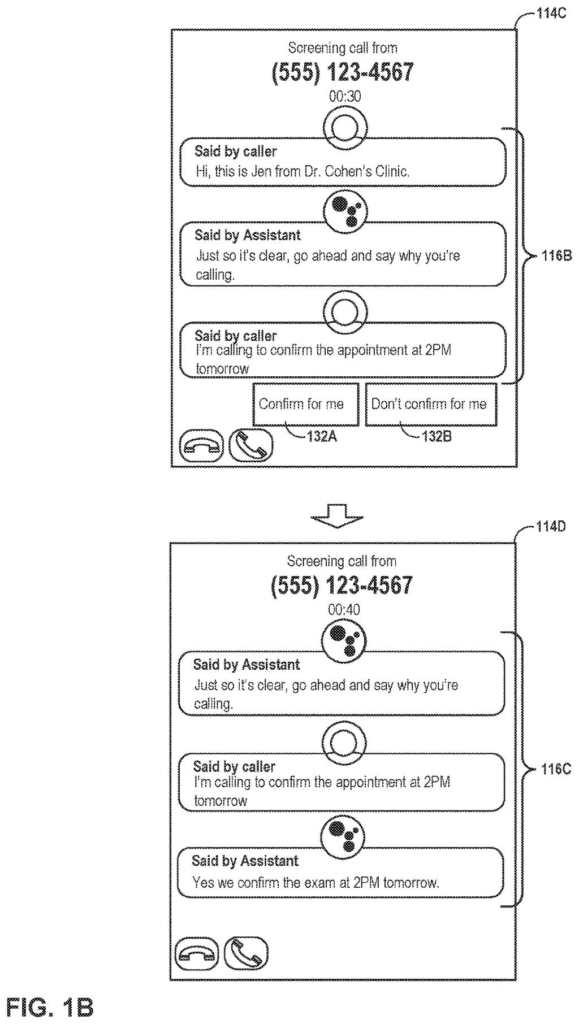
What Google's tap-to-reply call screening does
A phone buzzes on a desk in the middle of a meeting. The screen shows a number nobody saved. You can't answer, and you don't want to send it to voicemail in case it's the doctor's office.
Google's patent application describes a phone that answers for you. An automated voice greets the caller and asks who they are and why they're calling, while the words appear on your screen as a live transcript. As the caller talks, your phone offers a few tappable replies, like confirm the appointment or call back later. Tap one, and the phone says it out loud in its own words.
You never speak and you never have to listen. If the call turns out to matter, one tap hands it over to you.
… determining, by the one or more processors and based at least in part on contextual information associated with the call, one or more candidate replies …
Translation: The phone uses the situation on the line to suggest smart replies.
How the phone picks replies for each caller
Claim 1 covers a device that sets up a call, carries on a conversation in it, works out one or more candidate replies from contextual information about the call (details like what the caller just said, who they are, the time, or your calendar), and sends a matching reply when you select one.
The description fills in the screening setup. The phone answers an incoming call and talks to the caller using a conversation model (a neural network, meaning software trained on a large pile of anonymized phone conversations). Speech recognition turns the caller's voice into text, and text-to-speech voices the reply. The spoken reply doesn't have to match the button's wording. It just needs the same meaning.
The suggested replies change based on:
- Caller type, worked out from the phone number: contact, business, spam, or unknown. A spam caller gets options like "Wrong number" and "Take me off your list."
- Use case of the call, such as appointment confirmation, delivery, order ready, or "where are you."
- The caller's latest remark, so the choices follow the conversation.
The phone can also offer greeting choices before screening starts, such as "Is it urgent?" It can nudge a silent caller to speak. If it decides an unknown caller is really a business or a spammer, it swaps in a new set of replies mid-call.
Why this matters if you dread phone calls
Many people let unknown numbers go to voicemail because answering is a gamble: it could be a robocall, a spoofed number, or a call you can't take right now. A phone that does the talking while you steer with a tap gives you a middle option. You learn who is calling and why, and you step in only when it matters. In the filing's own example, a caller says "Hey this is your dad. I broke my leg," and one tap on "Hold on, I will answer" ends the screening and keeps the call connected.
The filing also points to people who find phone calls hard, including those with social anxiety or hearing or speech disabilities, who could manage calls without a separate relay service. Because you never speak, a scammer can't capture your voice. The description adds that the same approach could handle outgoing calls, such as booking a restaurant table.
Google's 60th filing we've tracked since May on AI agents that act for you follows talking to a robot dog and building home routines from menus.
Claim 1 is short and wide. It covers a device that holds a call, carries on a conversation, comes up with suggested replies based on the context of the call, and sends one when you pick it. Nothing in that wording mentions an incoming call, screening, spoken audio, or a particular kind of AI.
Those details show up in the narrower claims below it: the greeting menu in claim 10, caller type taken from the phone number in claim 7, the silence prompt in claim 5, and the neural network in claim 3. Read literally, claim 1 describes any phone feature that offers context-based tap-to-reply during a conversation, whatever the details.
A claim that wide may get trimmed during review. Even so, the core idea is useful and easy to picture: a machine does the talking, and you steer with one tap.
Get our take in your Top Stories
Liked this breakdown? Add Patentlyze as a preferred source on Google, and our plain-English take shows up more often in your Top Stories the next time Google patent news breaks.
There are more where this came from
We read every patent application Big Tech publishes and send you the ones worth knowing. Plain English, free, every week.
The drawings
9 drawing sheets from US 2026/0352761 A1 · click any drawing to enlarge


Show the other 1 sheets

Want this weekly breakdown for a company we don't cover? Patentlyze Pro →
Be the first to weigh in