
Google Patents an AI That Traces Angry App Reviews to the Update Behind Them
Companies usually learn an app broke from crash counts and speed numbers. This Google patent has an AI read what people are actually complaining about, then point to the code change that probably caused it.
What Google's complaint-to-code patent does
Every time an app gets an update, a few people head to social media to say something stopped working. Maybe your phone won't cast music to your speaker anymore, so you post a screenshot of the error. Somewhere inside the company, nobody connects that post to the update that shipped that morning.
Google's patent describes a system that makes the connection. It collects public complaints, such as posts, reviews and screenshots, and lines them up with the company's own internal records, like bug reports and code changes. An AI then looks for the change that landed right when the complaints began.
The result shows up in a report for developers: what's going wrong, how many people are affected, and which update is the likely culprit. The idea is to treat what you say as a real signal, alongside the usual crash counts and speed numbers.
… incorporating into a generative model prompt, as context for the generative model prompt, one or more of the unstructured inputs and one or more of the source code event inputs …
Translation: The AI reads both the angry user reviews and the recent software changes together.
How the AI pairs angry posts with code changes
The system pulls in two kinds of material. From outside the company, it gathers unstructured inputs (messy, free-form material with no standard format) such as social media posts, forum threads, app reviews, screenshots, and even video or podcast transcripts. From inside, it gathers source code event inputs (records of what developers did), such as bug reports and the edits engineers committed to the code.
Long outside posts are boiled down into short summaries (the filing mentions lengths of 4, 8, 16, 32 and 64 words) so they fit into the AI's limited working memory. Both piles then go into a single prompt (the written instructions given to an AI model), along with commands telling the model to match each complaint to the code event that likely caused it. For screenshots, a vision language model (an AI that reads images as well as text) can do the reading.
The model's answer can include:
- Trends in the negative feedback over time
- The date a wave of complaints began, matched to a code change around then
- A predicted root cause
- A priority ranking for the matching internal bug report
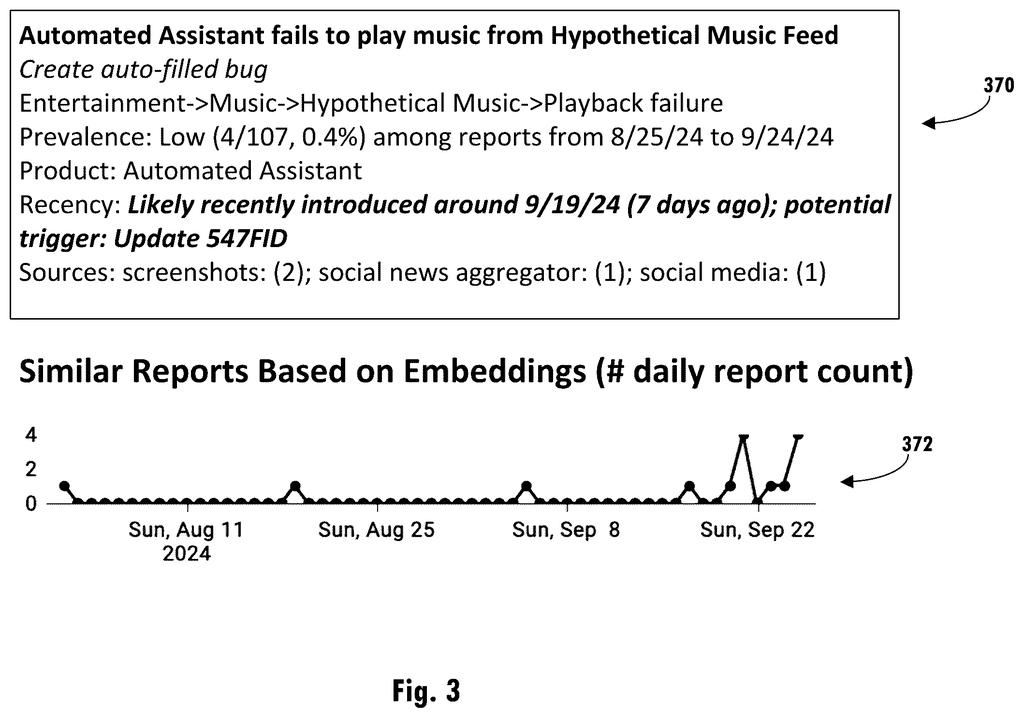
In the filing's example report, a problem is labeled with how common it is (4 of 107 reports) and a note that it was likely introduced around Sep. 19, 2024, with a specific update flagged as the potential trigger. The filing also says the same idea could apply to software that controls robots, using videos of robot behavior.
… map user feedback to source code events, and the results can be rendered on output devices. This enables the identification of user-perceived quality issues …
Translation: The system connects complaints directly to software updates so developers can find bugs fast.
What this means for app updates you install
For you, the practical upside is faster fixes. Today, many companies lean on crash rates and speed measurements to know when an update went wrong, and those numbers miss plenty of annoyances: an app that freezes without crashing, or a feature that stops working without warning. The filing argues that people's own complaints cover those gaps, including problems that are hard to log.
For Google, it's a way to turn scattered public chatter into a ranked to-do list for engineers. The filing also says the system can flag safety, harassment or public relations concerns the same way as any other regression, and that AI analysis may cut down on developer bias in judging quality. Whether it works depends on how well the model matches complaints to causes, which the filing doesn't quantify.
Google's 1027th filing in our Google coverage since May joins recent applications like smart glasses for finding lost items and recycling a chatbot's past answers.
If you've ever posted that an app broke after an update and then waited weeks for any sign of a fix, this patent goes after exactly that wait. The benefit to you is speed: a complaint that might sit unread today could be tied to a specific update within days.
You'd notice it only indirectly. There's no new button or setting. What changes is a fix arriving sooner, or a bad update getting pulled back before it reaches everyone.
The weak spot is that an AI is guessing at causes, and a wrong guess sends engineers down the wrong path. The filing gives no accuracy figures. Still, the benefit is easy to picture: fewer weeks living with a broken feature.
Get our take in your Top Stories
Liked this breakdown? Add Patentlyze as a preferred source on Google, and our plain-English take shows up more often in your Top Stories the next time Google patent news breaks.
There are more where this came from
We read every patent application Big Tech publishes and send you the ones worth knowing. Plain English, free, every week.
The drawings
6 drawing sheets from US 2026/0349668 A1 · click any drawing to enlarge


Want this weekly breakdown for a company we don't cover? Patentlyze Pro →
Be the first to weigh in