
Google Files Patent to Close the Gaps in Smart Glasses Images
Smart glasses paint their images with rows of tiny mirrors, and when those mirrors don't quite touch, a straight line can show up with blips in it. Google's patent application fixes that by stacking color-specific mirror layers so neighboring sets overlap.
What Google's overlapping smart glasses mirrors do
Imagine you're wearing smart glasses and a glowing arrow floats in front of you to show which way to turn. The arrow's straight edge has tiny breaks in it, like a line drawn with a skipping pen. That's the flaw this patent application goes after.
The cause is in the lens. The mirrors that bounce the image toward your eye are coated onto molded plastic, and molding leaves rounded edges and slightly slanted sides. Neighboring mirrors end up with small gaps between them, and those gaps become gaps in the picture.
Google's fix is to build the mirrors as thin layers instead. Blue, green and red mirror coatings are stacked with clear film in between, sliced at an angle, and arranged so each set overlaps the next one. With the overlap, the light coming out has no holes, and the image reaching your eye should look smooth.
… a first reflective facet to reflect light having a first optical characteristic and a second reflective facet to reflect light having a second optical characteristic that is different from the first optical characteristic …
Translation: The glasses use different tiny mirrors to bounce different types of light.ء
How the laminated mirror stack gets sliced
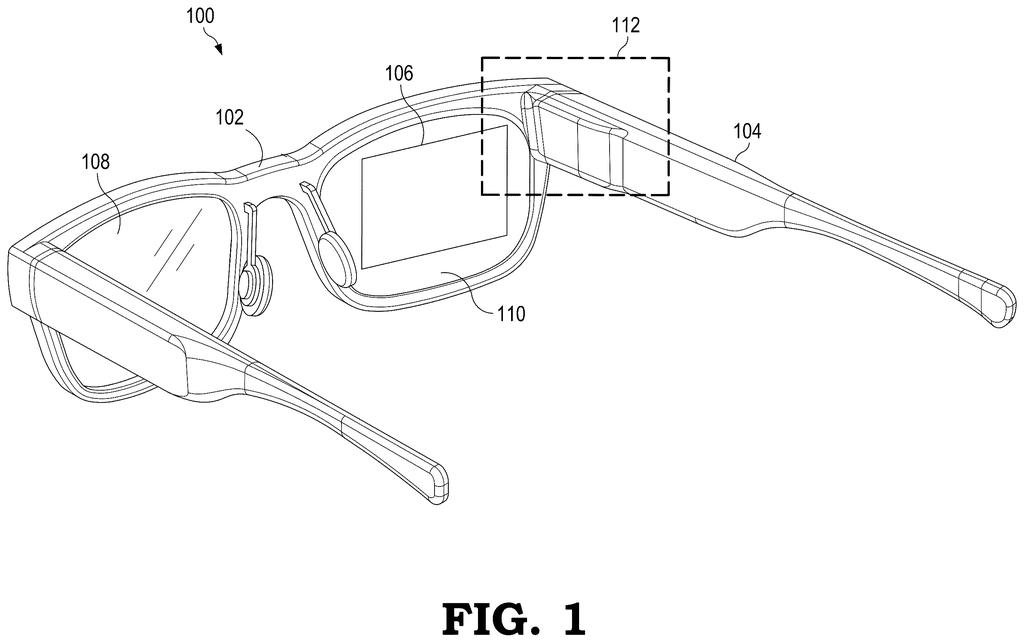
Smart glasses like this use a waveguide (a clear lens layer that carries light from a tiny projector across the glass to your eye). Light enters through an incoupler, bounces along inside, and leaves through an outcoupler. Sometimes that outcoupler is built from reflective facets, a row of tiny angled mirrors.
Conventional versions coat angled faces on molded plastic. Molding leaves rounded edges and slanted sides, so neighboring mirrors leave gaps, and the gaps show up as blips in the picture. The claims cover a waveguide where each set of facets holds separate mirrors for different colors (or different polarization, meaning the orientation of the light waves). Matching mirrors in neighboring sets overlap in the direction the light leaves.
The description builds this by lamination:
- Coat thin films with mirrors that each reflect blue, green or red light and let the other colors pass.
- Separate the mirrors with clear carrier film, and separate each set from the next with a spacer layer, which the claims describe as thicker than the carrier film.
- Stack several sets, then cut the stack at one shared angle (15 to 45 degrees, about 30 in an example) with a saw or laser.
- Glue the cut piece into the lens, or mold plastic around it.
The same layout can also serve as the incoupler or the exit pupil expander (a section that widens the area where your eye can see the image), not only the outcoupler.
Why gap-free lenses matter for Google's glasses
If you ever wear glasses with a built-in display, image quality decides whether text and icons feel crisp or fuzzy. Breaks in a line or a letter are easy to spot, and this filing targets exactly that flaw. It does so by treating the mirror section of the lens as something assembled from films, instead of one molded surface that has to be perfect.
The filing names no product and gives no measured results, so the benefits are the company's own claims about the design. Still, it shows Google working on the physical lens part of display glasses, which matters because thin, normal-looking frames depend on optics like this.
That makes this Google's 53rd filing we've tracked since May in our smart glasses displays watchlist, building on earlier applications like sunlight readability and even screen brightness.
Of all the display problems in smart glasses, gaps in the image are one a factory can plausibly fix. Nothing here needs new electronics or new software. It changes how one piece of the lens is built: thin colored mirror layers stacked with clear film, sliced at an angle, then glued or molded into the lens.
That keeps the road to a product short on paper. The materials are ordinary films and coatings, and the cutting can use a saw or a laser. What has to come first is proof that a factory can stack and slice these layers precisely and cheaply, over and over, since overlap between neighboring sets is the whole idea.
The filing gives no image quality measurements, so you can't tell how much better the picture gets. Treat it as a sensible manufacturing recipe for one lens part. It sits fairly close to buildable, and it can only arrive inside new hardware, never as a software update.
Get our take in your Top Stories
Liked this breakdown? Add Patentlyze as a preferred source on Google, and our plain-English take shows up more often in your Top Stories the next time Google patent news breaks.
There are more where this came from
We read every patent application Big Tech publishes and send you the ones worth knowing. Plain English, free, every week.
The drawings
12 drawing sheets from US 2026/0339101 A1 · click any drawing to enlarge


Show the other 4 sheets


Want this weekly breakdown for a company we don't cover? Patentlyze Pro →
Be the first to weigh in