
Google DeepMind Files Patent for AI That Flags Disease-Causing Changes in Proteins
A genetic test can turn up a long list of tiny changes in your proteins, and the hard part is knowing which one actually causes illness. This Google DeepMind filing describes an AI that ranks them by how out of place each change looks, using the same protein from many related species as a guide.
What DeepMind's protein-mutation patent actually does
A doctor gets a genetic test back for a patient with an unexplained illness. The report lists a long run of tiny changes in the patient's proteins, and most of them are probably harmless.
This patent application from Google DeepMind describes a computer program that sorts the harmful changes from the harmless ones. Proteins are chains of building blocks called amino acids, and a mutation swaps one block for another. The program looks at the same protein in many related species, hides the spot that changed, and asks an AI to guess which block belongs there.
If the AI is confident the original block fits and the swapped one doesn't, the change gets a high disease-risk score. If the swapped block looks like a natural fit, the score stays low.
generating a pathogenicity score characterizing a likelihood that a mutation to a protein is a pathogenic mutation, wherein the mutation modifies an amino acid sequence of the protein by replacing an original amino acid by a substitute amino acid at a mutation position …
Translation: The system calculates how likely a specific genetic change in a protein will cause disease.
How the AI hides a spot and guesses it back
The method starts with a multiple sequence alignment (MSA), which lines up the target protein against many related proteins from other organisms so the same positions can be compared. Each position becomes a numerical summary called an embedding. The position where the mutation happens is masked, meaning its summary is blanked out.
A neural network built from row-wise and column-wise self-attention layers (a technique that lets each piece of data weigh which other pieces matter) updates the whole table. A smaller projection network then reads the blanked position and outputs a score for each of the 20 standard amino acids. The final pathogenicity score is the difference between the score for the original amino acid and the score for the swapped one. In the filing's example, the original (L) scores 0.55, a swap to N scores 0.44, and a swap to R scores 0.01, so R is judged more likely to be harmful.
The filing also describes how the network is trained:
- Unmasking practice: it learns to guess amino acids that were hidden in training proteins.
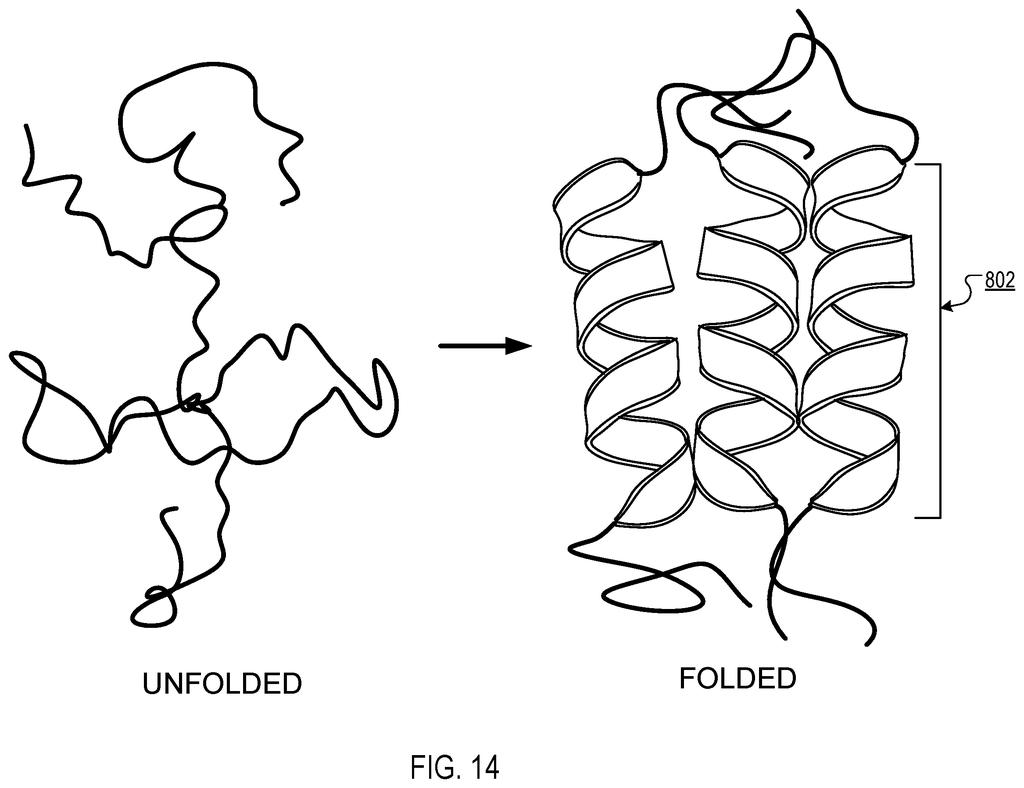
- Structure prediction: it also learns to predict a protein's 3-D shape through a folding network, which is discarded afterward.
- Label cleanup: mutations common in a population are labeled benign and never-seen ones pathogenic. Because that is noisy, training examples where the model confidently disagrees with the label are sampled and removed, then the model is retrained.
… processing the network input using the pathogenicity prediction neural network to generate a score distribution over a set of amino acids; and generating the pathogenicity score using the score distribution over the set of amino acids.
Translation: An artificial intelligence model analyzes the protein data to output numerical scores predicting disease risk.
Why a ranked list of gene changes helps doctors
The most direct use is in the clinic. The filing describes taking a blood, saliva or cheek-swab sample, finding which proteins carry mutations, and checking each against a database of scores covering the human proteome. A score above a chosen threshold (the filing mentions 0.5, 0.8, 0.9 or 0.99) could mark a mutation as a candidate cause of a patient's condition.
The filing also lists uses beyond human medicine. It describes picking mutated proteins for pest control, screening plants and animals for harmful mutations, and judging how dangerous a bacterium or virus strain is. That last one could help choose a milder strain when making a vaccine. For you, the likely effect is indirect: faster, better-ranked answers when a genetic test returns a long list of unknowns.
This is the 952nd Google filing in our Google coverage since May, adding to a body that includes a blood-test health risk predictor and a menu-based home routine builder.
Software alone carries this, and the filing describes a system already built and tested against real clinical data. No new hardware stands between here and a working tool.
The shortest route to something usable looks like a research database where genetics labs can simply look up precomputed scores for known mutations. That step requires trust from clinicians and a fit with how labs already write up results, but the engineering is largely done.
A version for individual patients sits much further out, needing access to personal genetic data and meaningful medical oversight. The realistic first stop is scientists and clinical researchers, and the filing points there directly.
Get our take in your Top Stories
Liked this breakdown? Add Patentlyze as a preferred source on Google, and our plain-English take shows up more often in your Top Stories the next time Google patent news breaks.
There are more where this came from
We read every patent application Big Tech publishes and send you the ones worth knowing. Plain English, free, every week.
The drawings
19 drawing sheets from US 2026/0341404 A1 · click any drawing to enlarge


Show the other 11 sheets


Want this weekly breakdown for a company we don't cover? Patentlyze Pro →
Be the first to weigh in