
Qualcomm Patents a Dual-Camera System That Erases Reflections From Photos
Taking a photo through a window almost always means fighting your own reflection. Qualcomm's new patent describes a way to use the camera on the other side of the device to figure out exactly what needs to be erased — and then fill it in with AI.
What Qualcomm's reflection-removal system actually does
Imagine you're on a train, trying to snap a photo of the landscape outside. Instead of the scenery, you get a ghostly reflection of yourself and the interior of the car staring back at you. It's one of the most frustrating things about phone photography, and no amount of pressing your face against the glass fully solves it.
Qualcomm's patent describes a two-camera approach to fix this. The idea is simple: if your front camera is shooting a scene through glass, the rear-facing camera — which is pointed in the opposite direction — can see what's being reflected. The system uses that rear-camera image to identify exactly which parts of the front-camera photo are reflections, not real scene content.
Once it knows where the reflections are, a generative AI model fills those spots in with plausible image content based on the rest of the photo. The result is a clean image without the unwanted overlay — no manual editing required.
How the front and rear cameras work together to kill glare
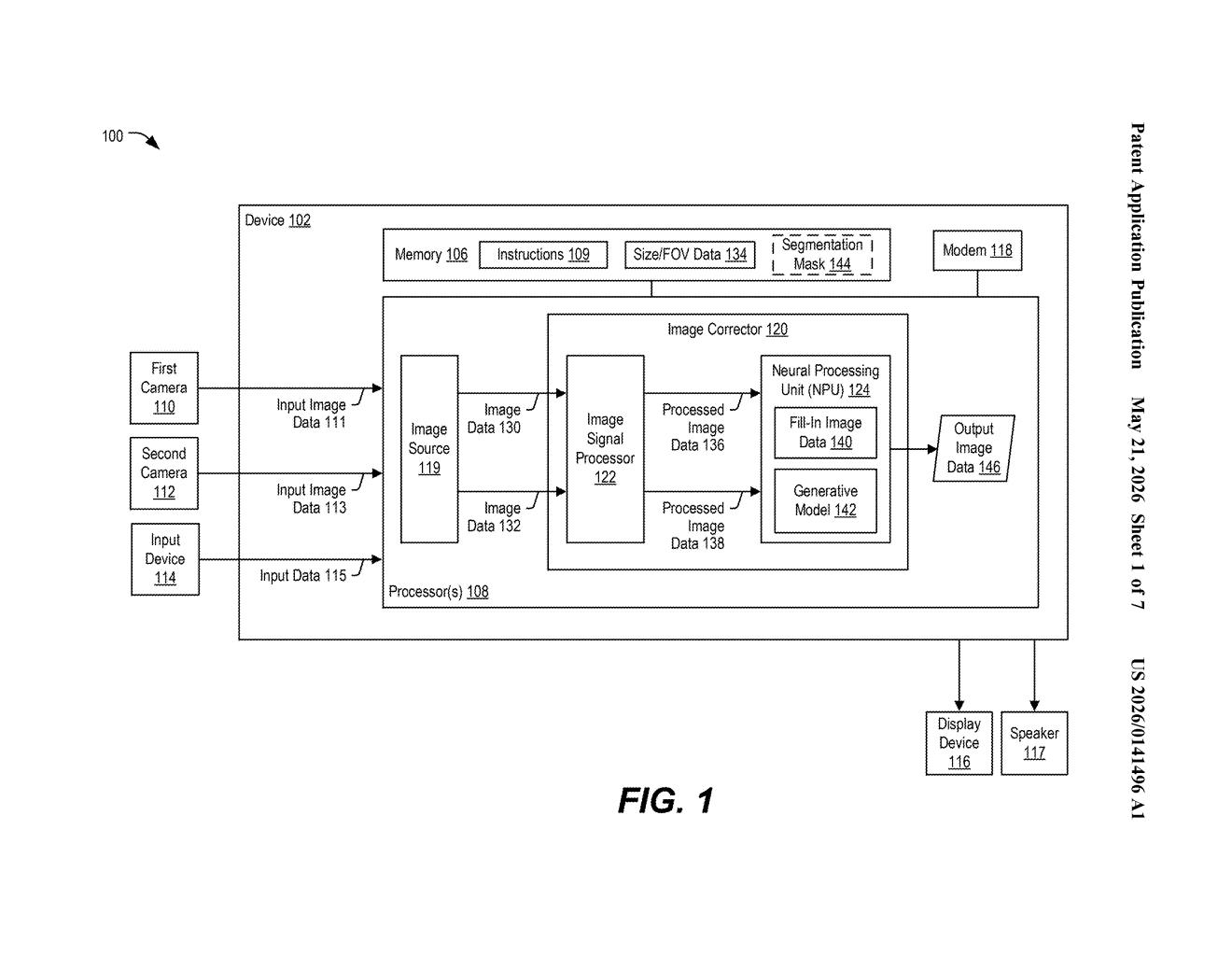
The patent describes a device with two cameras pointing in opposite directions — think front and rear cameras on a smartphone. When the primary (front-facing) camera captures an image, the secondary (rear-facing) camera simultaneously captures its own image of the scene behind the device.
Because the rear camera is pointing toward whatever is causing the reflection in the first place, the system can use that second image to build a segmentation mask — essentially a map that marks which pixels in the front-camera photo correspond to reflected objects rather than the intended subject.
Once the reflected regions are isolated, a generative model (the patent references a Neural Processing Unit, or NPU — a dedicated AI chip built into the SoC) creates fill-in image data: synthetic pixels that replace the reflection zone with visually coherent content inferred from the surrounding image.
The final output image is a composite: most of it is the original front-camera capture, with the flagged reflection regions swapped out for the AI-generated fill. The patent also references size and field-of-view (FOV) data to help align what the two cameras are seeing, since their lenses have different perspectives.
What this means for photography through glass
Reflection artifacts are a genuine pain point for anyone shooting through windows — car windows, storefront glass, airplane portholes, display cases. Current software workarounds (like polarization filters or post-processing apps) require deliberate effort from the user. A system baked into the camera pipeline that runs automatically at capture time would be a meaningful quality-of-life upgrade.
For Qualcomm specifically, this is the kind of computational photography feature that differentiates Snapdragon silicon in flagship Android devices. If this makes it into a future Snapdragon camera stack, it becomes a selling point OEMs can advertise — and something that would pressure competitors to match.
This is a genuinely clever use of the hardware that's already in every modern smartphone: the insight that the rear camera can 'see' what the front camera is reflecting is elegant. Whether the generative fill-in is good enough in edge cases — crowded reflections, fast motion, complex scenes — is the real question, and the patent doesn't have to answer that. Worth watching.
Get our take in your Top Stories
Liked this breakdown? Add Patentlyze as a preferred source on Google, and our plain-English take shows up more often in your Top Stories the next time Qualcomm patent news breaks.
There are more where this came from
We read every patent application Big Tech publishes and send you the ones worth knowing. Plain English, free, every week.
Want this weekly breakdown for a company we don't cover? Patentlyze Pro →