
Meta
Meta · AI / ML · Filed May 8, 2025 · USPTO published Nov 12, 2026 · This week's release
Meta Patents a System That Rebuilds Tired Ads From Their Own Parts
When an ad stops getting clicks, this Meta patent has software pull it apart into pieces (the text, the background, the product, even the voiceover), change some of them, and put out a fresh version on its own.
- Publication number
- US 2026/0361979 A1(US20260361979A1)
- Applicant
- META PLATFORMS, INC.
- Filed · Published
- May 8, 2025 · Nov 12, 2026
- Inventors
- Bina Thakkar, Daniel Peter Moller, Gabriel Benjamin Mark Shalom
- Status when we published
- Approved; patent expected soon
- Document
- 16 claims
- US classification
- 725/116
- Examiner
- BANTAMOI, ANTHONY (Art Unit 2422)
What Meta's ad-remixing patent actually does
Today, even an ad that works well wears out. The more often people see the same one, the less they click, and fixing it usually means one team spots the drop while a different team has to design something new. By the time the fresh version is ready, the best window may have closed. That delay is the problem Meta's patent application sets out to fix.
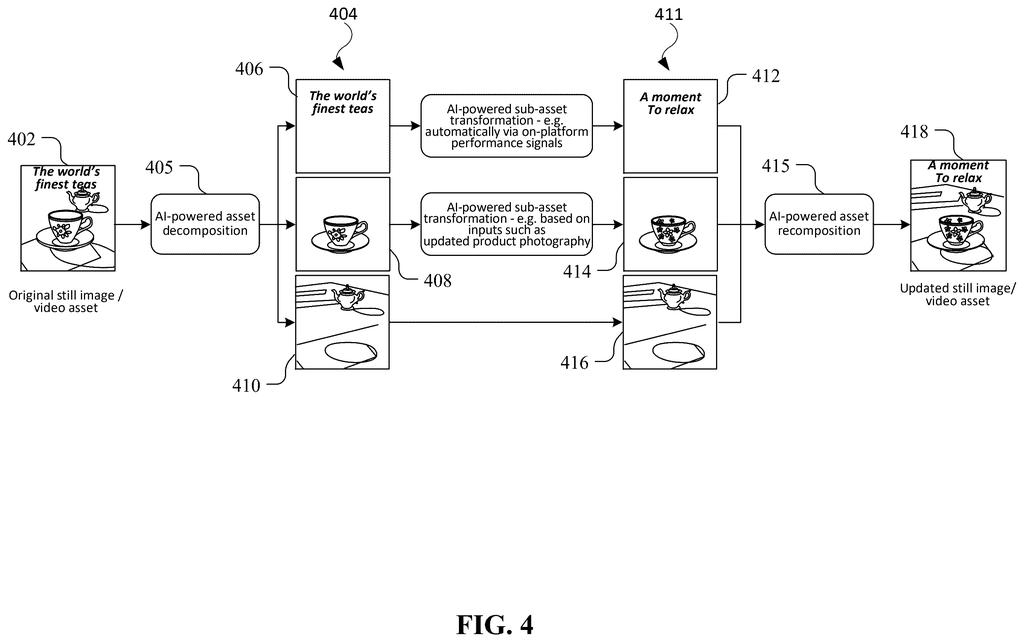
Meta's answer is to let software do the redesign. When clicks and views fall below a set line, the system splits the ad into its parts: the words, the background, the objects up front, the logo, the music and the voice. It changes one part, say swapping a pastry photo for a sandwich, then stacks everything back together as a new ad.
The same trick can translate the text into other languages, so viewers in Spain and Germany could each get their own version. Your feed would simply show the fresh one.
… automatically determining whether user engagement or user interaction by the one or more users with the at least one content item is below a predetermined threshold …
Translation: The system checks if people are ignoring an ad.
How Meta takes an ad apart and rebuilds it
The claims describe a four-step loop. The system watches how people respond to an ad, using signals like click rates and view-through rates (how much of a video people actually watch). When engagement drops below a threshold the advertiser sets, it breaks the ad into sub-assets: individual pieces such as text, background, foreground objects, logos, images, video and audio.
Next it changes at least one piece and recombines it with another piece to make a new ad. The filing's example is a tea ad. The headline "The world's finest teas" becomes "A moment To Relax," the cup gets a new color and pattern, and the layers are stacked back together with shadows restored. To fill the gaps left when one layer is lifted off another, the system uses inpainting (an AI technique that predicts the missing pixels from the surrounding image).
The filing also describes several variations:
- Translation: text or audio is translated for a region, such as Spanish for Spain and German for Germany.
- Video: the system can detect a voiceover's language and mood, redo it in a different voice and language, swap a jazz track for a classical one, and reorder the shots.
- Learning and control: a machine learning model (software trained on past examples) can learn which content tends to draw engagement, or an administrator can type in the variants directly.
… automatically generate an updated a content item(s) to obtain one or more new content items based on the segmented plurality of different images or the different videos …
Translation: It builds a fresh ad out of the old pieces when interest drops.
Why Meta's ad factory idea could reach you
For you, the most likely effect is more variety in the ads you see: fewer repeats of the same pitch, and more versions in your own language or season. For advertisers, the pitch is speed. Instead of waiting on a design team, a fresh batch (the filing mentions hundreds or thousands of versions) could appear as soon as results sag. The filing also argues that pulling underperforming ads cuts network traffic.
The patent office has approved this application, and once Meta pays the final fee it should be issued as a granted patent. It describes a method rather than a launched tool, and it says nothing about pricing, rollout or which Meta apps would use it.
Meta's fourth filing in our Voice & speech AI coverage since June connects to mood tracking by voice and AI personality selection, showing continued interest in voice-based user modeling.
Source: US 2026/0361979 A1 at the USPTO (PDF). Full patent text and figures are in the official publication.
Get our take in your Top Stories
Liked this breakdown? Add Patentlyze as a preferred source on Google, and our plain-English take shows up more often in your Top Stories the next time Meta patent news breaks.
Add Patentlyze on Google
One click.
There are more where this came from
We read every patent application Big Tech publishes and send you the ones worth knowing. Plain English, free, every week.
The drawings · 10 sheets
10 drawing sheets from US 2026/0361979 A1 · click any drawing to enlarge


Show the other 2 sheets


More from Meta
All 190 Meta patents →
More in AI / ML
All 2,637 AI / ML patents →
Google
Google Patents a Speech Recognizer That Types Fast, Then Fixes Its Own Mistakes
Google
Google Files Patent for Teaching Speech Recognition to Learn From Its Own Best Guesses
Google
Google Files Patent for Captions That Know Exactly When Each Word Was Said
Google
No comments yet