
Meta Files Patent to Track VR Controllers With One Light Instead of Many
Today's VR controllers carry a string of tiny infrared lights for the headset to follow. Meta's patent application replaces the whole string with one LED and a light-carrying channel built into the controller's frame.
What Meta's single-LED controller tracking does
Imagine you're swinging a virtual sword in a VR game. Behind the scenes, the headset's cameras are hunting for a pattern of tiny infrared lights on the controller in your hand, and that pattern tells the system where the controller is and how it's tilted.
Today, those lights are usually a string of separate LEDs wired together with flexible circuit strips, connectors and extra chips. All that hardware adds cost, and the strips can be hard to mount and easy to scratch. Meta's filing swaps the string for one LED and a thin channel that carries its light through the controller's frame.
The light travels along that channel and leaks out at spots along the way, such as small dents in its surface, so a single LED shows up to the cameras as many glowing dots. The channel can be shaped like a rod or a ring, so it can follow the controller's design. The filing says this could cut cost and power use, and keep tracking working when your hand blocks some of the dots.
… a waveguide disposed within a frame of the device; and an optical coupler configured to couple light from the light source into the waveguide, wherein the waveguide is configured to emit at least a portion of the light from a plurality of locations along the waveguide to define a plurality of beacons for tracking a displacement of the device.
Translation: A built-in light guide spreads a single light source across multiple points to track movement.
How one LED lights up many tracking points
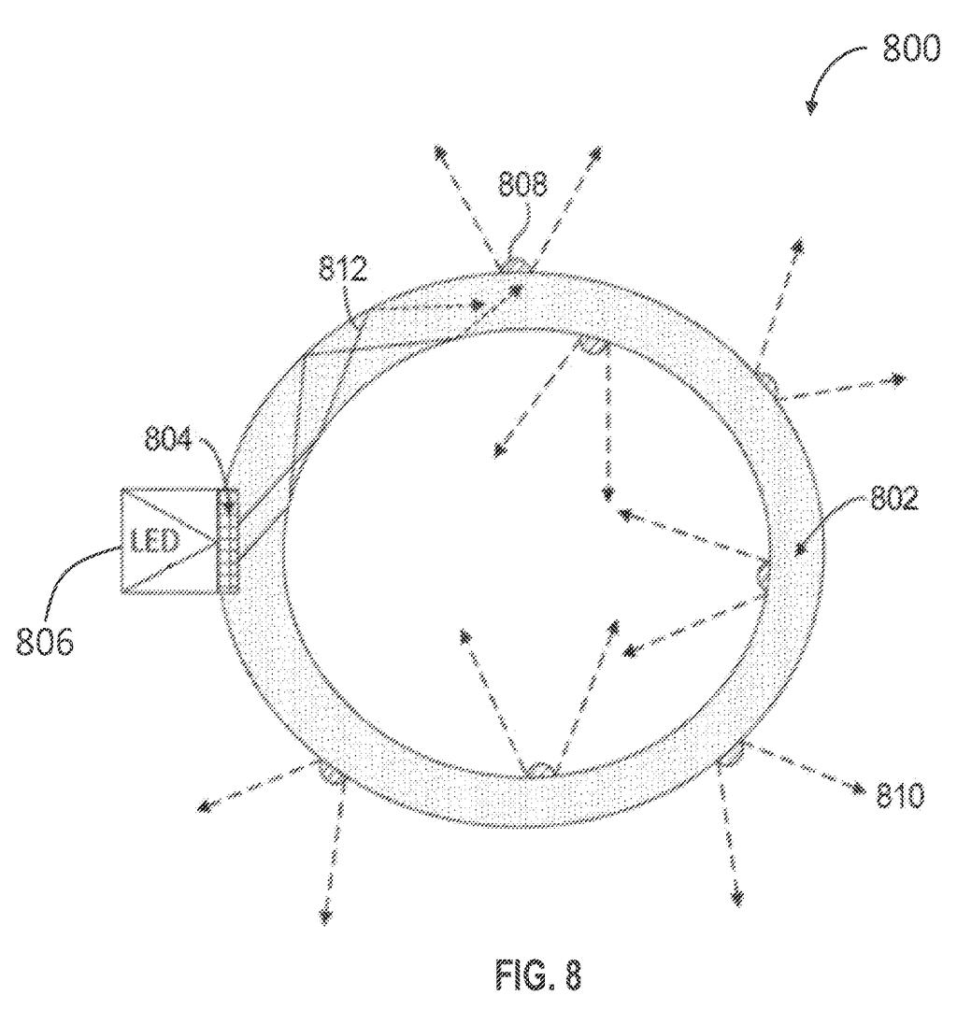
The filing describes a waveguide (a thin channel that carries light, much like a fiber-optic strand) built into the frame of a device such as a VR controller. A single light-emitting diode, or LED, shines into it through an optical coupler (a part that funnels the light in). The waveguide then lets some of that light out from several places along its length, and each place becomes a beacon the headset's camera can spot.
The filing describes several versions:
- A multimode optical fiber (a fiber that carries many light paths at once) that splits into several strands, each pointing in a different direction.
- A bundle of fibers fed by a parabolic mirror (a curved mirror) with the LED sitting at its focal point.
- A rod-shaped or ring-shaped waveguide with small dents or surface spots that scatter light out. The ring version uses a surface grating (a patterned surface that bends light) to bring the light in.
The light is usually infrared, so you can't see it, but the cameras can. Other claims add an accelerometer (a sensor that senses tilt relative to up and down) and a wireless module that reports the controller's orientation to the headset. One claim also says the beacons should send out light with a spread no narrower than what the headset camera can collect.
The waveguide may be configured to emit at least a portion of the light out of the waveguide as multiple beacons for tracking an orientation and a displacement of the device.
Translation: The system shines light out of the frame at various spots so cameras can track the controller's position and rotation.
Why this could make VR controllers cheaper
For you, the practical upside is mostly out of sight. A controller with fewer parts inside could cost less to build and could use less battery, since one LED does the work of a whole string. The filing also says the light channel can be shaped to fit different controller designs, which gives designers more freedom with grips and rings.
There's a tracking benefit too. Because the light leaks out at many points, the filing says some beacons should stay visible to the headset's cameras even as your hand turns or covers part of the controller. That could mean fewer moments where your virtual hand jumps or drifts. It's a patent application, so none of this tells you what will actually ship.
Meta's 81st filing we've tracked in the AR glasses race since May builds on a wider-view lens idea and a detachable menu bar to show how the company keeps shaping what AR eyewear might do.
Claim 1 is wide. It asks for a light source, a light-carrying channel built into the frame of a device, and a part that feeds the light into that channel, with light escaping from several spots to serve as tracking points. The wording never mentions a headset, a controller or infrared light.
Those details show up in later claims, and claim 14 narrows things to a handheld controller with a grip. If the broad version were granted, it could reach any tracked gadget built around one light feeding many glowing spots, which would limit how rivals design their own controllers or tools.
The idea itself is a plain cost-cutting move: fewer LEDs, fewer circuit strips, fewer connectors. Broad first claims often change during review, so the final wording could end up tighter than what was filed.
Get our take in your Top Stories
Liked this breakdown? Add Patentlyze as a preferred source on Google, and our plain-English take shows up more often in your Top Stories the next time Meta patent news breaks.
There are more where this came from
We read every patent application Big Tech publishes and send you the ones worth knowing. Plain English, free, every week.
The drawings
13 drawing sheets from US 2026/0349249 A1 · click any drawing to enlarge


Show the other 5 sheets


Want this weekly breakdown for a company we don't cover? Patentlyze Pro →
Be the first to weigh in