
Apple
Apple · Networking · Filed May 7, 2025 · USPTO published Nov 12, 2026 · This week's release
A New Apple Patent Helps Your Phone Know When It's Connected to a Satellite
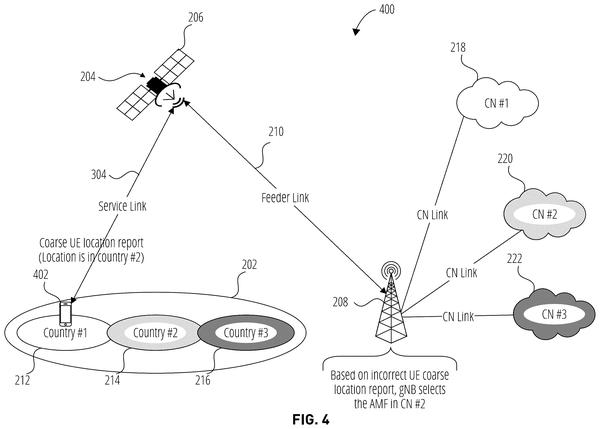
Your phone often can't tell whether it's talking to a cell tower or a satellite, and that matters because satellite links are slower and may not carry every service. Apple's filing has the network hand your phone a list of which networks are satellites.
- Publication number
- US 2026/0362303 A1(US20260362303A1)
- Applicant
- Apple Inc.
- Filed · Published
- May 7, 2025 · Nov 12, 2026
- Inventors
- Roland Gruber, Robert Zaus
- Status when we published
- Waiting for an examiner
- Document
- 20 claims
- US classification
- 455/435.2
What Apple's satellite-labeling patent does
Imagine you're driving through a patchy stretch of countryside and your phone hops onto a satellite link. It works, but the connection is slower, and it might not support voice calls or video.
Here's the catch: some carriers run satellite service without labeling it in a way many phones can read. So your phone can't always tell a satellite from an ordinary tower. Apple's filing fixes that by having the network send your phone a list of which carrier codes, coverage zones and radio channels belong to satellites.
Once your phone knows, it can treat satellite as the backup option. It picks a regular tower first and falls back to a satellite only when nothing else offers what you need, like a voice call. It can also adjust its waiting times, since signals traveling to space and back take longer.
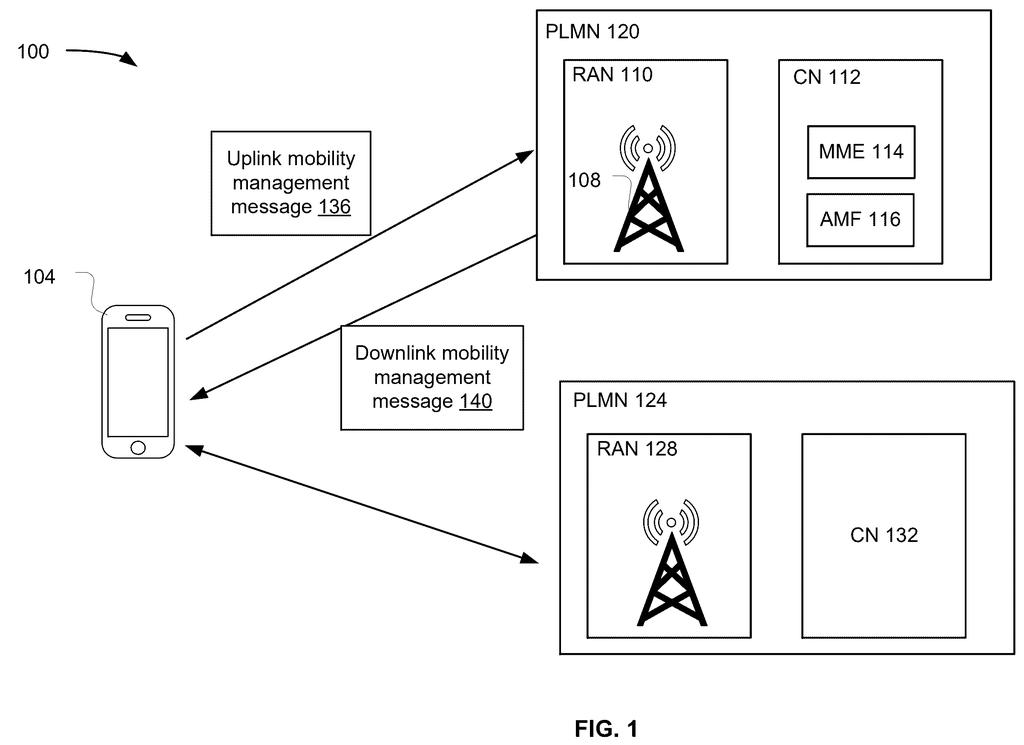
receiving a mobility management message via non-access stratum (NAS) signaling, the mobility management message including an information element (IE) to indicate one or more public land mobile network (PLMN) identities (IDs), tracking areas, or carrier frequencies that are designated for satellite cells; …
Translation: Your phone gets a special signal from the network that points out which towers are actually satellites.
How the satellite list reaches your phone
The core of the filing is a message. Your phone and the carrier's core network (the central computers that handle sign-ins and handoffs) already trade private notes called NAS messages when the phone signs on, checks in or signs off. Apple's filing adds a new field to those notes that lists which networks are satellite-based.
The list can name three kinds of things:
- Carrier network IDs, the country-and-operator code pairs a network broadcasts
- Tracking areas, numbered zones a network divides its coverage into
- Radio channel numbers (called ARFCNs), the specific frequencies a cell uses
The field can say whether the entries are listed one by one, as a consecutive range, or from different carriers. It is sent only after the security handshake, so the phone knows it came from a real carrier.
The phone stores the list and compares it with what each nearby cell broadcasts. A match means satellite. The list can also carry on/off flags for voice, video and text messaging. The selection rules rank regular towers ahead of satellite ones, and a satellite network missing a service you need ranks lowest. Signal strength breaks ties.
Once a satellite is identified, the phone can lengthen its timers, support a satellite-specific rejection message, and handle several tracking area codes per cell. Your home carrier can also switch the whole feature off with a flag stored on your SIM, so another operator can't steer your phone's choices.
Embodiments further provide schemes for prioritizing and/or deprioritizing a satellite cell during PLMN and/or cell selection (or reselection).
Translation: The system figures out when it is better to connect to a satellite instead of a normal cell tower.
What satellite labels mean for your signal
If you've ever watched your phone cling to a weak connection, you know why this matters. As carriers add direct-to-cell satellite service, which the filing says some operators run without the labels most phones need, a phone that can't recognize satellite coverage can't treat it sensibly. With this scheme, your phone could pick a regular tower when one works and keep satellite for when it's the only option.
The service flags add a second layer: if a satellite link can't carry voice and you need to make a call, your phone ranks it last. Carriers gain control too, since they decide which networks get labeled and in what order. It's a rulebook between phones and networks, so you'd notice it, if at all, as a phone that makes saner choices about where to connect.
Apple's 648th filing in our Apple coverage since May follows applications like the satellite battery saver and the sliding headset pad.
Source: US 2026/0362303 A1 at the USPTO (PDF). Full patent text and figures are in the official publication.
Get our take in your Top Stories
Liked this breakdown? Add Patentlyze as a preferred source on Google, and our plain-English take shows up more often in your Top Stories the next time Apple patent news breaks.
Add Patentlyze on Google
One click.
There are more where this came from
We read every patent application Big Tech publishes and send you the ones worth knowing. Plain English, free, every week.
The drawings · 20 sheets
20 drawing sheets from US 2026/0362303 A1 · click any drawing to enlarge


Show the other 12 sheets


More from Apple
All 672 Apple patents →

More in Networking
All 498 Networking patents →
Samsung
Samsung Files Patent for Phones That Learn When a Satellite Can Actually Hear Them
Samsung
Samsung Files Patent to Keep Your Phone Connected as Satellites Hand It Off
Qualcomm
Qualcomm Patents a Way for Phones to Switch Between Cell Towers and Satellites Automatically
Samsung
No comments yet