
IBM
IBM · AI / ML · Filed May 6, 2025 · USPTO published Nov 12, 2026 · This week's release
IBM Files Patent for an AI That Designs New Molecules Step by Step
IBM's new patent describes an AI that designs a molecule the way you might edit a sentence: one small change at a time, checking each against a goal. The twist is how it remembers the molecules it has already seen.
- Publication number
- US 2026/0360481 A1(US20260360481A1)
- Applicant
- International Business Machines Corporation
- Filed · Published
- May 6, 2025 · Nov 12, 2026
- Inventors
- Lan Ngoc HOANG, CLYDE FARE, Lamogha Chiazor
- Status when we published
- Waiting for an examiner
- Document
- 20 claims
- US classification
- 703/12
What IBM's molecule-designing AI actually does
A chemist needs a molecule that captures carbon and stays stable at the same time. Most candidates nail one goal and miss the other, so the search drags on.
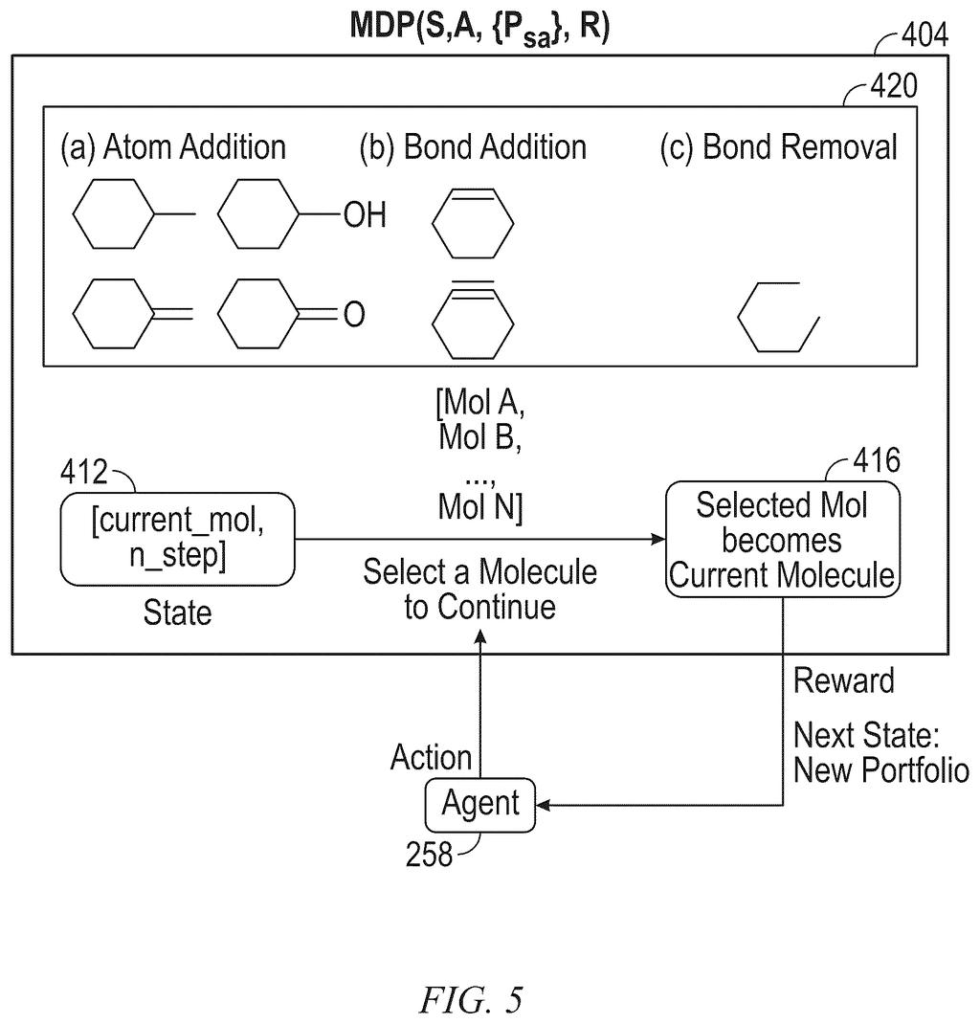
IBM's new patent describes an AI built to shorten that hunt. You give it targets, such as a score for how drug-like a molecule is. It then builds a new molecule by adding or removing one atom or bond at a time, checking each move against the goal. In the filing's example, it takes 50 of these steps to produce one new molecule.
The twist is how it keeps track of its options. Instead of mashing every known molecule into one blurry summary, it keeps a small summary for each one. That preserves more detail, and it means the order you list the molecules in doesn't change the answer.
… selecting, using the modified decision transformer, a next action to perform to generate a modified molecule from a current molecule of the plurality of molecules based on one or more representative rewards and the one or more given target properties; …
Translation: The AI picks its next chemical modification based on expected rewards and target goals.
How the AI keeps a mini-summary of each molecule
The system uses a modified decision transformer. That is an AI model, built on the same architecture behind modern chatbots, that reads a history of goals, situations and moves, then picks the next move. Here, a move means adding or removing an atom or a bond, and the goals are target properties such as carbon capture capacity or a drug-likeness score.
The main change is the ministate. Normally, all the example molecules in a dataset get squeezed into one combined summary, which loses information. In the filing's example, each of 1,000 molecules starts as a 2,048-bit description and is shrunk on its own to 128 bits using a learned linear transform (a simple trained math step that compresses numbers). The AI then works with 1,000 small summaries instead of one.
The attention step (how the model decides which pieces of information to look at) is also changed. Within a block of ministates, each molecule can see the ones on both sides. Across blocks, it only looks at earlier ones. The result is that shuffling the order of the molecules makes no difference.
When there are several goals, the system blends them into one reward using a Lagrange multiplier (a math technique for balancing competing goals under constraints) or a set of reward agents. The weights can be adjusted to favor some goals over others. The loop repeats over M steps, such as 50, to produce one new molecule. The rewards are also used to keep training the model.
The processing and selecting operations are repeated over M steps to generate a new molecule
Translation: The system loops this process multiple times until it builds a completely new molecule.
What this means for drug and materials research
If you care about new medicines, or materials that pull carbon out of the air, the slow part is finding candidates that hit several goals at once. A tool like this could narrow the list before anyone mixes a chemical. One claim even has the finished design sent as a digital file to a pharmaceutical manufacturer to be made.
Keep expectations modest. The filing's results come from a single drug-likeness score on a computer-generated dataset, and any molecule the AI suggests would still need to be simulated or tested in a lab. For IBM, it is another use of the model type behind chatbots, pointed at chemistry instead of language.
IBM's 51st filing in the AI assistant and agent work we've tracked since May builds on one spawning new assistants mid-chat and one tailoring tone to the reader.
Source: US 2026/0360481 A1 at the USPTO (PDF). Full patent text and figures are in the official publication.
Get our take in your Top Stories
Liked this breakdown? Add Patentlyze as a preferred source on Google, and our plain-English take shows up more often in your Top Stories the next time IBM patent news breaks.
Add Patentlyze on Google
One click.
There are more where this came from
We read every patent application Big Tech publishes and send you the ones worth knowing. Plain English, free, every week.
The drawings · 7 sheets
7 drawing sheets from US 2026/0360481 A1 · click any drawing to enlarge


More from IBM
All 470 IBM patents →

More in AI assistant & agent
All 413 AI assistant & agent patents →
Google
Google Patents an AI That Turns Your Prompts Into Step-by-Step Questions
OpenAI
OpenAI Patents a Rulebook Its AI Reads Only When a Touchy Topic Comes Up
Amazon
Amazon Files Patent for a Fact-Check on the Links AI Chatbots Cite
Salesforce
No comments yet