
Intel Patents a Robot That Guesses Object Weight From Your Posture
Before a robot grabs something from you, it needs to know how heavy it is — and Intel thinks the best way to figure that out is to watch how you're standing.
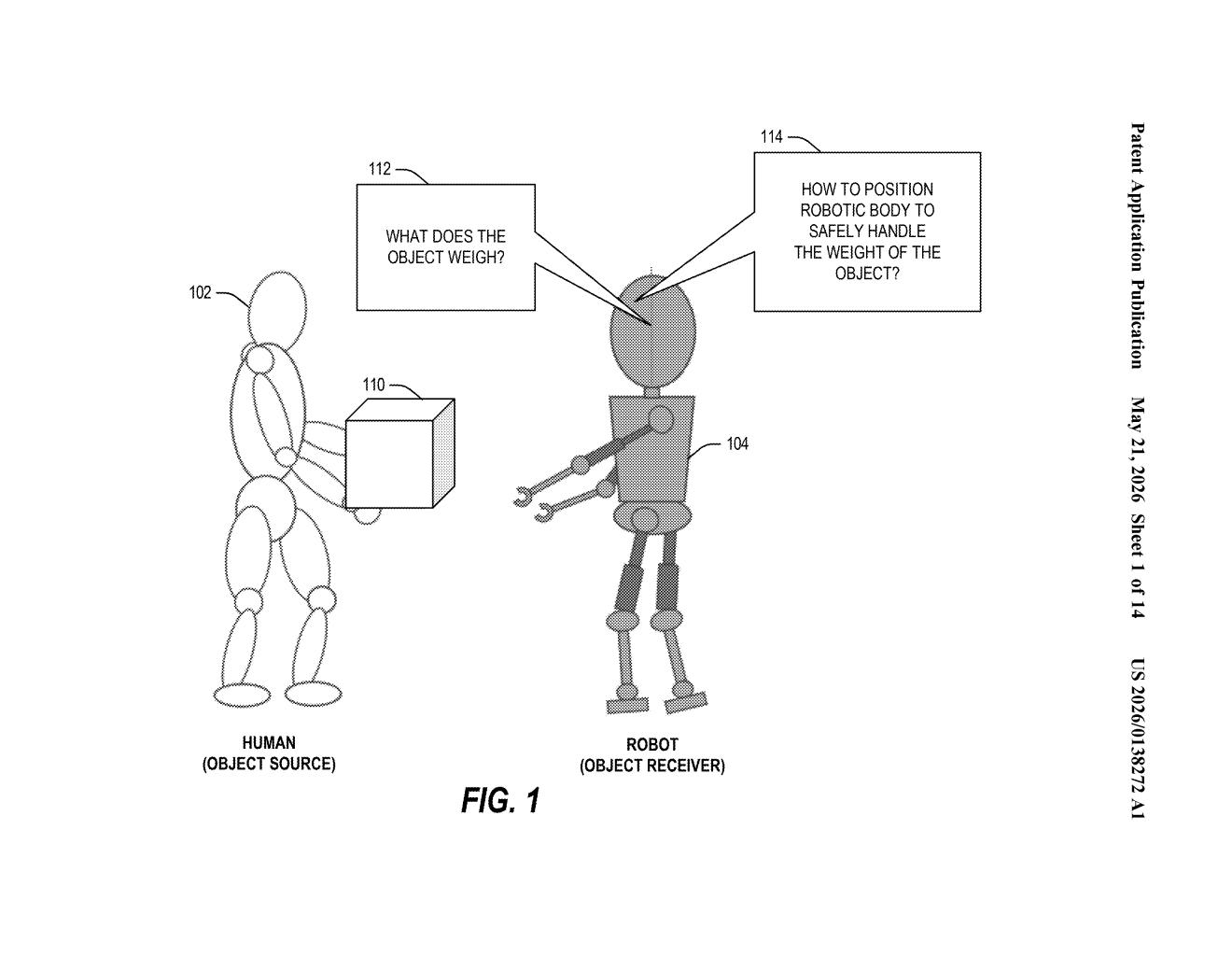
How Intel's robot reads your body to gauge a load
Imagine handing a heavy box to a robot. It has no idea whether you're passing it a feather or a fifty-pound weight — and that uncertainty can cause it to grip too hard, move too fast, or drop the thing entirely. Intel's new patent addresses this by watching you instead of just the object.
The idea is that your body tells a story about what you're carrying. When something is heavy, your posture shifts, your arms drop, your balance changes. Intel's system tracks those cues in real time — breaking down your body into segments, calculating where your center of gravity sits, and using that math to estimate how much the object probably weighs.
Once the robot has a weight estimate, it can adjust its grip, speed, and positioning before it even touches the thing. The same logic applies whether the handoff is coming from a person or another robot.
How posture segments and center-of-gravity math combine
The patent describes a perception pipeline that runs on a robot receiving an object from either a human or another robot. Here's the sequence:
- Track the object and the source — the robot's camera identifies both the object being transferred and the entity holding it.
- Pose estimation — the system identifies the posture of the handoff source from captured images, likely using a skeletal keypoint model (software that maps joints like shoulders, elbows, and hips into a stick-figure skeleton).
- Segment analysis — the body is broken into labeled segments (torso, upper arm, forearm, etc.), each with known or estimated mass properties.
- Center-of-gravity calculation — the system computes the real-time center of gravity by balancing those segments. A heavier object shifts that center in predictable ways, which lets the system back-calculate an estimated object weight.
- Responsive action — the robot uses the weight estimate to decide how to position itself, how firmly to grip, or how slowly to move during the transfer.
The claim covers both human and robot sources, which is notable — the same biomechanical logic can be applied to a bipedal or ambulatory robot handing something off, not just a person.
What this means for warehouse and caregiving robots
Robots in warehouses, hospitals, and homes increasingly need to receive objects from humans safely. Right now, most systems rely on force sensors in the gripper — which only kick in after contact. Intel's approach is predictive: the robot forms a weight estimate before it touches anything, using visual input alone. That could reduce fumbles, prevent injury, and speed up handoff cycles in industrial settings.
For elder care or assistive robotics — where the robot might be taking something fragile or unexpectedly heavy from a person — getting the weight estimate right before contact is genuinely important. This filing also signals Intel's interest in the full robotics perception stack, not just chips that power it.
This is a genuinely clever use of biomechanics — turning postural balance into a passive weight sensor is a non-obvious approach that sidesteps the need for extra hardware like force-torque sensors. It's probably not a standalone product, but it's the kind of perception module that slots neatly into a broader robotics platform Intel could sell to OEMs building humanoids or cobot arms.
Get our take in your Top Stories
Liked this breakdown? Add Patentlyze as a preferred source on Google, and our plain-English take shows up more often in your Top Stories the next time Intel patent news breaks.
There are more where this came from
We read every patent application Big Tech publishes and send you the ones worth knowing. Plain English, free, every week.
Want this weekly breakdown for a company we don't cover? Patentlyze Pro →